If the video above is not available, here are two other ways to view:
150607AM FTF-29 LP-8 Hungering-7.docx
HFG-07
Applying a Biblical Worldview
of Love & Compassion
Isaiah 58:6-12
At salvation, each of us was designed by God to impact the world around us. The way God describes our choices to fulfill our duty was simply stated in Acts about how David lived. David accomplished God’s will by doing what God desired for him to do.
Acts 13:36 (ESV) For David, after he had served the purpose of God in his own generation, fell asleep and was laid with his fathers and saw corruption,
Acts 13:36 (NKJV) “For David, after he had served his own generation by the will of God, fell asleep, was buried with his fathers, and saw corruption;
God wants us to serve those people He puts around us during our lifetime.
Jesus saved us to live for Him in our corner of the world.
He called us to become salt and light to the world we live in.
Salt speaks of us spreading the healing, and life-giving work of the Gospel.
Light speaks of us shining Christ as the Way, Truth & Life, in this world of darkness. That means simply:
LIVING FOR GOD
The early believers were known for their love, patience, endurance, and compassion.
They rescued orphans. They took in the helpless. They fed and clothed the needy.
Wherever they lived life was better around them.
They were different. They were hopeful. They were joyful.
They were real people, struggling through life like everyone else, only with a contagious hope.
Much of the early church at first was Jewish. They had heard the Scriptures all their lives. They knew God’s desire for compassion on the foreigners, and on the needy. The compassionate lifestyle we see in our Isaiah 58 passage is what all Jewish background believers would have heard growing up. As we saw last time, the first step in embracing a Biblical or Christian worldview is for each of us to start carefully:
LISTENING TO GOD
God is love (1 Jn. 4:8,16).
Jesus said that His love reflected through us would be the way people would know we are His disciples (Jn 13:35).
The Spirit of God overflows us with love from God (Rm. 5:5).
God wants us to be kind and tenderhearted and compassionate like Him (Eph. 4:32).
This is the most understandable attribute of God.
When God explains His character in 1 John, He says: God is love. God loves us. We are to love one another.
When God explains to us what He desires to be our attitude towards the world He demonstrated it by His ministry: Jesus who is the exact image of God the father showed such tender compassion for both saved and lost people. He felt for their needs and extended compassion towards them.
God wants to have us reflect His love in this world. Jesus said that the badge of love would be how the world would know that we are His people. God wanted Old Testament Israel to live in such a way that the world around them saw, and felt the love and compassion of God. That is how:
GOD EXPLAINS HIS DESIRES IN ISAIAH 58
Transcript
.jpg)
Welcome this morning to our application. And I was thinking as I was preparing this week about how much our lives in the church are like life in America. Did you know in America, most people, I’m sure not us, but most other people have too much stuff. And so, they first fill their house, and then if you drove around yesterday, the garage sales, and saw all the garages packed to the ceiling, they fill their garage, and then when that gets full, they get a mini storage. Rather than lessening the acquisition, they just find a new spot to put it, and it ends up that we’re just overloaded with stuff, and it’s paralyzing.
Do you know that happens with our knowledge about God? Most of us have heard far more challenges from the Bible than we have consciously embraced and acted upon. And so, what happens is we collect knowledge. We just, and it almost gets detached. It’s almost like we have a bin, just like for our stuff, where we just keep throwing more truth in there that we don’t even use. And so, this morning, rather than let that go on anymore, I thought we’ve been tracking through Isaiah 58.
The goal this morning is, let’s back up. There it is. Whoop, let’s back, there. How do we, and here’s the operative word this morning, how are we to be applying this Biblical worldview, and if you remember from last week what that is, Biblical means it’s God’s, as revealed in His Word, and worldview is how we look at life, how we see things, how we operate, what is our default setting, our unconscious almost operating way we look at things, feel about things, like things, don’t like things, that’s our worldview. Theologically, we could say that’s what doctrines we have embraced. The Biblical depends on whether they’re proper doctrines, whether they’re defensible, whether they’re actually from God, or we don’t know where they came from. But how do we, if we have a worldview that is Biblical, how do we apply it? And this morning, particularly, from Isaiah 58, how do we have a lifestyle, and an attitude, and a default setting, that is set on being reflective of Christ’s love? And expressive of Christ’s compassion? So that’s our goal, our target this morning.
.jpg)
Now why this is important is, the Bible says that at salvation, God did something to us. See, we were born selfish, self-centered. Most children in their earliest months and earliest years are totally self-centered. They scream and cry and thrash around for what they want. Rarely for what anybody else wants. And we grow up, and we still feel that way, but we don’t thrash and scream. We just, manipulate and operate, until a divine transformation takes place. That’s salvation. And when we’re truly saved, and salvation is not osmotic. You don’t get saved by being around Christians, and being in church, and you know that. It’s a radical, instantaneous transformation. Now there’s a process, and God uses many pieces, and our family, and Sunday School teachers, and the Word, and the Spirit is convicting. But there’s a moment that we’re born into God’s family. Just like we were born into this world. Jesus is the one that said that. He told Nicodemus, you were born once, you’re here standing, you have a mom, and everything else, but you need a second birth. And that’s what salvation is. A person is not born until they’re born. A person is not saved until they’ve been born again. But when that happens, when that, that remarkable, miraculous, supernatural event takes place, at salvation, that event, God does something inside of us. He designs us to impact the world around us.
Now, it’s interesting, God wrote one obituary in the Bible that I love. It’s one of my favorite ones, it’s right here. God wrote, of all people, David’s obituary. And this is what it says, God reduced David’s seventy-year life into a handful of words. It says, in the NIV and ESV, it’s a little clearer than the KJV and New King James, but it says this, when David had fulfilled God’s purposes in his generation, he died. Wow. God said, David did what I designed him to do in His generation.
Did you know that the Lord designed each of us to do something right where He put us? Now it’s rare, for those of you that count and keep track of things, do you ever hear me mention this person from a message? But there’s a locally trained man who became a telegenic face of Christendom, not a Biblical one, but he was one and had a glass cathedral in California in Garden Grove, who was trained right here in Grand Rapids. And do you know what Robert Shuler said? I think he might have caught this from the Bible. “Bloom where you’re planted”. That was one of his mantras, he did all the Amway training back in the seventies when I used to go to Amway training, when my parents went, and I remember that Robert Schullerism. In fact, I can still quote his Possibility Thinker’s Creed. Isn’t it terrible what we can remember from our past? I haven’t thought of that in thirty years, but I can still remember it. But you know what Schuller said? God, he was probably reflective of Acts 13:36, God designed us to impact the world around us.
I wasn’t called specifically to go to where my friends are in Chad or Niger in Africa. I wasn’t called there. They’re impacting there. I was called to impact the world around me. Do you know, a lot of people are always wanting to go somewhere and do something. If you’re not doing it here, we have very little confidence you’ll do it there. See, we are supposed to do what God designed us to do in the world around us, where He has placed us. And that’s why David was a man after God’s own heart. He did what God wanted to do in his generation for God’s glory.
.jpg)
This moves on into what Jesus called being salt and light. Now, sadly, salt and light has become hijacked as a political term. We’re supposed to be salt and light, so boycott Walmart, right? That’s right there in Matthew. Boycott Walmart. And right after that, whatever else, no. That is, you can do that, and that is a potential possible down the road application. The interpretation is, salt speaks of the healing, life giving, and the context of Christ is the Gospel. It’s only the Gospel that causes us to be able to go into any situation and bring healing to broken lives, broken marriages, broken everything’s, and life to people that are dead and paralyzed. And mortally infected with sin. And light speaks of us.
Remember I told you when we were packing out, or passing out our Easter outreach packets, I said, those are flashlights. We are shining the light of Christ, who is the way, the truth, and the life, in a world of darkness. Do you remember? Luke 1 says that the whole world is in darkness, and we’re blinded, and we’re sitting on the edge of a precipice, and we’re scooching along, and people are falling into everlasting darkness to suffer the vengeance of eternal fire, as Jude calls it, because they’ve never met Christ, who is the light, who shows them the way, who is the truth, and brings life. That’s what we’re here for. Not primarily to picket and boycott and politically activate a temporal fix on trying to Christianize a pagan culture. We’re supposed to impact, one at a time, people with the salt and light of the glorious Gospel of Jesus Christ.
.jpg)
Basically, we’re supposed to live for God. Now, let me ask you this. What did the people They heard all this, firsthand, what did the people that sat through the feedings of the five and four thousand, that sat through the actual public ministry of Christ, that actually knew Jesus, that knew His apostles, and that actually populated the first generation of the church? I’m talking about the people alive in Christ and the Apostles day. How did they take all this?
.jpg)
What’s interesting is the early believers, that first generation, heard Jesus say, by this will all men know that you are my disciples, by the love that you have for one another, and the way you reflect My compassion. And those early believers began to be known for their love.
In fact, outsiders would say, wow, how they love one another! In fact, I already, I’ll read to you again. Aristides, a pagan philosopher, was looking at the church and says, oh, how they love one another! Don’t just love one another. It’s not all ingrown. It’s reflective. Their patience, their endurance, their compassion is visible. They rescued orphans. Which orphans? On another continent? The ones around them. See, if every believer became vitally engaged where God planted them. It would be transformational. We’re all hoping and wishing to go somewhere else and somehow travel. No. Rescue them here. Take care of the helpless here. Feed and clothe the needy here. If every believer on the planet was operative with Christ’s compassion, it would be like the first century. Wherever believers were living, life became better all around them.
.jpg)
The pagans noticed. That they were different. They were living for something different than the pagans were living for. They were different. They were hopeful. They were joyful. Now what was the primary makeup of the early church? Slaves. As Christianity spread, it spread like wildfire through the slaves. Now slaves were people that were either in debt, or were prisoners of war, or were the descendants of slaves, and it was generational, and they were slaves, and they were property. They had a title, they were purchased at auction, it’s just like a car, and you could do whatever you want with your car. You could run it off a cliff if you wanted, you’re a slave. You could entertain your dinner guests by feeding your slaves to carnivorous creatures. Conger eels. Many dinner parties in Rome had a pool in the middle and these voracious human eating creatures, and they would throw slaves in there and they’d thrash around and get eaten up. It was really exciting. Like watching an action movie nowadays, only real, they were real people that were struggling through life, most of them slaves like everyone else, only they had a contagious hope. They knew that they had an endless life. They knew that the goal in life was not to get free from slavery or to make a lot of money or to be beautiful and healthy. But they knew that it was to live for Christ.
Let’s get to Isaiah 58. Because much of the early church were Jewish. They had heard the Scripture all their lives. They knew God’s desire for compassion on the foreigners. It’s in all the feasts. And for the needy. This compassionate lifestyle was what they had learned reflected in Isaiah 58.
.jpg)
To have a Christian worldview, each of us be, really need to focus on listening to what God says. And if we listen to God, God has already said, I am love. God is love. 1 John 4:8 and 16. Jesus said His love reflected through us would be the way all people would know that we’re His disciples. That’s John 13:35. The Spirit of God overflows us with love from God. That’s Romans 5:5. It says that when the Holy Spirit’s inside, love flows out of us. Now what’s interesting is the news media of the 1st century saw it in the believers. The news media of the 21st century doesn’t seem to be reporting the same about this iteration of Christianity. They don’t think that we who believe the Bible are primarily motivated by love and compassion. They think we’re motivated by other things, and it, maybe it’s where we’re putting our emphasis. God wants us to be kind and tender hearted and compassionate like He is, Ephesians 4:32. In fact, love is the most understandable attribute of God.
When God explains His character, He says, God is love, and God loves us, and we’re to love one another. He says, that’s simple, that’s just easy to grasp. And God wants us to reflect His love in the world.
.jpg)
.jpg)
And so, God explained how we do that in Isaiah 58. Now, many places, but we just picked this one for right now, and what it says, if you look down at verse 6, and this is really interesting, verse 6 is the operative, the modifier of this whole passage. And God says, this is what I want you to long for. That’s code for the fast.
Remember what fasting is? Fasting is denying self. Praying is seeking God. Fasting is denying self. When we deny ourself in fasting, we begin to long for what we’re fasting from. And what the Lord says is, I want you to put, tag onto that longing. I want you to, just like your body is longing for whatever you’re withholding from it, I want you to long for some things for Me with that same intensity. And this is what I want you to discipline your personal appetites. You don’t have what you, what is right and what you desire. And I want you to discipline them and long for things. And that’s what Isaiah 58 is all about. It’s a list of the things that God wants us to long for.
.jpg)
And the bottom line is, if you really read the Scriptures, not just Isaiah 58, there are 1188 other chapters. God says the same thing. If you think and operate My way, it will produce what it produced in Christ’s life. Jesus was most characterized by compassion. Now, pause. Do your co-workers, classmates, employees, employers, team members, neighbors, do they see us primarily as loving and compassionate? The thing about a worldview is if you believe correctly, you behave correctly. If you believe what God says, the behavior that emanates from that is compassion and love. And that’s what He’s describing in Isaiah 58. You got it?
Let’s all stand with your Bibles open. Isaiah 58, we’re going to read starting in verse 6 and actually jump into this passage because this is what God says, I want you to long for in your daily life. You don’t have to go to Bangladesh, and you don’t have to go to Niger and Chad, and you don’t have to go anywhere else. You can just do it right here. This is what I want you to long for right where you are.
Starting in verse 6. “Is not this a fast I have chosen: to loose the bonds of wickedness, to undo the heavy burdens, to let the oppressed go free, and that you break every yoke?” Verse 7. “Is it not to share your bread with the hungry, and that you bring to your house the poor who are cast out; When you see the naked, that you cover him, and not hide yourself from your own flesh?” Verse 8. “Then shall your light break forth like the morning, your healing shall spring forth speedily, your righteousness shall go before you; The glory of the LORD shall be your rear guard.” Verse 9. “Then you shall call, and the LORD will answer; You shall cry, and He will say, ‘Here I am.’ If you take away the yoke from your midst, and the pointing of the finger, and the speaking of wickedness,” verse 10, “If you extend your soul to the hungry and satisfy the afflicted soul, then your light shall dawn in the darkness, and your darkness shall be as the noonday. The LORD will guide you continually, and satisfy your soul in drought, and strengthen your bones; You shall be like a watered garden, like a spring of water, whose waters do not fail. Those from among you shall build the old waste places; so, you shall raise up the foundations of many generations; and you shall be called the Repairer of the Breach, the Restorer of the Streets to Dwell In.” Wow. That’s a very interesting passage. I wonder if it has anything to do with us today. We’ll see.
Let’s bow together. Father, I thank You that when You came to Earth as God the Son, and when You opened Your ministry, Lord Jesus, You walked over, received the scroll of Isaiah, carefully opened it to this section, Isaiah 58 through 61, and You read Isaiah 61:1 and 2, a condensed version of what we just read. And You read a verse and a half and closed the scroll and said, this is the launch of your Gospel ministry. I pray that we would embrace the same worldview that You have given us in Your Word, that the world watching us would know that we have been born again to Your living hope by the love and compassion that our lives radiate at every level. It’s only possible by Your Spirit. We pray that You would stir and challenge our hearts to that end today. In the name of Jesus, we pray. Amen.
.jpg)
And you may be seated. As you’re seated, God explains something in our passage. Isaiah 58 is God explaining what He wishes to see happening inside of us. See, what’s so interesting is our culture works from the outside. They work on like I was talking with a friend of mine who is a big biker, and I don’t mean a vroom biker, a pedal biker. And we’re similar ages, and I said to him, I said, do you wear your helmet? He says, sometimes I do. I said, is that a law with bicycling? And he said, not really. He said, but you’ll be shamed into it by everybody around you. They make these looks at you. We like to externally conform people to stuff. But that only works as long as the pressure is on externally to conform.
God wants to work inside of us. And He wants us to embrace His truth and for it, inside of us as we live and work in a sin-stained society, He wants something happening inside of us. He wants us not getting insulated and hardened to all the needs of the fellow humans around us. Now, did you know that’s what’s happening? We see countless disasters, if you watch the news, if you read the newspaper, if you listen to the news, if you even read a digest of the news. We are exposed to everything.
This week, did you see the, I don’t know, three-year-old Kurdish refugee? In northern Iraq, this little, tiny girl, I know it was a staged picture, but it was a heartthrob. She’s carrying in each hand a two-and-a-half-gallon water jug, and it says she has to walk for miles to get… now, I know she didn’t have any water in there, those two would have weighed twice as much as she does. She was just a wisp of a thing. But that was heart rending. And if they would have had a little URL to, just click here and give five dollars… but you know what? You see those over, and over. The first time we saw someone, cut off their head by the, I forget the new name for them, but the ISIL or IS group. It was shocking. But it’s not shocking anymore. We’ve seen it too many times. Did you know that we slowly by constant shock, our threshold rises, it has to be a bigger shock, and those other things, and what that’s called is we’re getting hardened, we’re getting insulated, we’re getting conditioned to the needs of fellow humans all around us, so that we can start going through life, and we don’t see any difference between the people standing, at Westnedge and I-94 off ramp with their little signs. We don’t see any difference between them and the people in the news, and they’re all just at arm’s length. And I’m no more responsible for getting water into that Kurdish refugee on that mountaintop in northern Iraq than I am to do anything with that person holding the sign that says, I’m hungry. We’re insulated. We’re isolated. We’re slowly hardened to thinking I have any responsibility. They should go to the mission. They should go to Loaves and Fishes. The government should be doing more. They’re taking so much of our income. And we just comfort ourselves. And God says, no. I don’t want that happening inside of you. You are living and working in a sin-stained society. I don’t want you to get hardened.
.jpg)
So now look at Isaiah 58, starting in verse 6. Look at just verse 6 with me and think what God is saying. God desires for us, the people that have ears to hear Him, to seek Biblical deliverance for people captivated by enslaving sins around us, by telling them the Gospel. Now, this is what’s interesting. When Jesus started His ministry, He didn’t start it as a social work- feeding and clothing the needy and hungry. He started out primarily as a Gospel enterprise.
Secondarily, He did heal and feed and say, help give alms to the poor Gospel is always preeminent. Now, see, that’s what’s so easy. We can get all caught up with digging better wells in Africa, and, of course, they would never listen to the Gospel anyway, so let’s at least dig them a well. There was never that option to separate. Now, what we do separate is, we preach the Gospel without digging them a well. Jesus never did that. You understand that. Now the new iteration is, we’ve digged the well without preaching the Gospel. He never did that either. The Gospel is primary. It’s right here.
Look at verse 6. Look at what He says. Is not this a fast? This is the longing I’ve chosen for you. To loose the bonds of wickedness. To undo the heavy burdens. This is the vocabulary of sin-destroyed lives all around us. Remember, that’s how Jesus, turn over to Isaiah 61:1. It’s just on the other side of my page. “The Spirit of the LORD is upon Me,” this is how Jesus started His ministry in Luke 4. “Because the LORD has anointed Me to preach the good tidings to the poor; …to heal the brokenhearted, to proclaim liberty to the captives, …opening of the prison to those who are bound; to proclaim the acceptable year of the LORD.”
.jpg)
You know what? Jesus was not advocating a social revolution. Did you know He didn’t empty one prison? He didn’t go and get, He had thirty thousand people, they could have overwhelmed every Roman outpost and let out all the political prisoners. There were good Jews that were unlawfully convicted and put into jail. He never advocated social revolution. Ever. On the contrary. He said, if you see some unreasonable Roman soldier that’s making you carry his pack for a mile, which was the law, carry it for two. And say, hey, I’m supposed to honor Caesar. Let me carry your pack. And if someone sues you for your shirt, give them your coat too. Tell them, hey, all that work, why don’t you take more? And they’ll go, are you crazy? You say no. I have the compassion and love of Jesus Christ. And you are living for this world, and your coat and shirt are going to burn up. But I’m going to live forever. So, you can take all you want. Because this isn’t really what I’m living for.
Now is that what played out in the courtrooms across America? And the families fighting for, more inheritance. Jesus was not advocating social revolution. He did not seek to overthrow. The government of Christ’s day was about as corrupt as any government could get. Wages were low, prices were high, labor relations were at an all-time low. There were slaves, there were these unreasonable, greedy owners and masters, and that was the world. And Jesus never sought to have a societal overthrow of that corruption. He was not calling for emptying the jails and prisons. He was not advocating for liberation from the Roman army’s occupation. Basically, He said, I want you to primarily give the Gospel.
.jpg)
Now go to verse 7a. He says, I want you, after you’re giving the Gospel and seeing the prison houses of sin opening and people coming to have a new heart and a new spirit and coming to Christ, I want you then. Then you can work on digging the good water. Well, after you introduce the reason you’re there is to see people liberated from the power of darkness and set free and turn to the light, feed the needy and the hungry around us by showing them Christ’s love and compassion. Look at verse 7. Something really interesting’s in there. It’s really annoying that it’s in there. Look at verse 7. Is it not to share World Vision’s bread? Or Loaves and Fishes bread, or Samaritan Purse’s bread, or Kalamazoo Gospel Mission’s bread with the hungry. Isn’t that what it says? There’s a four-letter word there. What does it say? Say it louder. Your. Do you know what? There’s a personal element here. I take my own supply for today’s meal and share that with those who have nothing. That’s what this is about. This is not drumming up more social institutions.
Do you know what’s really powerful? I had a friend, he was, he’s a really good salesman. He used to be a businessman downtown. And he began this ministry where he would have his wife pack him a second lunch, and depending on the season, he loved doing this most of all when it got to be cold or rainy. He would have the lunch, and then he would have either gloves or socks, different things. And he would go out and look for the people that are always hanging around the warm places when it’s cold, because they’re, they’ve been, tossed out of the mission because they can’t be there 24/7, or wherever they’re staying, and they’re just wandering looking for a warm place, and he says hey, my wife made an extra meal and here’s a nice set of socks for you because you know you could see, have you ever looked down? And seeing some of the footwear, these, you can really tell whether someone’s in need by looking at their shoes. You all know that, right? If they’re coming up, say they need a dollar and they’ve got a hundred dollar, shoes on, they probably don’t. But if they’re barefooted in the cold inside of worn-out shoes, they probably really need it. And you know what he did? He shared food, gloves, and the Gospel in a package. Notice it says your, it’s actually causing hurt to myself. In fact, I told you this before. This is what I read to you last time.
.jpg)
This is what the Aristides, the pagan philosopher, wrote to the emperor Hadrian. He said, if these Christians see poor and needy people and they don’t have enough to feed them, they will fast for two or three days. To supply that person their need. That’s compassion.
.jpg)
Number three. Look at this middle part of verse 7. God desires us to seek shelter for the homeless and the unprotected. Look at this. I’m not responsible, personally, honestly. I’m not responsible for the Yazidi or whatever those people are that are captured up on the mountain, and ISIS is all around them, and the U.S. Government’s bombing ISIS so that these Yazidi people won’t be massacred by the ISIS in, over there. I personally am not responsible for that. But boy am I responsible for the people that need shelter and are homeless and unprotected that live in my world. Now secondarily, yes, we’re all rich in this room. And yes, we should think about, other things. But you know how you start being burdened for those other things? Being burdened for the people around us, showing them Christ’s love and compassion.
It should be that I heard what, eight years ago? I forget how long ago it was that the pulpit committee from Calvary contacted me, and one of the things they told me is that at that point in time that Calvary had, I think they said the largest footprint. of any church somewhere, either in the county, or the city, or southwest, I don’t know where, but this footprint, all this facility, and education space, and everything, and I thought, I really did, I thought, I wonder how big the footprint of the compassion of Christ is. So, a church with that big of footprint, does that mean that everybody in that area knows that the homeless and unprotected that are around them see Christ’s love and compassion from us? Is that what they know Calvary for? Is that what they know us for? Do your neighbors know you go here? Do they think you’re loving and compassionate? See that’s what this is about. This is a worldview that changes us.
.jpg)
At the end of verse 7, God seeks for us to never get calloused and indifferent to the oppressed around us. It says, they’re our own flesh, they’re fellow humans. There aren’t three races. There’s one. Acts 17 says, God made from one blood all the peoples of this world. We are related to the Yazidis and to the homeless of Kalamazoo. And we never should get calloused and indifferent for those that are oppressed. How do we do that? We maintain Christ’s love and compassion in our lives. We say, Lord, I want to be moved with compassion, like You are.
.jpg)
And then, God says, you should never be prejudiced in any form. Treat people the way Christ’s love and compassion were displayed towards sinners.
You remember what James said, the first book of the New Testament? He was the pastor of Jerusalem. He says, hey, if there come, this is James 2, if there comes into your assembly two people, the first one, his clothes are lamprós, that’s the Greek word, it means they glow. Have you ever met people like that? You just look at their clothes and you go, whoa, I’m not going to touch them. Those cost a bundle. That’s the most unbelievable outfit I’ve ever seen. They’re lamprós. They’re just glowing. And they’re chrusos. That’s the word gold fingered. It actually means that. Not James Bond type. Just, there’s so many rings on their fingers that it looks like their fingers are solid gold. And so, this person comes in, to the church, and everyone goes, oh, move out of the way, give him the best seat, give him the padded one, fan him during the service, because he is glowing and has gold fingers. And a second person comes through the door at the same time. And it says, a poor man, and the Greek word is he smells. Like he’s been wearing those clothes through too many activities. And he’s stinky. And if our first response is to put gold-finger in the air-conditioned box seat, and the other fellow, say, it’s making people feel a little, could move to the back? That is not how God is, is what James says. He says, how can you show respect to persons when God doesn’t do that? God says, don’t have prejudice, whether it’s materialistic, financial, whether it’s socio-economic or it’s melanin, the skin color prejudice. There’s one race, and it doesn’t matter. The rich are going to go to Hell as fast as the stinky poor if they don’t have the light of the Gospel poured on them. Don’t confuse the issue by treating them differently. But we do. And that’s why communion is all about us, asking. As we hold in our hands the picture of Christ’s love, and as we feel in our lives His never-failing compassion on us, we’re to ask ourselves whether we, to the people around us, are projecting and shining Christ’s love and compassion.
Let’s think about that as we bow our heads. As we bow our heads, I’m going to pray in a moment. The elders and deacons are going to go prepare to serve us communion. But communion is a time of examining our hearts. And I think while it’s on your mind, before you start thinking about lunch and everything else, say, Lord, am I applying the worldview that your Bible gives me of love and compassion? Am I applying that in the world I live right now? Am I reflecting Christ’s love and compassion?
Father in Heaven, as we come before You, we all are painfully aware of how easily we get hardened, indifferent, calloused, deadened. We just have seen one too many disasters and heard one too many pitiful fake stories in email and charities that have been swindled, swindlers and people that have done crazy things. And so, we just get a little layer of a little thickness to our compassion and a little delay. And I pray that we would come before You who gave Yourself for us and say with Your wisdom from above, we want to live out Your love and compassion today. And we want all men to know, all people around us to know, that we’re Your disciples, because they see our love inside the church for our widows, for our orphans, for our needy people, for our helpless, and handicapped, and struggling people. And then we can’t hold it in. It just overflows this place. And it just radiates out through this big footprint you’ve given us in this place. Primarily it’s to see people liberated from the enslavement of sin. But they need to see the love of God in Jesus Christ in our lives. And so, this communion is a communion where we’re asking for You to do that in our lives. And where we’re asking for You to help us to have that contagious hope that the early church had. Because our hope is in the Lord because You gave yourself for us. Bless this bread, a picture of Christ, broken for us, in the name of Jesus we pray. Amen.
At salvation each of us were designed by God to impact the world around us.
The way God describes our choices to fulfill our duty was simply stated in Acts about how David lived. David accomplished God’s will by doing what God desired for him to do.
Acts 13:36 (ESV) For David, after he had served the purpose of God in his own generation, fell asleep and was laid with his fathers and saw corruption,
Acts 13:36 (NKJV) “For David, after he had served his own generation by the will of God, fell asleep, was buried with his fathers, and saw corruption;
God wants us to serve those people He puts around us during our lifetime.
Jesus saved us to live for Him in our corner of the world.
He called us to become salt and light to the world we live in.
Salt speaks of us spreading the healing, and life giving work of the Gospel.
Light speaks of us shining Christ as the Way, Truth & Life, in this world of darkness. That means simply:
Living for God
The early believers were known for their love, patience, endurance, and compassion.
They rescued orphans. They took in the helpless. They fed and clothed the needy.
Wherever they lived life was better around them.
They were different. They were hopeful. They were joyful.
They were real people, struggling through life like everyone else, only with a contagious hope.
Much of the early church at first was Jewish. They had heard the Scriptures all their lives. They knew God’s desire for compassion on the foreigners, and on the needy. The compassionate lifestyle we see in our Isaiah 58 passage is what all Jewish background believers would have heard growing up. As we saw last time, the first step in embracing a Biblical or Christian worldview is for each of us to start carefully:
Listening to God
God is love (1 Jn. 4:8,16).
Jesus said that His love reflected through us would be the way people would know we are His disciples (Jn 13:35).
The Spirit of God overflows us with love from God (Rm. 5:5).
God wants us to be kind and tenderhearted and compassionate like Him (Eph. 4:32).
This is the most understandable attribute of God.
When God explains His character in 1 John, He says: God is love. God loves us. We are to love one another.
When God explains to us what He desires to be our attitude towards the world He demonstrated it by His ministry: Jesus who is the exact image of God the father showed such tender compassion for both saved and lost people. He felt for their needs and extended compassion towards them.
God wants to have us reflect His love in this world. Jesus said that the badge of love would be how the world would know that we are His people. God wanted Old Testament Israel to live in such a way that the world around them saw, and felt the love and compassion of God. That is how:
God explains His desires in Isaiah 58
One of the clearest passages where God explained His desires for the compassionate worldview of His people is here in Isaiah 58:6.
As we turn there think again about this question. Are we living the way God wants us to live by embracing a biblical worldview in a fallen world? Prayer is seeking God. Fasting is denying self.
In Isaiah 58:6 God says this is what I want you to long for. This is what I want you to discipline your personal appetites and desires to accomplish. Please stand as we hear the way God wants us to operate while living in our fallen world:
Isaiah 58:6-12(NKJV) “Is this not the fast that I have chosen: To loose the bonds of wickedness, To undo the heavy burdens, To let the oppressed go free, And that you break every yoke? 7 Is it not to share your bread with the hungry, And that you bring to your house the poor who are cast out; When you see the naked, that you cover him, And not hide yourself from your own flesh? 8 Then your light shall break forth like the morning, Your healing shall spring forth speedily, And your righteousness shall go before you; The glory of the Lord shall be your rear guard. 9 Then you shall call, and the Lord will answer; You shall cry, and He will say, ‘Here I am.’ “If you take away the yoke from your midst, The pointing of the finger, and speaking wickedness, 10 If you extend your soul to the hungry And satisfy the afflicted soul, Then your light shall dawn in the darkness, And your darkness shall be as the noonday. 11 The Lord will guide you continually, And satisfy your soul in drought, And strengthen your bones; You shall be like a watered garden, And like a spring of water, whose waters do not fail. 12 Those from among you Shall build the old waste places; You shall raise up the foundations of many generations; And you shall be called the Repairer of the Breach, The Restorer of Streets to Dwell In.
A Biblical Worldview Produces Compassionate People
In Isaiah 58:6-12 we can find that God explains what He wishes to see happening inside of us as we live and work in a sin-stained society. He wants us to not get hardened or insulated from the needs of fellow humans all around us.
The first impact that God wants to have in our lives through fasting is to stir a longing in us for the needy people living in the darkness of sin all around us.
1. God desires us to:
Seek Biblical Deliverance for People Captivated by Enslaving Sins around us, by telling them the Gospel.
Isaiah 58:6“Is this not the fast that I have chosen: To loose the bonds of wickedness, To undo the heavy burdens, To let the oppressed go free, And that you break every yoke?
Remember that Jesus used this verse as He launched His public ministry in Nazareth, as recorded in Luke 4. Jesus used this verse with a spiritual application. Turn there and see the launch of Christ’s ministry.
Luke 4:17-20 (NKJV) And He was handed the book of the prophet Isaiah. And when He had opened the book, He found the place where it was written: 18 “The Spirit of the Lord is upon Me, Because He has anointed Me To preach the gospel to the poor; He has sent Me to heal the brokenhearted, To proclaim liberty to the captives And recovery of sight to the blind, To set at liberty those who are oppressed; 19 To proclaim the acceptable year of the Lord.” 20 Then He closed the book, and gave it back to the attendant and sat down. And the eyes of all who were in the synagogue were fixed on Him.
Jesus was not advocating social revolution. He did not seek to overthrow the corrupt government. He was not calling for emptying all the jails and prisons. He was not advocating for liberation from the Roman Army’s occupation.
Jesus said His ministry was spiritual, not political. His Kingdom was other worldly, not this world. Jesus came to rescue humans needing the power of God to be set free from the bondage of sin. That is also our calling. We follow His lead.
2. God desires us to:
Seek to Feed the Needy and the Hungry around us, by showing them Christ’s love and compassion.
Isaiah 58:7a Is it not to share your bread with the hungry,
Notice the personal element here.
I take my own supply for today’s meal and share that with those who have nothing. Remember back when the philosophers were describing early Christianity? The actually witnessed this happening. Let me read that again.
About A.D. 133 Aristeides[1], a teacher of philosophy, presented a defense of Christianity to Emperor Hadrian.
Now the Christians, O King…have the commandments of the Lord Jesus Christ himself engraven on their hearts, and they observe, looking for the resurrection of the dead and the life of the world to come. They do not covet men’s goods; and love their neighbors; they despise not the widow, and grieve not the orphan. He that hath distributeth liberally to him that hath not. If they see a stranger, they bring him under their roof and rejoice over him, as if it were their own brother; for they call themselves brethren, not after the flesh, but after the spirit and in God…. And if there is among them a man that is poor and needy, and they have not an abundance of necessities, they fast two or three days that they may supply the needy with their necessary food.
3. God desires us to:
Seek Shelter for the Homeless and the Unprotected Around Us, by showing them Christ’s love and compassion.
Isaiah 58:7b And that you bring to your house the poor who are cast out; When you see the naked, that you cover him,
4. God desires us to:
Seek to Never Get Calloused & Indifferent for the Oppressed around us, by maintaining Christ’s love and compassion in our lives.
Isaiah 58:7c And not hide yourself from your own flesh?
5. God desires us to:
Seek to Refuse Prejudice in any form around us, by treating others the way Christ’s love and compassion was displayed towards sinners.
Isaiah 58:9b “If you take away the yoke from your midst, The pointing of the finger, and speaking wickedness,
6. God desires us to:
Seek to Display Christ’s love for the poor, needy, outcast & afflicted in society around us.
Isaiah 58:10 If you extend your soul to the hungry and satisfy the afflicted soul,
We are to notice and respond to the needy that God has placed in our path. It was those who walked along the same road with the Good Samaritan that Jesus condemned. Not everyone was responsible for the man beaten and left for dead along the road. Just those who traveled that road.
We are responsible to have love and compassion for those who God places along the road of our lives. Remember that our love and compassion is contagious? Listen now as God describes what the lives of those who allow His Spirit to flow through, fill, and like a river of living water flow out of their lives. This is what God wants all of us to be.
It is Christ in me the hope of glory, that is what God has planned, designed, and desired from us. Listen to what Paul says in:
Colossians 1:27 (NKJV) To them God willed to make known what are the riches of the glory of this mystery among the Gentiles: which is Christ in you, the hope of glory.
Compassionate People Just Reflect Christ’s Compassion
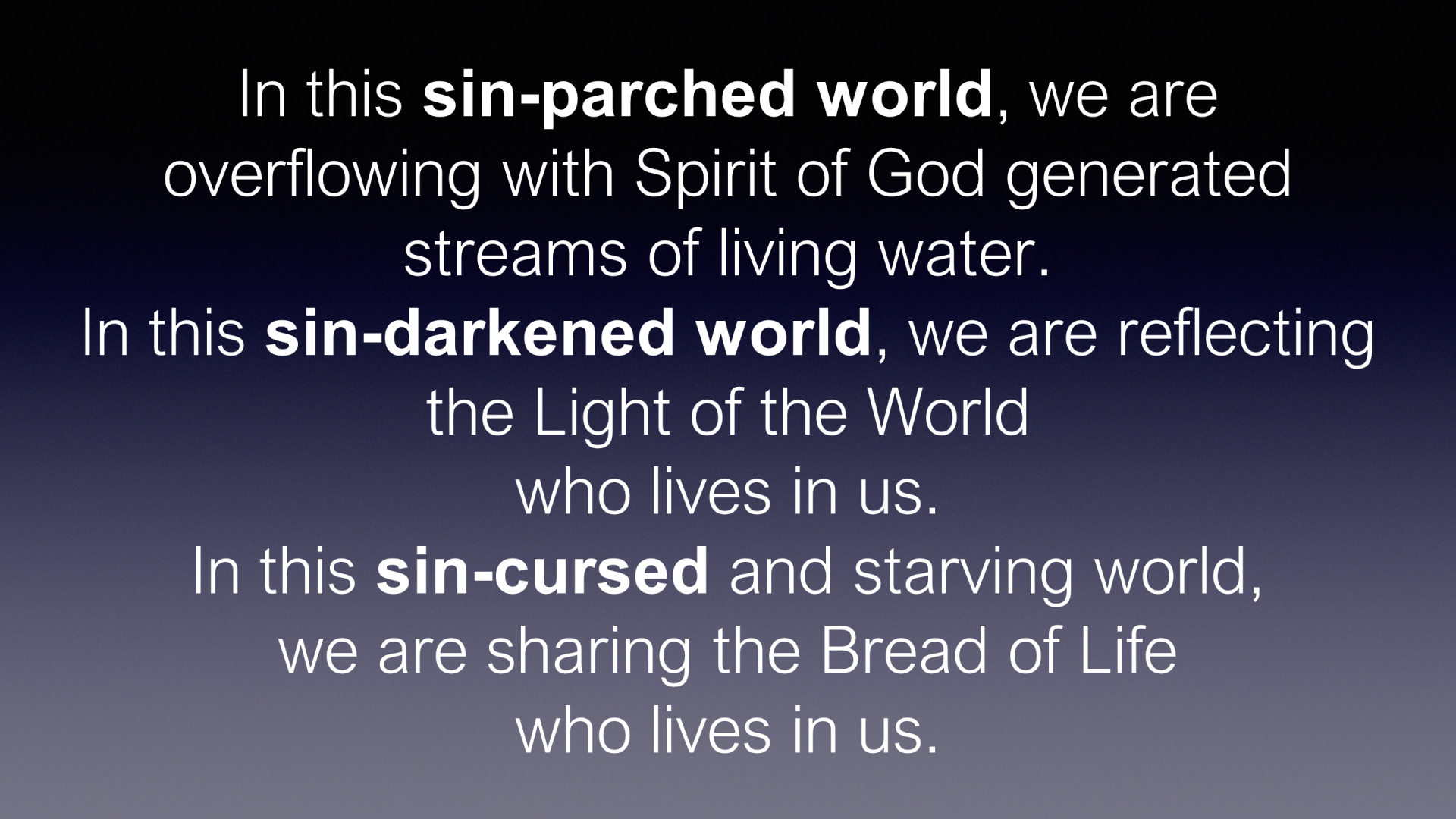
In this sin-parched world, we are overflowing with Spirit of God generated streams of living water.
In this sin-darkened world, we are reflecting the Light of the World who lives in us.
In this sin-cursed and starving world, we are sharing the Bread of Life who lives in us.
In this sin-enslaved world we know the Truth who lives within us, and can point people to how He can set them free.
In this sin-blinded world we have had our sight restored by the touch of Jesus and we want all we meet to also feel His touch and have their eyes opened as they are turned from darkness to light.
That is the abundant life with which:
God Promises to Bless His Followers
Isaiah next lists of the ten blessings God pours out through His Spirit into the lives of those who follow Him, love Him, and serve Him.
Each of these blessings are just reflections of Christ living in us, shing through us, and flowing out of us. It isn’t us. It is never about us.
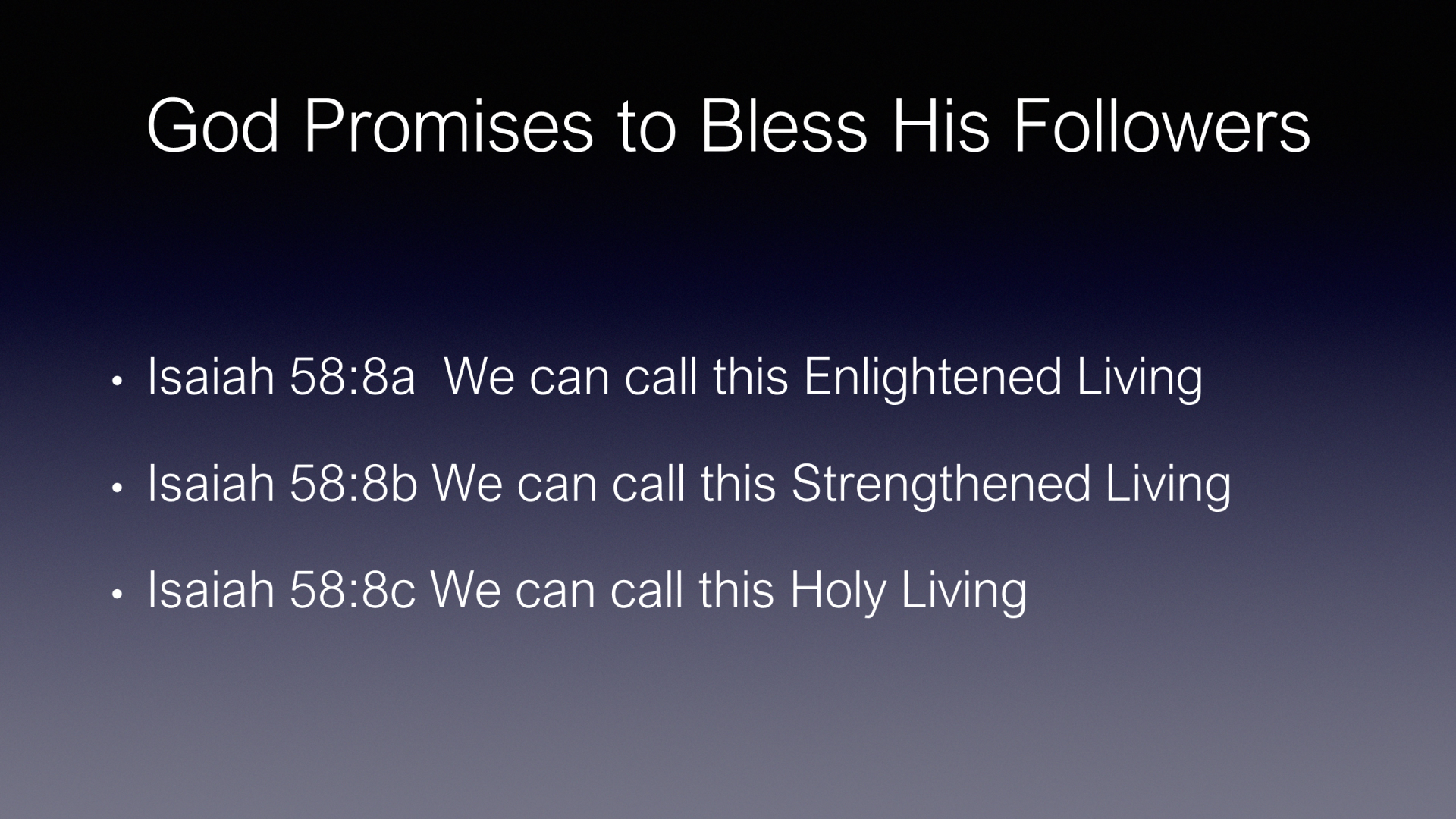
1. Isaiah 58:8a Then your light shall break forth like the morning.
We can call this the Enlightened Living that Jesus spoke of when He promised in the Gospels to all that follow Him, that they would “not walk in darkness…but have the light of life” (John 8:12)
2. Isaiah 58:8b Your healing shall spring forth speedily.
We can call this the Strengthened Living that Jesus spoke of when He promised in the Gospels to all that follow Him, that they would like Him “have food to eat ye know not of…” (John 4:32)
3. Isaiah 58:8c And your righteousness shall go before you.
We can call this the Holy Living that Jesus spoke of when He promised in the Gospels to all that follow Him, that they would “hunger and thirst after righteousness” (Mt. 5:6)
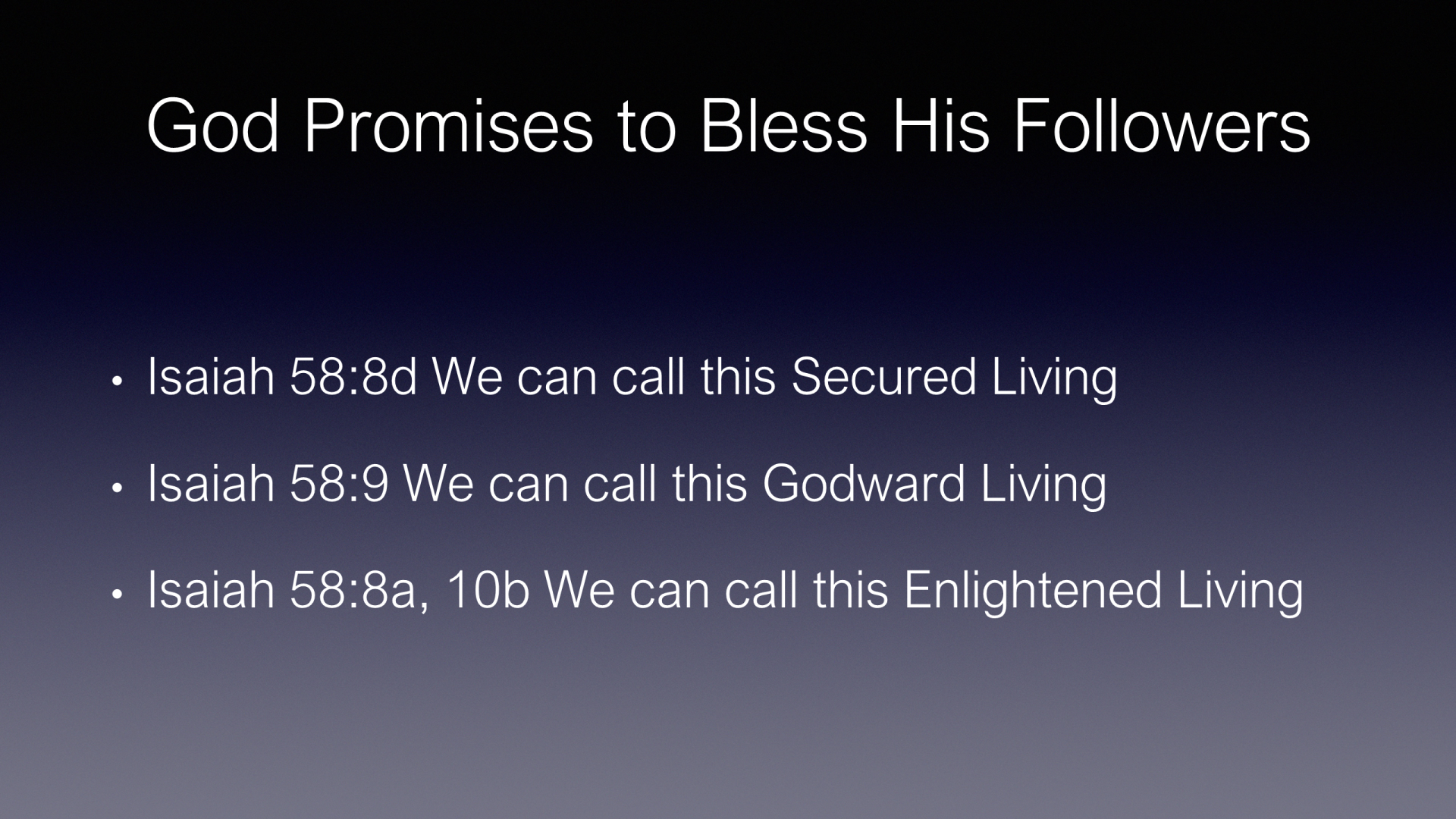
4. Isaiah 58:8d The glory of the Lord shall be your rear guard.
We can call this the Secured Living that Jesus spoke of when He promised in the Gospels to all that follow Him, that they would know that “Lo I am with you always…” (Mt. 28:20)
5. Isaiah 58:9 Then you shall call, and the Lord will answer; You shall cry, and He will say, ‘Here I am.’
We can call this the Godward Living that Jesus spoke of when He promised in the Gospels to all that follow Him, that they would find that “whatever you ask…I will do it” (John 15:16).
6. Isaiah 58:8a, 10b Then your light shall dawn in the darkness, And your darkness shall be as the noonday.
We can call this the Enlightened Living that Jesus spoke of when He promised in the Gospels to all that follow Him, that they would “not walk in darkness…but have the light of life” (John 8:12)
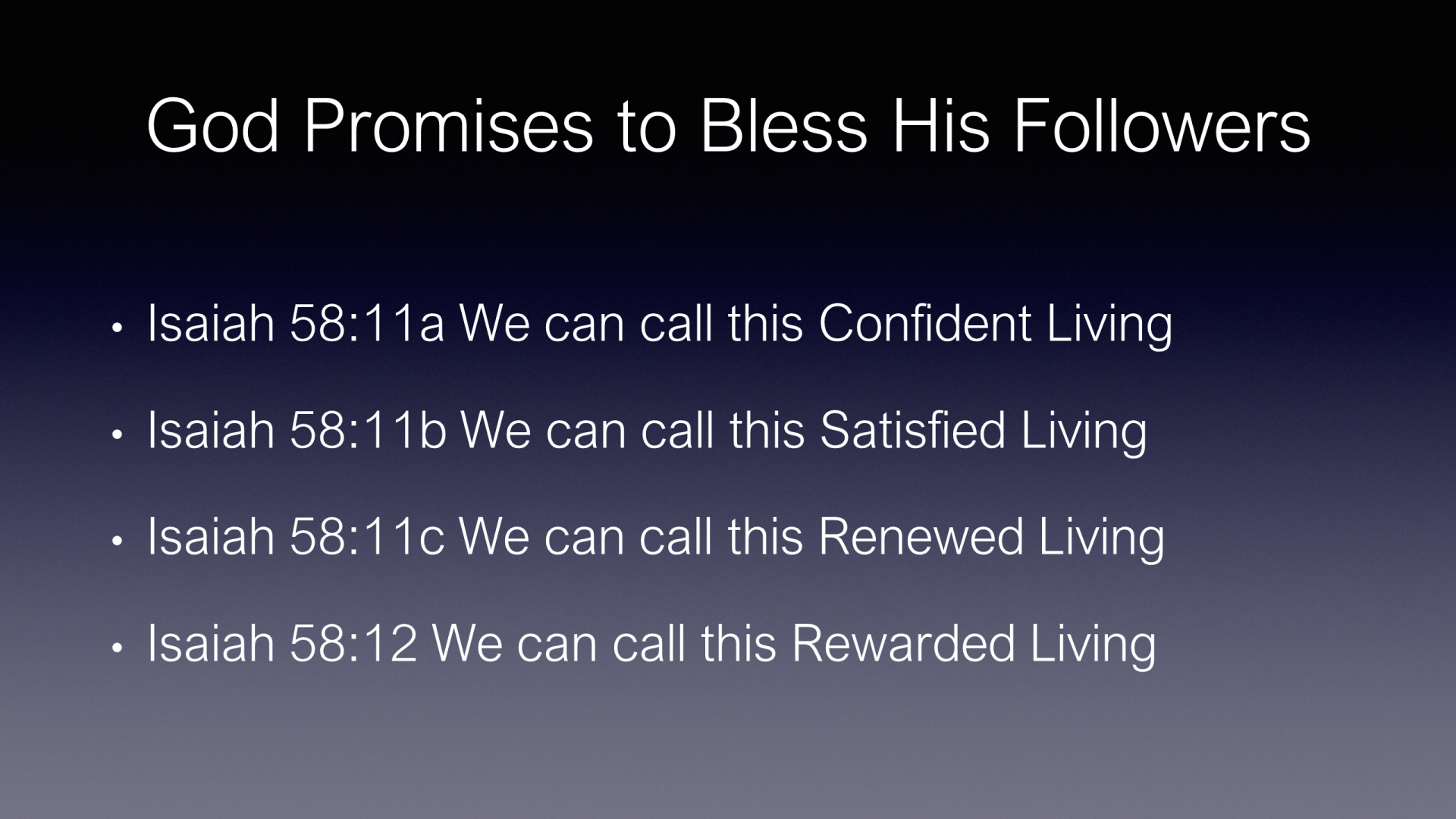
7. Isaiah 58:11a The Lord will guide you continually.
We can call this the Confident Living that Jesus spoke of when He promised in the Gospels to all that follow Him, that they would have “My peace I give unto you…” (John 14:27)
8. Isaiah 58:11b And satisfy your soul in drought.
We can call this the Satisfied Living that Jesus spoke of when He promised in the Gospels to all that follow Him, that they would have “Life, and live more abundant…” (John 10:10)
9. Isaiah 58:11c And strengthen your bones; You shall be like a watered garden, And like a spring of water, whose waters do not fail.
We can call this the Renewed Living that Jesus spoke of when He promised in the Gospels to all that follow Him, that they would have “never thirst…out of him flow rivers of living water…” (John 6:35; 7:37)
10. Isaiah 58:12 Those from among you shall build the old waste places; you shall raise up the foundations of many generations; and you shall be called the Repairer of the Breach, the Restorer of Streets to Dwell In.
We can call this the Rewarded
Living that Jesus spoke of when He promised in the Gospels to all that follow Him, that they would “lay up for yourselves treasures in Heaven…” (Mat 6:20)
Each of these blessings are just reflections of Christ living in us, shining through us, and flowing out of us.
It isn’t us. It is never about us.
Is Christ reflecting His LOVE through you?
[1] Drawn from the Godward Life.