If the video above is not available, here are two other ways to view:
HFG-18
151004AM
Seeing & Responding to Christ’s Ministry
Portrayed in God’s Tabernacle
Isaiah 6:1-13
Today we are confronted with what it means to come face to face with God.
In Exodus, God sent a seismic sound and light show that shocked and awed the people of Israel.
Then He left behind the plans to build a portable Doorway to Heaven where humans could come face to face with God, by way of substitionary sacrifices. Coming before God is awesome.
That is what we need to think about more often, what it means to come face to face with God, which is only through Christ.
FACE-TO-FACE WITH GOD
Only what is attached to God will last forever.
Anything that is not attached to God needs to be detached from our lives.
As we open to Isaiah 6, think about the balance sheet of your life. As one famous missionary once said while laying on his deathbed, “Only one life, t’will soon be past; and only what’s done for Christ will last”.
That means the most important measure of life is how useful we are to God. The only enduring parts of our life will be those spent serving God.
Transcript
.jpg)
It is a joy to be together today, the first Sunday of the month when we get to celebrate Communion. Communion is all about coming face to face with God. In fact, in the tabernacle, there was a table of showbread. It’s translated that way in some of the Bibles. Actually, literally, it is the bread of the face. And whose face are we talking about? God’s. And it was almost like when the priest was on one side of the table, God was on the other. And at communion this morning, that’s what it is. We’ve been invited to a meal, and the Majesty on High is sitting at the head of the table, and we’re eating with Him. And what a thrill that is.
But let’s open our Bibles to Hebrews, the last verse of the 4th chapter, because there’s a real challenge we have this side of the cross. We live after the cross. We live on the good side of the cross. Christ has already been sacrificed once for all time. On this side of the cross, the last verse of Hebrews 4, the 16th verse, tells us that we can come boldly. In fact, this is the wording of chapter 4, verse 16. Let us therefore come boldly to the throne. Now, you know how the rest of the verse goes, of grace, that we may obtain mercy and find grace to help in time of need. But we’re coming to the throne. The throne was for 500 years embodied on Earth in the Tabernacle and the succeeding Temple of Israel. Because God, the Scriptures tell us, sat enthroned over the mercy seat on the Ark of the Covenant. And so, when God had that structure built on the other side of the cross, in the Old Testament, He did a seismic sound and light show that was of such immensity, it scared them all to death. Literally. And He was showing them reverence. Stay away, or you’ll be thrust through with a spear if you even get near the base of the mountain. And now on this side, look at it. Come boldly to the same throne. Aren’t you glad we’re on this side of the cross? And the grace and mercy side.
But this morning, we need to see and respond to the ministry that Christ is revealed in the tabernacle. We need to see and respond on this side of the cross in the same reverent way God expected on the other side of the cross, because He hasn’t changed. God has only taken care of the guilt of our sin once and for all through Christ, but it has not changed the challenge we have. Do you know what we have on this side of the cross? We only think about, let’s come in boldly. And let’s, we’re just recipients of great grace, and we forget the Majesty seated on the throne that is still just as holy as He was back then.
Now on the other side of the cross, they had trouble thinking of ever boldly coming anywhere near Him. He was too awesome, and too powerful, and too consuming and they were afraid to come near Him. And I think sometimes, in our generation, people are a little too lightly coming to Him. But, let’s look at that this morning.
Today, we’re confronted with what it means to come face to face with God. The showbread, the communion, the face of God. Facing, at a meal with God, face to face. In Exodus, God sent that seismic sound and light show that shocked and awed the people of Israel but He left behind the plans to build a portable doorway to Heaven. That’s what the tabernacle was. It was a portable, set up, doorway to Heaven. And people could see through that doorway to the very throne of God. And He set those plans in the hands of Moses and that humans, if they followed His prescribed Words, could come face to face with God. But always through a substitutionary sacrifice. A substitute that took the offeror’s place. That was the only way of approaching God. Coming before God, is an awesome thought.
Now you know, in the ancient world, people were taken with the gods. Much of the construction we have left over all around the world that people on vacation go and visit is somehow connected with the worship of the ancients. Stonehenge, in Southwest England. The pyramids, in Egypt. All the temples of Athens that the cruise ships go by. Even down in the, Mayan Riviera down in Central America, all those pyramid structures. Those were all objects of worship. And there was a great superstition and a great draw of religion.
In fact, Paul, remember in Titus 2, when we went through that, the first word describing a godly older woman. Do you remember that word? Hieroprepēs. Hiero, hieron means temple. Prepēs is a representative. A godly older woman was to be like a woman that was representing the gods. And in the ancient culture, it was the woman that met you at the gate of the temple of Zeus, or the temple of whoever you were going to worship in the pantheon of Greco Roman world. And that woman would meet you at the door and say, no, this is a sacred way. Usually, the temple was a mile away. In fact, if you go to Ephesus, get off the cruise boat, go to Ephesus, and the temple, the great temple of Artemis at Ephesus is a mile outside of town. They didn’t put their temples in the middle of towns. Towns built around them. They were outside of town because the gods were to be revered. And she’d say, oh, you can’t come in until you take a bath and put on a special robe and quietly follow me. And Paul said, that’s what godly older women are to be. A walking through life representative that takes people to God. Boy, what a high calling. Paul laid it on those ladies back then.
But the idea of reverential awe is what’s always connected with worship, of whether it’s foreign, fake, dead gods, or the true and living God. And so, God sent this structure. So, people through the tabernacle could be face to face with God. But think about it for a moment. I’m going to let you use your thinking for a moment. Your imagination there. Because God gave us pictures. Here’s an 81 square mile camp of tents and a gigantic tent in the middle that had a flame of fire, a pillar of fire over it all the time representing the presence of God. And God put that glowing, eternal representation of His glory right in the center of camp. And for 40 years, they run a camp out. Do you remember why? God says every one of you are going to die and be buried in the campground. Not one of you is going to get to the promised land because you didn’t honor Me. And so, as their lives were getting old and faded and they were wearing down and getting closer and closer to their turn to being buried, they were looking at this changeless representation. This glowing pillar of fire and during the daytime a cloudy covering that kept them from the blazing 125 degree Sinai sun. And they saw a changeless God as they faded away. Why did God put that right in the middle of the camp? Because only what is attached to God will last forever.
And God said, you guys are dying. You’re all, your carcasses, that’s how Hebrews calls it, your carcasses will fall in the desert, and you will be buried. And for 40 years they went to a collection of campgrounds, and at every campground they buried more people, because not one of them would go in the promised land because of their unbelief. But as they were dying off, God said, only what’s attached to Me, if you attach yourself to Me, you will last forever. And I’m right in the middle of your camp, and I have this big, changeless, glowing tent. Attach your life to Me.
See how gracious God is? He was gracious, always has been. The Lord God, merciful and gracious, long suffering. That’s God. But you know, anything that’s not attached to God, needs to be detached from our lives.
See that’s why the tabernacle of God is Jesus Christ and His temple we have become. We are supposed to constantly be thinking, I want everything that I have a choice about in life to be attached to God. We want the balance sheet of our life to reflect the Lord. Let’s turn to Isaiah 6, if you’re not there. We’re going to read the whole chapter. Back up to Isaiah 6 and we’re going to read all 13 verses in just a moment.
As we open to Isaiah 6, think about the balance sheet of your life as one famous missionary by the name of C. T. Studd once said while lying on his deathbed, only one life will soon be passed and only what’s done for Christ will last. That’s a great saying. That means that the most important measure of life is how useful we are to God. The only enduring part of our life will be those spent serving God. Think of the balance sheet of your, you know what the balance sheet is? It’s when you get all the car payments, and the house payments, and all the student loans, against all of your savings, and you see what’s left. The balance sheet. And for most Americans, there’s not anything left. There’s a red number there. And when we think spiritually of our balance sheet, what we think about is what parts of my earthly pilgrimage, my going through life, has been lived attached to God as His servant. See, He only turns the meter on when we serve Him. The meter of redeeming the time. So, we redeem any time we have when He turns the meter on, and it counts when we’re serving Him.
Now, I think today, October 4th, is my father’s 100th birthday. Now, he’s been with the Lord for eight years, but I always think on October 4th, and I always think of him as someone that never was a missionary. He never was on staff at any church. He never was any formal position. He worked for 46 years at General Motors, Oldsmobile Division, Plant 3. Forty six years. And sought to serve the Lord there. We can redeem our time, turning the meter on, and it counts on the balance sheet for God when we say, I’m on duty. I want to attach my life, my thoughts, my choices, my plans, my activities, my amusements, my work to You. And I want to live for You. That means that the most important measure of life is how useful we are to God. And the only enduring parts of our life will be time spent serving God. And the tabernacle was plopped right in the middle of three million people to remind them why they were living on Earth.
The reality, God is on His throne. And as you’re living in your little tent in the Sinai, dying of snakebites and scrambling around to collect manna, you can have an eternal dimension to even that. See, what a gripping tribute to our Lord’s graciousness. When we look closely at God’s plan for preparing us to be useful, we see something from this event. God showed Himself [well, neither one’s going to work. There we go…] to Isaiah.
.jpg)
He showed His glory in chapter 6. Now you notice, and before we read it, notice what it says at the end of verse 1. I saw His robe filling the temple. This is the permanent representation of that temporary tabernacle, only it was the one in Heaven that all of them are modeled after.
Remember, there is a temple in Heaven. Moses got to see it. God had him sketch plans. He came down and made a copy on Earth to show this doorway to Heaven. Isaiah sees the real thing in Heaven. He sees the purpose of the tabernacle and temple, to see God’s throne. And it utterly changed him. And this morning what we’re going to look at is, what does God want our response to be from seeing Him face to face as we worship Him. Okay? Isaiah 6:1-13. Let’s stand together once more and remain standing. I’m going to read all 13 verses. Usually, we don’t. I thought, wow, we’ll get a whole chapter in this morning. Here we go.
In the year that King Uzziah died. By the way, it was around 739/40 BC, about 8th century BC, Isaiah… I saw the Lord sitting on a throne, high and lifted up. And the train of His robe filled the temple. Above it stood seraphim, each one with six wings. With two he covered his face, with two he covered his feet, and with two he flew. Verse 3, and one cried to another and said, holy, holy, holy is the Lord of hosts. The whole Earth is full of His glory. Verse 4, and the posts of the doors were shaken by the voice of him who cried out, and the house was filled with smoke.
Now look up from your Bibles. Doesn’t this sound a little bit like chapter 19 in Exodus? This flaming, these flaming ones, the seraphim. That means a flaming one, a burning one. Literally, seraph is a burning one. So, there are burning ones around God, smoke, and everything’s shaking. Wow.
Verse 5. And I, so I said, woe is me, for I am undone, or disintegrating, because I am a man of unclean lips. I dwell in the midst of a people of unclean lips, and my eyes have seen the King, the Lord of Hosts. Verse 6, Then one of the seraphim flew to me, having in his hand a live coal, which he had taken from, with the tongs from the altar, and he touched my mouth with it and said, behold, this has touched your lips, your iniquity is taken away, and your sin purged. And I also heard the voice of the Lord saying, whom shall I send, and who will go for Us? Then I said, here am I. Send me.
Now, usually that’s where we stop and talk about are you going to go, and where is God sending you? But did you catch how he got taken out of his comfort zone and his convenient life with unclean people not even knowing they were and he was, by seeing God. So, the Lord sends him. Look at verse 9. We usually don’t read this. And He said, go and tell this people, keep on hearing but don’t understand. Keep on seeing but don’t perceive. Make their hearts as people dull, their ears heavy, and shut their eyes, lest they see with their eyes and hear with their ears, and understand with their heart, and return and be healed.
Verse 11, I said, Lord, how long? And He answered, until the cities are laid waste and without inhabitant, the houses are without a man, the land is utterly desolate. The Lord has removed men far away, and the forsaken places are many in the midst of the land, but yet a 10th will be in it and will return and will be for consuming as a Terebinth tree, or as an oak whose stump remains when it is cut down. So, the holy seed shall be its stump. Do you see why no one reads the ending? It’s a downer. God said, after you’re called to this great ministry, Isaiah, nobody’s going to listen, nobody will respond. I’m going to destroy the whole land. It’s going to be desolate, and it’s because they have hard hearts.
But Isaiah, that doesn’t change what I want to do with you. See, most of us worry about what we do rather than who we are. God said, I’m more concerned who you are. I want you to be consecrated for Me. No matter whether anything happens from your ministry, it’s who you are that matters forever. We’re going to learn a lot about that this morning. Let’s bow together for a word of prayer.
Father, we have come, actually to celebrate communion today. That’s the whole purpose of this gathering this morning. The culmination, the high point. It’s when we come face to face with You and celebrate Your body and Your blood that were sacrificed in our place. But to prepare for coming face to face with You, I pray that we would learn the lessons You taught to Isaiah. Because those are the lessons of coming face to face with God. The lessons of the tabernacle that became the lessons of the temple. They become the lessons of all those who see the very tabernacle of God in Jesus Christ bodily. And to us, who have become Your temple, it’s the same lesson. That you want us to see Your holiness. And respond the way that You have told us in Your Word pleases you. So, teach us that. Stir our hearts, and may we, at this communion, be struck with the reality and the change that comes of being face to face with You. In the name of Jesus we pray. Amen.
.jpg)
You may be seated. As you’re seated, God showed Isaiah His glory and simply stated we could basically, summarize all the teaching of the Bible on this topic, of the holiness of God. And our response to it is that God’s desire for each of us is the same as for Isaiah. God wants each of us to become consecrated. He wants each of us to go through this process that Isaiah went through. Because that’s why He put that tabernacle, that temple in their midst. God’s desire for us is that we see how He brings us to usefulness. The bottom line of our life is how useful are we to God. The bottom line of parenting. Do you want to know what God put all those children, if you have any children or ever will, the bottom line of parenting is how useful you raise your children to be to God. How useful to God. Most people, that isn’t on the list. The job is on the list, the education, the scores, the athletics, the scholarships. Usefulness to God? Oh, when they get out of college, right? See, the bottom line of everything is usefulness to God. The only thing that lasts forever is God and His servants.
See, and that’s why when you get to Revelation, the Lord says, I’m here with My bondservants. What’s a bondservant? A servant is someone that does someone else’s will. They’re forced to, enslaved, or scared to death, they have to, or we do it because we love them. But we do the will of God. That’s what His slave is. We willingly become His slaves. And Isaiah was showed how to be useful to God. And Isaiah shows us a pathway that each of us who want to follow the Lord, that leads us into daily, monthly, and lifelong usefulness to God. And here are the stages.
Basically, if we had summarized what we just read in Isaiah 6, it would be number one, remember God’s holiness. Did you know that’s the first element of the prayer pattern we’re all supposed to be following? Jesus said, in this manner pray ye, our Father who art in Heaven, hallowed be Thy name. Be Your name. You know what that is? Remember God’s holiness. See Him high and lifted up. See Him on that throne. See Him surrounded by holy, holy, holy. Remember that changeless facet. God is holy and surrounded by holiness. That’s number one.
Number two, what Isaiah found in verse 5, realize my sinfulness. Did you know there’s a recurring theme in the Bible that everybody that got really close to Jesus Christ and realized who He was, Boom! Just, they were overwhelmed in His presence. That’s what happens when you come face to face with God. You realize how holy He is and how unholy we are. And that was what Isaiah needed to go through.
And then receive God’s cleansing, and that’s that tongue. I want to trace these truths with you in your Bibles you can come back and remind yourself of these truths in the days ahead.
.jpg)
So, first of all, to become useful to God, we have to remember His holiness. And that’s the first four verses. And look at those verses because the whole structure of those four verses is that God is by nature holy. God is separate from sin. God is perfect. God is sinless. God is flawless. He is pure. He’s surrounded by an utter holy atmosphere in Heaven. So, no matter how compassionate God is, no matter how full of grace and overflowing with mercy, God is always holy, holy, holy. He never lets down His… people say, oh just let your hair down, I’m not, I don’t have any. I don’t relate to that, when I can’t figure out what they mean by that. Let your hair down. They just loosen up or something. Does God loosen up? Does God let His hair down? Just go? Oh, it’s all right. No. He is utterly, eternally, holy. So, we have a problem. We aren’t,His is.
But He built a doorway. And He said the way you come through the doorway is as you receive the Lord. So, walk therein. The same way we got saved is the same way we walk through life, realizing God is holy. And that holiness stuns us. In the realm of eternity, around the throne, at the center of the universe, there’s one word that’s repeated regularly. The worship of Heaven has a constant background beat. Kind of like, the drum keeps everybody together and provides so we can keep in tempo. Do you know what the tempo of Heaven is orchestrated by? Holy, holy, holy. That’s the unchangeable background. For many of us, just saying those words makes a song play in our hearts. In fact, for those of you that don’t know what I’m talking about, I wrote it down for you. Let’s read this, okay?
.jpg)
Think of Reginald Heber’s song that he got from Isaiah 6, that he got from God. Let’s read it, okay? Holy, holy, holy, Lord God Almighty. Early in the morning our song shall rise to Thee. Holy, holy, holy, merciful, and mighty, God in three persons, blessed Trinity. What’s the lesson of that? God says, remember My holiness. Remember God’s holiness. That is to be the first, when we start our day in prayer, we are to lift our hearts and focus on Him, that He is on His throne, that He is surrounded by these flaming fires, and they’re saying, holy, holy, holy, holy, holy, holy, holy, and forever they’ll say that. Remember God’s holiness. Okay?
Here’s a quiz. The answer has three words. I just said them. Let’s see if you can remember. What are we to do? Remember God’s holiness. Okay, now that all of you that didn’t say anything, no, you won’t do anything wrong. There’s always a whole group that stay back to make sure they don’t mess up. It’s three words, and we’re supposed to focus on that every day, that we are to remember God’s holiness. Did you do that this morning? Is that how you got ready for church? Was it more important than whether your car was washed and shiny, and your clothes were captivatingly nice? Did you want to focus? Do we regularly, as the very first part of our day, focus on where we’re headed, who bought us, who we belong to, and the atmosphere that surrounds Him? Remember God’s holiness.
.jpg)
Thinking about His holy presence, standing before His throne, falling on our faces before Him, leads to the second key, the second element, the second step on this pathway that God shows Isaiah. Being useful to God means thinking deeply upon how far we fall short of God’s glory. How much we need His gracious, forgiving, cleansing touch. So that means that the second element is, we need to realize my sinfulness. Look what verse 5 says. So, I said, as soon as Isaiah got sight of God as God is, his immediate response is woe is me. I am undone. Literally, in the Hebrew, I’m disintegrating. I am like the meteorite coming through the atmosphere. I’m burning and flaming and breaking off. I’m disintegrating. Because I am a man of unclean lips. And I dwell in the midst of a people of unclean lips. And my eyes have seen the King, the Lord of hosts.
The message of Isaiah 6:5 is, the closer we get to the light, the more we see our sinfulness, our lack of holiness. When Job came to understand the almighty El Shaddai God, he confessed in Job 42:5-6 the same thing. I am undone. I have seen the King and I’ve seen the Lord, the Holy One. And I repent in dust and ashes. When Peter saw the God of the universe displayed in Jesus Christ the Son, he cried out in Luke 5:8, depart from me, I’m a sinful man. When John, the beloved apostle saw Christ in His unveiled glory on Patmos, he fell and laid on the ground face down like he was dead. That’s the response seeing the awesome holiness of God prompts in those that see Him.
The theme of those who stand around the throne is that the Lamb was slain, He was slain for their sin, and He gave Himself for me. By the way, that’s Paul’s testimony. I’m crucified with Christ, nevertheless I live in the flesh, I live by faith in the Son of God who loved me, and what? Gave Himself for me. Paul said, I was redeemed. I was purchased. I’m a sinner. The testimony of those saints who have walked the path before us can help us frame fitting words to express our need of such redeeming love.
.jpg)
In fact, the good friend of the Whitfield’s and of the Wesley’s, their friend who wrote this hymn, was so unsure of his salvation. And they said to him, why don’t you write down your gratitude? That will help you. Write your gratitude for what God has done for you. He wrote this song for us. And you all know it. In fact, let’s read it. Let’s read about what our response should be to the holiness of God. You ready? There is a fountain filled with blood drawn from Emmanuel’s veins and sinners plunge beneath that flood, lose all their guilty stains. Lose all their guilty stains. Lose all their guilty stains. And sinners plunge beneath that flood, lose all their guilty stains. Do you know that God’s holiness prompts us to realize how thankful we are? That He’s forgiven us from so much.
I always remember my wonderful wife, Bonnie, our first Sunday at Grace Community Church. I met her on May 1st of 1983. Had our first date about four days later. We’re engaged about six weeks later. Married December 27th of the same year. Moved out to join, I was invited to staff at Grace Community Church with John MacArthur, moved out there. Boom, boom, boom. Met her, got married, got ordained, went out to Grace. We were on our first Sunday at Grace Community Church, and there were 12,000 people in the services that day. We were in just one of the services, and there were thousands of people there. They dimmed the lights. MacArthur was up there preaching up a storm and leading us in communion. And I was in awe, and I was just looking at his technique, and I was looking at his powerful elocution, and I was thinking what a great communion, how beautiful the building was. And in the midst of all that, we were standing singing for the bread passing, and I heard, [crying noises]. And I said, what’s wrong, honey? What’s wrong? Did I do something wrong? What’s wrong? She says, oh, no. She says, I am so aware of how much the Lord has forgiven me. I thought, I was looking at the building, and the lights, and the sermon, and you’re looking at the Lord!
Now, what does the Bible say? To whom much has been forgiven, the same loves, what? Much. Oop, some of you didn’t know that. Jesus said, to whom much has been forgiven, the same loveth much. The proportion of our love for God, it’s totally dependent on how much we realize we’re forgiven of. That means much sin forgiven, much love for Christ. Little sin I think I’ve committed or needs forgiving, little need to love and be grateful to Christ.
Do you remember the publican and the sinner? The publican and the pharisee, the publican was a sinner, the pharisee didn’t think he was. And he said, I’m so glad I’m not rotting like that scum over there. You got a good deal with me. Got that scum over there. I can talk to You. And the Lord didn’t even hear him, wouldn’t even listen to him. But the one who wouldn’t look up and said, I don’t even merit face time with You, be merciful to me, the sinner. There’s an article there. The publican said, I’m THE sinner. Did you know that’s marking people who really know the Lord? What did Paul say? I am the chiefest of sinners. Do you really think Paul was a worse sinner than Nero? The profligate homosexual murderer of his mother and his wives and everybody else? Do you think Paul was worse than all the bestiality and necromancy of the Ancient Roman world? Do you really think Paul did worse things than those bestial things they did? No. Do you think Paul thought he was the worst sinner? Mm hmm. Why? Because he knew how much he was forgiven of, so he loved more.
Do you know how to reach a pagan world like we live in? Don’t think that the person in the gutter that’s vomiting up their filth is worse than we are. Don’t think that the gay activist is somehow a worse sinner than we are. They, in the gutter, or in their activism, or the abortionist selling body parts, they are just acting like sinners are supposed to act. They’re just living out their script. That’s how sinners live. We know God, and the more we know of Him, the light is brighter and brighter. We see our sinfulness and we are so like Bonnie standing next to me. She was connected, at that communion, with what was going on. She was totally focusing on the One who loved her and gave Himself for her and knew she was forgiven of much. And she was overflowing with gratitude.
Christians, you don’t hear anything grateful out of them. It’s only complaint and criticism. Do you know what that means? They’re not very aware of how wickedly sinful they are and how much they’ve been forgiven. And Isaiah had to come to that place. So thirdly, to be useful to God, I must always remember God’s holiness. I must realize my sinfulness. And then I cry out and ask to receive God’s cleansing.
.jpg)
And that’s what verses 6 and 7 say. And Isaiah cried out, confessing his sinfulness in verse 5. And then one of the seraphim, one of the burning ones, verse 6, flew to me. Having in his hand a live coal which he had taken with the tongs from the altar. You understand? God’s throne is there, and there’s an altar in front of His throne. And that altar is the altar like we see in the tabernacle in the temple. It’s the brazen altar, and it’s the altar that was the place of the sacrifice for sin. And that’s a picture of the cross and of Christ’s death. And what God was portraying was, He took a coal from the altar from the place of sacrifice and sins being dealt with, and that’s the basis on which Isaiah was cleansed, consecrated, forgiven.
And look what it says in verse 7. Then he touched my mouth with it and said, behold, this has touched your lips, your iniquity is taken away, and your sin purged. He received God’s cleansing. That’s the message. When we remember God’s holiness, the light of our holy God makes us realize our sinfulness. That leads us to the work of the cross, to the sacrifice of Christ, offered once perfectly and completely to pay the penalty of sin for all who come by faith. And usefulness comes to those who will be cleansed and who walk in the light. That’s the only way to stay full of God’s Spirit. That’s why we need constant cleansing.
The Spirit of God is holy, and He does not fill us with His power, His boldness, and all that He wants to do through us when we grieve and quench Him by having undealt with sin. And so, what Isaiah had to do is, he had to see the holiness of God, realize his sinfulness, and renew that desire for God’s cleansing. And that’s why we’ve gathered today. The most useful servant is a humble believer who readily confesses the complete cleansing that the gracious work of Christ has accomplished. Once we’re assured of His cleansing, the evil one can’t find a place to plant seeds of doubt and despair. And we can affirm God will never condemn us, Romans 8:1. And though our sins were deeply staining us, like crimson, we’re white as snow, Isaiah 1, in God’s sight. And that truth makes us full of hope, and we well up with hope by the power of the Spirit of God in us.
.jpg)
There was a notoriously wicked sinner who wrote his testimony out. And he got so famous from this testimony. He was a debauched… If you’ve ever read the life of John Newton, he was like a modern day movie star. He lived that way. He was debauched, depraved, drunken, grossly immoral. He would take advantage and violate all the slaves he could get when he was hauling them back and forth, and they did all kinds of horrible things. Then he got saved. And he wrote his testimony. And then he lost his mind. Did you know that? He had Alzheimer’s, dementia, in excessive amounts. He did not know anything. He didn’t know who he was. They had to keep him in a room. And he was so famous, the last two years of his life, hundreds of people came to visit him. And he would be sitting in his bed, and they wouldn’t let him out. And people would come up and smile at him and he’d say, I don’t know who you are and I don’t know who I am, but I was a great sinner and Jesus is a great Savior. You know what the biographers say? He said that all day long. He probably forgot he said it. He said it over again. That’s good dementia. That’s the way we all should end. Aware of what God has done.
To prepare our hearts, it’s time to roll into communion, is this your testimony? Just this week I had an appointment with someone. I didn’t even know who it was. I just went for my appointment, and I met him, and they said, you know what? I was sitting out there in communion one year ago, and you said, don’t touch that communion if you’re not a Christian. And then, I explained what it meant to be a Christian. To acknowledge that I am lost and sinful, and believe Christ is my only hope, and that He wants to forgive me, and then cry out to Him, and ask Him to save me. And actually, he said, while you said that, my girlfriend went, [looked at him] because she knew the Lord and knew he didn’t. And he said, he bowed his head and right there, cried out to the Lord. And he said, when he opened his eyes, the tray was going by and he grabbed one. And he said, it was his first time celebrating communion as a believer. Because of the amazing grace of God, that saved a wretch, not like one of those people we see out there, like me. See, I once was lost. God found me. I was born blind. But the instant I called the name of the Lord by faith, I can see. Is that your testimony this morning? Do you know you’ve been forgiven much? Do you love Him much? That’s what God wants when we come face to face with Him.
Let’s bow for a word of prayer. As the men go to prepare to serve us communion, we need to bow before the Lord. And if you haven’t yet done it, ask Him for His cleansing. Ask Him to purge your heart, as I’m asking Him to purge mine from all uncleanness, so that I can, with clean hands and pure heart, worship Him. Hold this picture of Christ that the bread and the cup truly is, and say, Lord, I want to be useful to You for all the moments You give me in life.
Father in Heaven, we bow before you right now. I pray that we would be reminded today of Your holiness, that we would realize anew and afresh our sinfulness. We are sinners by nature and by choice and by Your divine decree. And You want to give us a new heart and a new spirit, and You do it, salvation. But we’re still in this flesh, and this flesh is so traitorous. If we do not mortify and through Your Spirit put to death the deeds of the flesh, they begin to neutralize everything You want to do in our lives. So, at this communion, we look to Your holiness. We’re flooded with gratitude because of Your great mercy and our great sinfulness. And we thank you for forgiving us. But we ask You to cleanse us and give us a fresh new beginning. Just like the wave across the shore of the ocean makes it all fresh and unblemished and brand new, You want to give us a fresh new beginning every time we bow and seek Your cleansing. You give us a fresh new start. You’re the God of new beginnings.
And I pray that someone like the fellow one year ago, that someone today will for the first time realize that they need Your salvation. And today would be the first time they celebrate communion as a believer. And for the rest of us, may we just have that fresh new beginning that we can have every time we focus on You and receive Your cleansing. Thank you for the bread. Bless us as we worship You through it. In the name of Jesus, we pray. Amen.
NOTES
Today we are confronted with what it means to come face to face with God.
In Exodus, God sent a seismic sound and light show that shocked and awed the people of Israel.
Then He left behind the plans to build a portable Doorway to Heaven where humans could come face to face with God, by way of substitionary sacrifices. Coming before God is awesome.
That is what we need to think about more often, what it means to come face to face with God, which is only through Christ.
Face to Face with God
Only what is attached to God will last forever.
Anything that is not attached to God needs to be detached from our lives.
As we open to Isaiah 6, think about the balance sheet of your life. As one famous missionary once said while laying on his deathbed, “Only one life, t’will soon be past; and only what’s done for Christ will last”.
That means the most important measure of life is how useful we are to God. The only enduring parts of our life will be those spent serving God.
The Tabernacle was a reminder for us who live on Earth, of the reality of God upon His Throne. Today, what response does God expect of us when we see Him as He is this moment, seated upon His Throne?
When we look closely we see that God’s plan for preparing us to be used as His servants has not changed in thousands of years. Open with me to Isaiah 6, and the amazing call God gave to Isaiah.
God Showed Isaiah His Glory
From the Old Testament we find that our unchanging, immutable God has the same plan. To reach the godless society God called him to reach, Isaiah was told a timeless truth.
More than anything you do, God is interested in who you are.
The key to usefulness in life, doing what God designed us to do, is first being what God wants us to be.
Listen to God’s voice as He tells us the story of His call and preparation of Isaiah.
In this chapter we’ll read we see the keys to a life that is useful to God. In the end, that is all that will matter.
Isaiah 6:1-13 In the year that King Uzziah died, I saw the Lord sitting on a throne, high and lifted up, and the train of His robe filled the temple. 2 Above it stood seraphim; each one had six wings: with two he covered his face, with two he covered his feet, and with two he flew. 3 And one cried to another and said: “Holy, holy, holy is the LORD of hosts; The whole earth is full of His glory!” 4 And the posts of the door were shaken by the voice of him who cried out, and the house was filled with smoke. 5 So I said: “ Woe is me, for I am undone! Because I am a man of unclean lips, And I dwell in the midst of a people of unclean lips; For my eyes have seen the King, The LORD of hosts.” 6 Then one of the seraphim flew to me, having in his hand a live coal which he had taken with the tongs from the altar. 7 And he touched my mouth with it, and said: “ Behold, this has touched your lips; Your iniquity is taken away; And your sin purged.” 8 Also I heard the voice of the Lord, saying: “ Whom shall I send, And who will go for Us?” Then I said, “Here am I! Send me.” 9 And He said, “Go, and tell this people: ‘ Keep on hearing, but do not understand; Keep on seeing, but do not perceive.’ 10 “ Make the heart of this people dull, And their ears heavy, And shut their eyes; Lest they see with their eyes, And hear with their ears, And understand with their heart, And return and be healed.” 11 Then I said, “Lord, how long?” And He answered: “ Until the cities are laid waste and without inhabitant, The houses are without a man, The land is utterly desolate, 12 The LORD has removed men far away, And the forsaken places are many in the midst of the land. 13 But yet a tenth will be in it, And will return and be for consuming, As a terebinth tree or as an oak, Whose stump remains when it is cut down. So the holy seed shall be its stump.”
Prayer
Simply stated we can conclude from a careful study of the Bible that:
God’s Desire for Each of us is Consecration
There are 3 stages that are keys to usefulness for God. There is a pathway for each of us who want to follow that leads us into daily, monthly, and life-long usefulness to God.
Here are the stages. Let me tell you what they are and then show them as they are described in these verses. God wants you and me to:
1-Remember God’s Holiness
2-Realize my Sinfulness
3-Receive God’s Cleansing
Now trace these truths into your Bibles with me. Write them down so that you can come back often and remind yourself of these simple truths that have been repeatedly taught and explained to God servants for all of the 2,700 years since God spoke them to Isaiah.
First, to be useful to God we must always:
1-Remember God’s Holiness
That is the message of Isaiah 6:1-4.
God is by nature holy. He is separate from sin, perfect, sinless, flawless and pure.
So no matter how compassionate He is, no matter how full of grace and overflowing with mercy: God is still Holy, Holy, Holy.
In the realm of eternity, around the Throne at the center of the Universe there is one word that is repeated regularly, over and over again. Holy, Holy, Holy is our God.
For many of us, just saying or hearing those words begins a song playing in our hearts and minds. Do you know that song?
With just our voices, lift these truths to God, from each voice and heart, agree with what God wants us to do: Remember God’s Holiness.
Holy, holy, holy! Lord God Almighty!
Early in the morning our song shall rise to thee.
Holy, holy, holy! Merciful and mighty,
God in three persons, blessed Trinity!
The first key to any usefulness for eternity is: Remembering God’s holiness.
Repeat that with me all together: Remember God’s Holiness.
Say it again, louder and confidently so it stays on our hearts: Remember God’s Holiness.
Thinking about His Holy Presence and standing before His Throne, and falling on our faces before Him, leads us to the second key.
Being useful to God means thinking long and deeply upon how far we fall short of His Glory, and how much we need His gracious, forgiving, and cleansing touch.
Second, to be useful to God I must always remember God’s Holiness as I:
2-Realize my Sinfulness
That is the message of Isaiah 6:5.
The closer we get to the Light, the more of our sinfulness we can see.
When Job came to understand the Almighty El-Shaddai he confessed (Job 42:5-6).
When Peter saw the power of God the Son displayed he cried out (Luke 5:8) “depart from me, I am a sinful man”.
And when John the Beloved Apostle, saw Christ in his unveiled glory on Patmos, he fell at His feet as if dead (Revelation 1:17).
The theme of those who stand around the Throne is that the Lamb who was slain, was slain for their sin. He gave Himself for me (Galatians 2:20) was Paul’s testimony.
The closer we are to God’s Holiness the more I Realize my own personal Sinfulness.
Again, the testimony of saints who have walked this path before us can help us frame fitting words to express our need of the Redeeming Lamb’s precious shed blood. In our hymn book turn to # 196 There is a Fountain” and join me again with just your voices declaring that though we are great sinners, our Savior is greater and He washes ALL my sins away.
There is a fountain filled with blood drawn from Emmanuel’s veins;
And sinners plunged beneath that flood lose all their guilty stains.
Lose all their guilty stains, lose all their guilty stains;
And sinners plunged beneath that flood lose all their guilty stains.
Thirdly, to be useful to God I must always remember God’s Holiness, Realize My Sinfulness, and then cry out and ask to:
3-Receive God’s Cleansing
That is the message of Isaiah 6:6-7.
When we Remember God’s Holiness, the Light of our Holy God makes us Realize our Sinfulness.
That leads us to the work of the Cross, to the sacrifice Christ offered once perfectly and completely to pay the penalty of sin for all who come by faith.
Usefulness comes to those who will be cleansed and who will walk in the light and stay full of God’s Spirit.
The most useful servant is a humble believer who readily confesses the complete cleansing that the gracious work of Jesus accomplished. Once we are assured of His cleansing the evil one can’t find a place to plant seeds of doubt and despair. We can affirm that God will never condemn me (Romans 8:1); and that though my sins were as deeply staining me as crimson I am white as snow in God’s sight. That truth makes us full of His hope, welling up with the joy of the Spirit, and kept by His Peace.
To the end of our lives, whether in weakness, sickness, or even dementia (as the great hymn writer John Newton suffered at the last years of his life) we can confidently express our conviction that though we were great sinners, Jesus is a Great Savior. Why not practice stating your testimony aloud with me right now, through his words you know so well:
Amazing grace! How sweet the sound
That saved a wretch like me!
I once was lost, but now am found;
Was blind, but now I see.
Isaiah 6 records what happens when we get to see God as He really is.
Meeting the King of the Universe at the Doorway to Heaven
Now, back to the Doorway to Heaven that God had built as a guide for us to understand Christ’s work. Remember we started with the nation of Israel at Sinai.
After God came down from Heaven to the Earth, the mountain began quaking, a cloud of fire surrounding God was burning the top of the mountain, and a pillar of smoke rose like from a blast furnace.
Point 1: Our God is a Consuming Fire
Exodus 19:16-20 (NKJV):
16 Then it came to pass on the third day, in the morning, that there were thunderings and lightnings, and a thick cloud on the mountain; and the sound of the trumpet was very loud, so that all the people who were in the camp trembled. 17 And Moses brought the people out of the camp to meet with God, and they stood at the foot of the mountain.18 Now Mount Sinai was completely in smoke, because the Lord descended upon it in fire. Its smoke ascended like the smoke of a furnace, and the whole mountain quaked greatly.19 And when the blast of the trumpet sounded long and became louder and louder, Moses spoke, and God answered him by voice. 20 Then the Lord came down upon Mount Sinai, on the top of the mountain. And the Lord called Moses to the top of the mountain, and Moses went up.
Each of the elements aurrounding God’s Holy Throne speak of a scene so awesome, and so massively powerful that frail creatures like we are as humans would have trouble surviving.
So our God who is like a consuming fire, and dwells in unapproachable light (1 Tim. 6:16), whose face shines like the Sun in its brightness (Mt. 17:2; Rev. 1:16) came down to Mt. Sinai to show Moses how to construct a Doorway to Heaven. God was offering an access point for humans to come before Him.
Point-2: Almighty God Invites Us To Enter His Presence
Exodus 24:14-16 (NKJV) And he said to the elders, “Wait here for us until we come back to you. Indeed, Aaron and Hur are with you. If any man has a difficulty, let him go to them.” 15 Then Moses went up into the mountain, and a cloud covered the mountain. 16 Now the glory of the Lord rested on Mount Sinai, and the cloud covered it six days. And on the seventh day He called to Moses out of the midst of the cloud.
The Doorway to Heaven, called the Tabernacle, was so important to God He went though the amazing, fiery entrance, the quaking mountain, and blast furnace pillar of smoke, them had Moses wait in the waiting room for six days. Finally God begins to speak.
Point 3: God Opens The Doorway to Heaven
Now look at Exodus 25:1 where God showed Moses a pattern in the Heavenly Tabernacle, and then starts with the furniture.
Exodus 25:1-2, 8-9 (NKJV) Then the Lord spoke to Moses, saying: 2 “Speak to the children of Israel, that they bring Me an offering. From everyone who gives it willingly with his heart you shall take My offering.8 And let them make Me a sanctuary, that I may dwell among them. 9 According to all that I show you, that is, the pattern of the tabernacle and the pattern of all its furnishings, just so you shall make it.
What does God reveal? How to walk on Holy ground while here on Earth.
Walking on Holy Ground
Today I would like to invite you to walk with me on holy ground. That Holy Ground is the verses in which we find our Lord Jesus Christ in all His glory.
God left a visible plan of salvation for the world. For 500 years it was a tent that Moses built. Then it was in a Temple that Solomon
First join me in a quick overview of how God laid out the plan of salvation so clearly in the detailed plans for the Tabernacle. The Tabernacle portrays a seven-step plan of salvation:
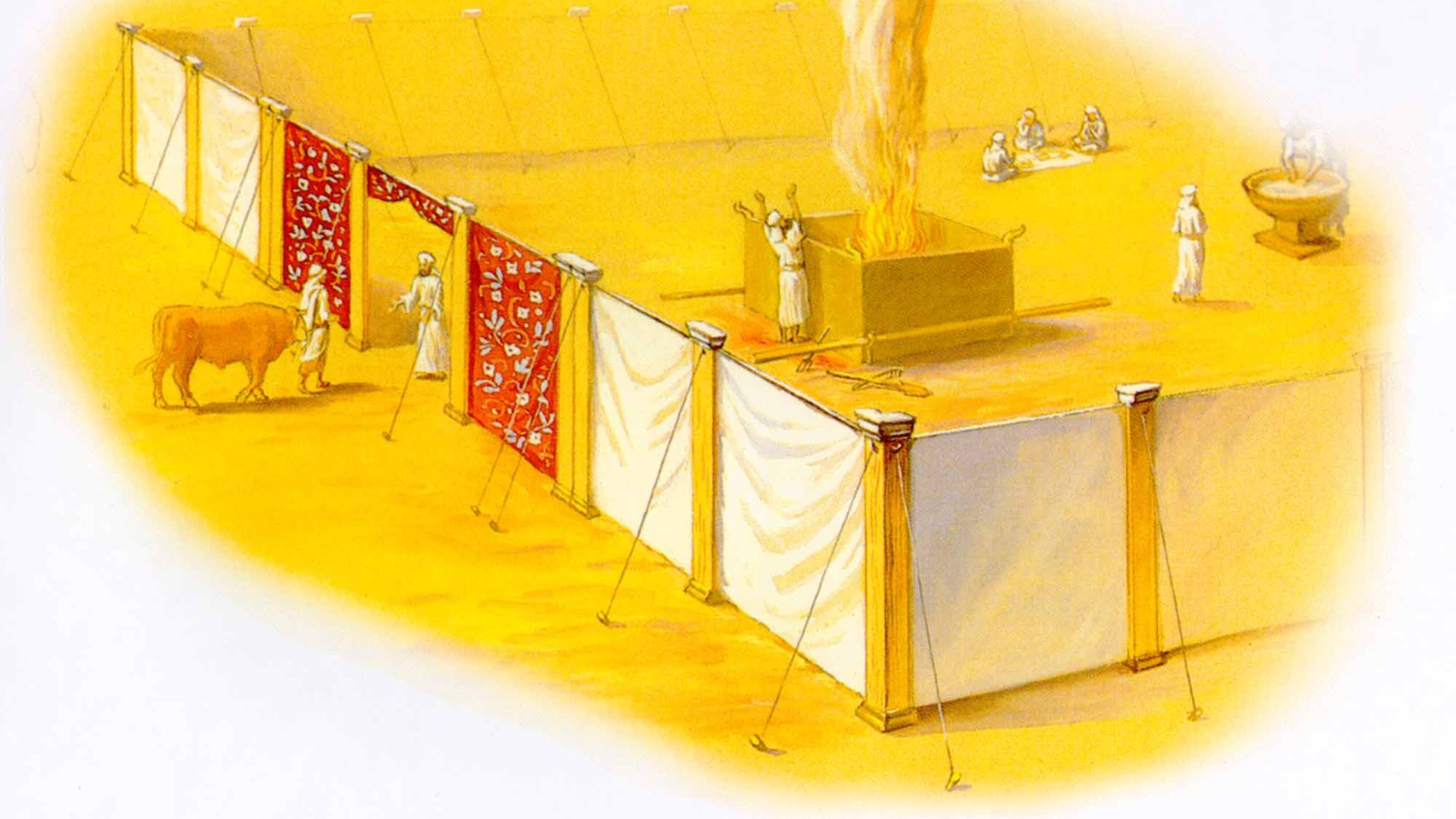
A sinner is outside the Tabernacle, kept away by a 7 ½ foot high white fence, set of posts held up by 60 solid brass sockets. There is only one way or gate into the enclosure, which opened directly in front of the Brazen Altar. That altar is the Cross of Jesus, which is where our spiritual life begins at salvation.
The next step after salvation is the regular cleansing at the Brazen Laver.
After being cleansed the next door leads to the Holy Place [about the size of a large living room (30 x 15)] where we find the Golden Table of Bread as we fellowship with Jesus through His Word.
Then guided by the light of the Golden Lamp stand we are able to walk confidently as I John 1:7 says.
Then and only then can we understand the power of prayer as portrayed by the Golden Altar of incense.
Through prayer we enter the Holy of Holies of God’s very presence.
In that Holiest Place we find the peace and security of the Ark of the Covenant, the blood sprinkled mercy seat and the glow of the Shekinah of God’s presence.
THE TABERNACLE ENTRANCE:
THE COURTYARD OF THE TABERNACLE was one hundred fifty feet long and seventy-five feet wide. Its single gate, on the east side, was thirty feet wide and seven and a half feet high, allowing a large number of people to enter at the same time.
This entrance is a graphic picture of Jesus Christ, who said, “I am the way” and “I am the door.” Just as there was only one entrance to the Tabernacle, there is only one way to God-the only Way and the only Door, Jesus Christ.
Christianity is exclusive, not because Christians make it so but because God has made it so. Throughout the centuries, of course, Christians have made the earthly church exclusive in many wrong ways. But God has intentionally made His spiritual, eternal church exclusive. It can be entered only through Jesus Christ.
Psalm 100: Make a joyful shout to the Lord, all you lands! Serve the Lord with gladness; Come before His presence with singing. Know that the Lord, He is God; It is He who has made us, and not we ourselves; We are His people and the sheep of His pasture. Enter into His gates with thanksgiving, And into His courts with praise. Be thankful to Him, and bless His name. For the Lord is good; His mercy is everlasting, And His truth endures to all generations.
“O Worship the King” # 10
ALTAR OF BURNT OFFERING:
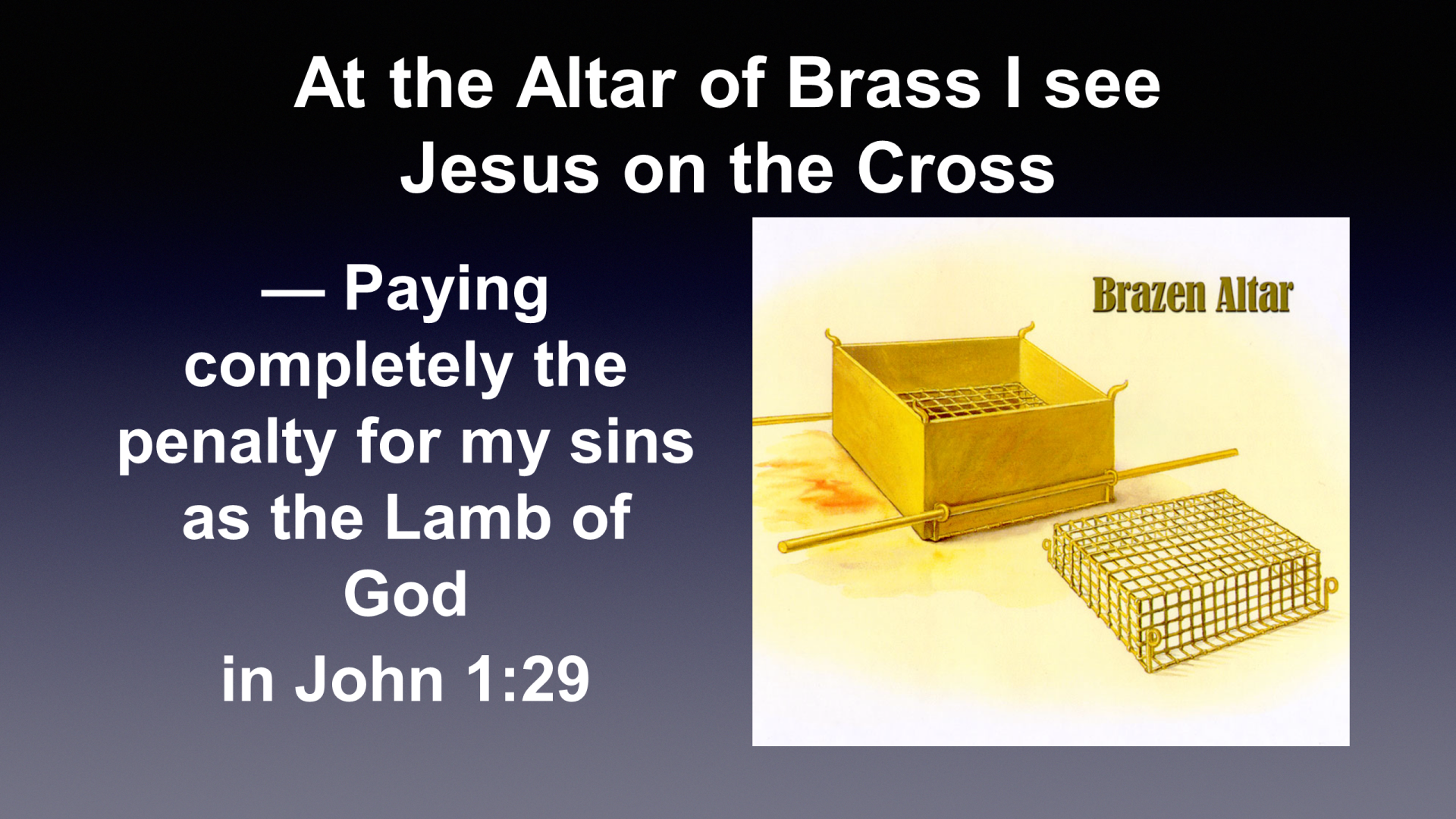
The first article of furniture in the outer court was THE BRONZE ALTAR. It was made of acacia wood sheathed with bronze. It was seven and a half feet square, stood four and a half feet off the ground, and was topped with a bronze grate. The coals were placed underneath the grate and the sacrifice was placed on top.
On the four corners of the altar were horns, to which the animal was bound when it was being sacrificed. The bronze altar is again a perfect picture of Jesus Christ, who Himself was a sacrifice for sin.
At the Altar of Brass I see Jesus on the Cross – paying completely the penalty for my sins as the Lamb of God.
John 1:29 The next day John saw Jesus coming toward him, and said, “Behold! The Lamb of God who takes away the sin of the world!
Revelation 5:9-10 And they sang a new song, saying: “You are worthy to take the scroll, And to open its seals; For You were slain, And have redeemed us to God by Your blood Out of every tribe and tongue and people and nation, 10 And have made us kings and priests to our God; And we shall reign on the earth.”
“Jesus Paid it all” # 210
LAVER:
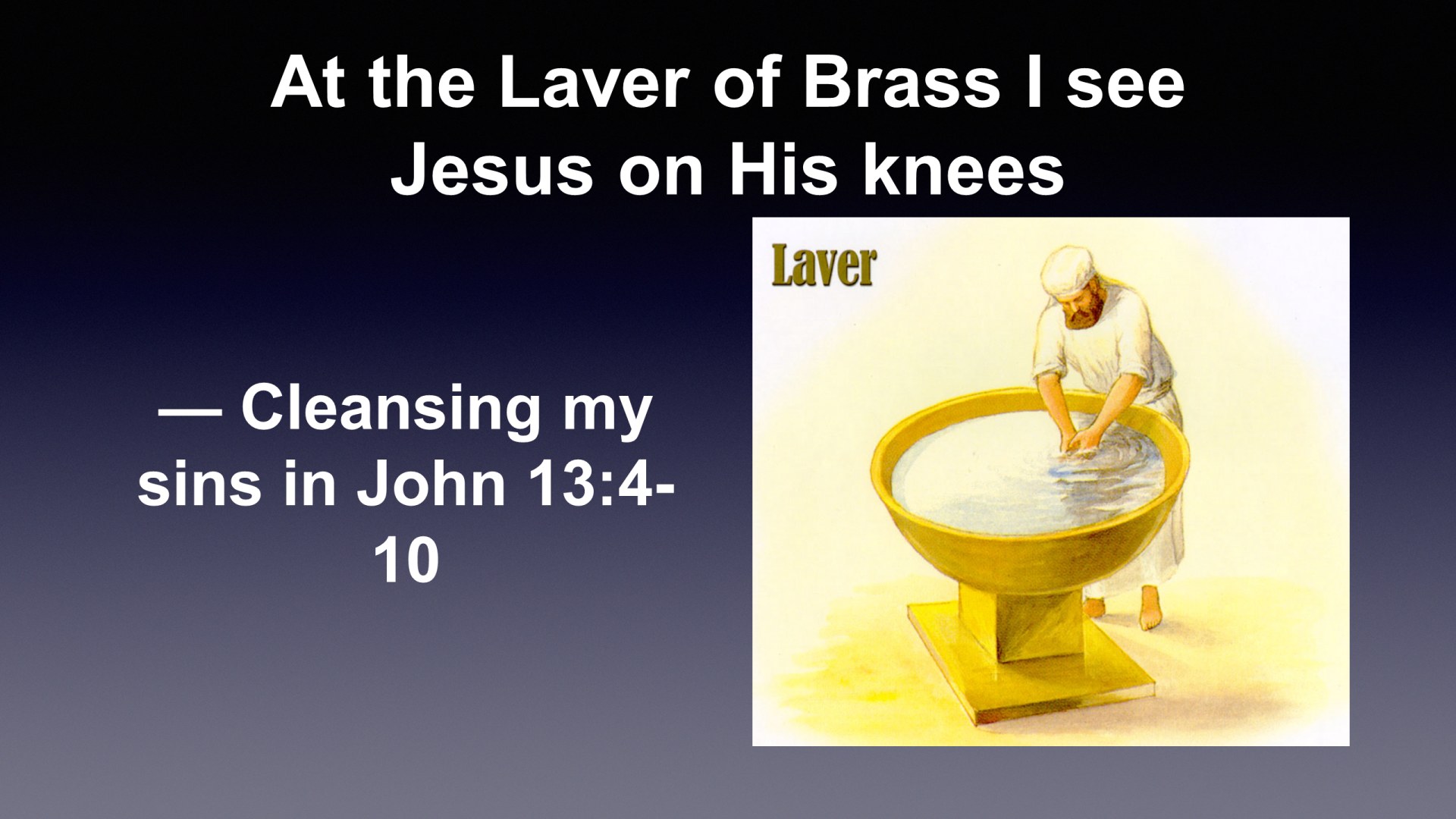
The next piece of furniture in the court was THE LAVER or basin, also made of bronze. In it the priests would wash their hands, and even sometimes their feet, as they went about the bloody services of sacrifice.
Here is a picture of Jesus Christ as the cleanser of His people. Once we have received forgiveness for our sins through Christ’s sacrifice of Himself, we still need His daily cleansing that restores fellowship and joy.
At the Laver of Brass I see Jesus on His knees – cleansing my sins.
John 13:4-10 rose from supper and laid aside His garments, took a towel and girded Himself. 5 After that, He poured water into a basin and began to wash the disciples’ feet, and to wipe them with the towel with which He was girded. 6 Then He came to Simon Peter. And Peter said to Him, “Lord, are You washing my feet?” 7 Jesus answered and said to him, “What I am doing you do not understand now, but you will know after this.” 8 Peter said to Him, “You shall never wash my feet!” Jesus answered him, “If I do not wash you, you have no part with Me.” 9 Simon Peter said to Him, “Lord, not my feet only, but also my hands and my head!” 10 Jesus said to him, “He who is bathed needs only to wash his feet, but is completely clean; and you are clean, but not all of you.”
Hebrews 9:14 how much more shall the blood of Christ, who through the eternal Spirit offered Himself without spot to God, cleanse your conscience from dead works to serve the living God?
“There is a Fountain” # 196
LAMPSTAND:
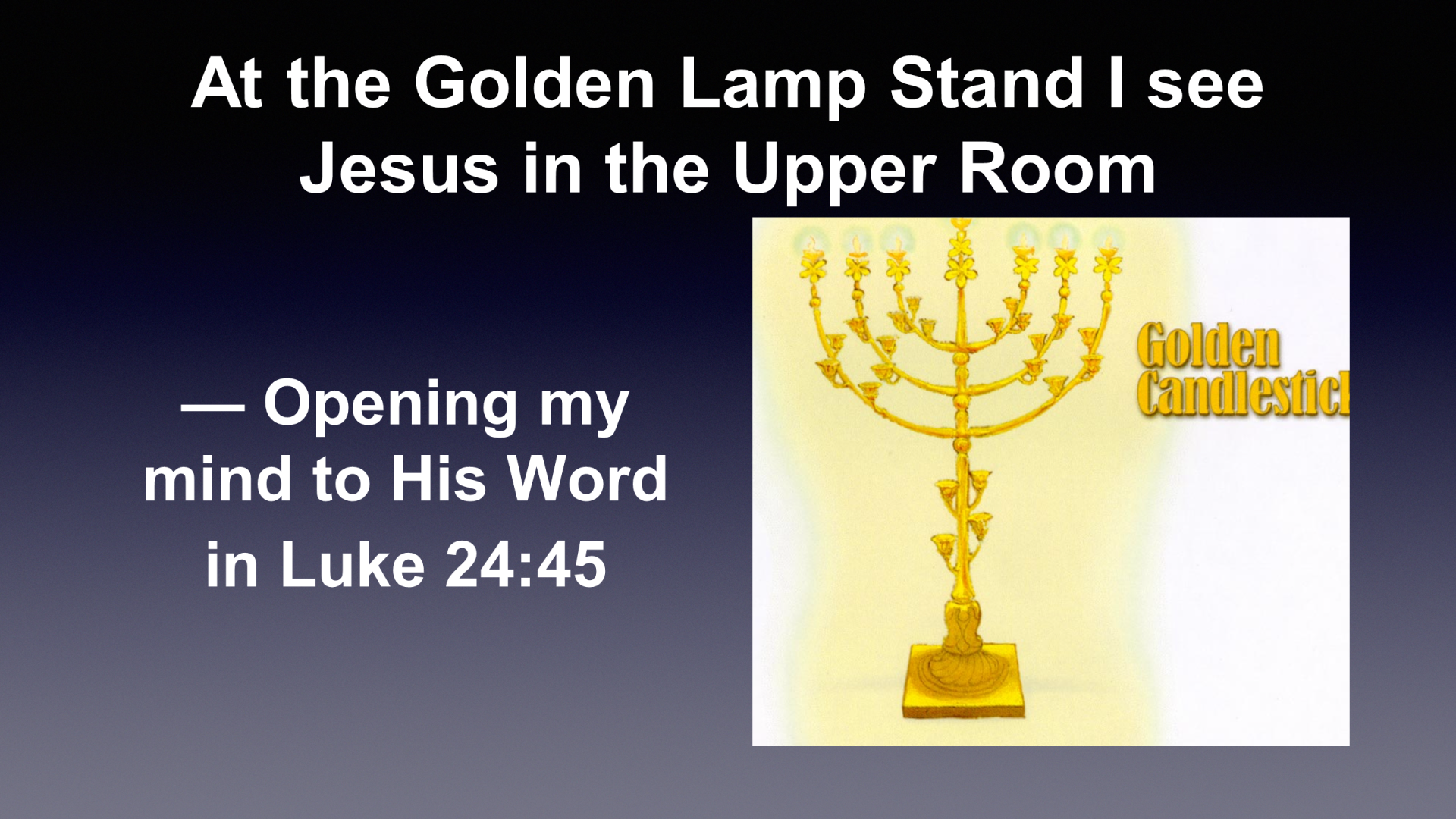
On the left, as the priest entered, was a solid GOLD LAMPSTAND having seven branches, each filled with the purest olive oil. “While I am in the world, I am the light of the world,” Jesus said (John 9:5).
When He left the world, the world was left in darkness, and only for believers is He the light of life. He is the light that directs our paths, the One who, through the Spirit, illumines our minds to understand spiritual truth. He is the One who, by the indwelling Spirit, guides us through the world of darkness. He is our light.
At the Golden Lamp Stand I see Jesus in the Upper Room – opening my mind to His Word.
Luke 24:45 And He opened their understanding, that they might comprehend the Scriptures.
Ephesians 1:17-18 that the God of our Lord Jesus Christ, the Father of glory, may give to you the spirit of wisdom and revelation in the knowledge of Him, 18 the eyes of your understanding being enlightened; that you may know what is the hope of His calling, what are the riches of the glory of His inheritance in the saints,
“Spirit of the Living God” # 247
Table of the Bread of the Presence:
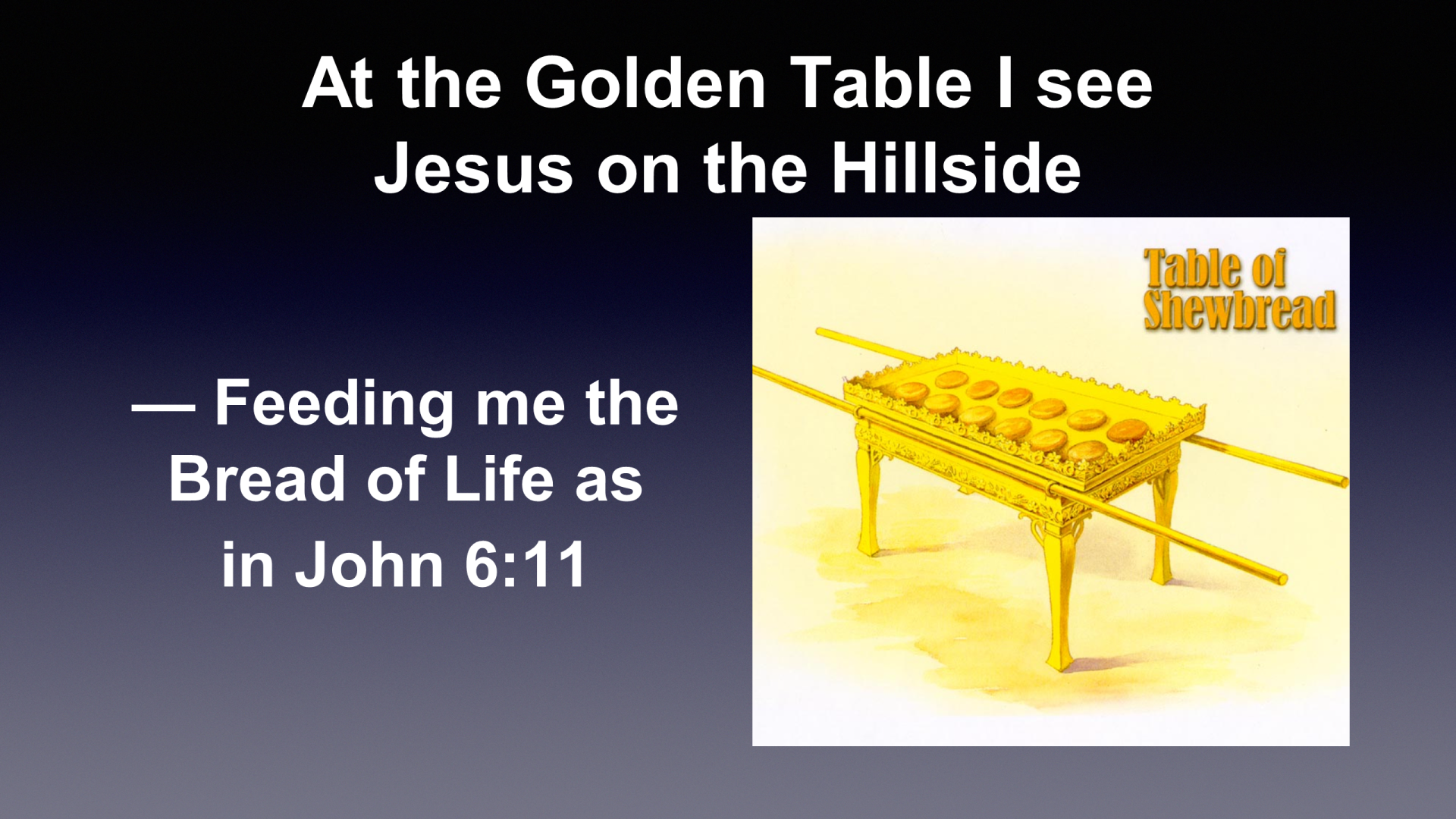
On the right was THE TABLE on which was THE SACRED BREAD, or show-bread. This table, like the base of the altar, was of acacia wood overlaid with gold. It was three feet long, one and a half feet wide, and two and a quarter feet high.
Every Sabbath twelve loaves of fresh bread were set on it, one for each of the twelve tribes. At the end of the week, the priests, and only the priests, were allowed to eat the loaves.
Jesus is our sustenance. He is our table of sacred bread. He is the One who feeds us every day, who sustains us with the Word. The Word is not only our food but our light. And the oil is the Spirit of God, who lights the Word for us. The altar of incense pictures Jesus interceding for us, the perfect Sacrifice becoming the perfect Intercessor.
At the Golden Table I see Jesus on the hillside – feeding me the Bread of Life.
John 6:11 And Jesus took the loaves, and when He had given thanks He distributed them to the disciples, and the disciples to those sitting down; and likewise of the fish, as much as they wanted.
Hebrews 2:14-18 on screen: Inasmuch then as the children have partaken of flesh and blood, He Himself likewise shared in the same, that through death He might destroy him who had the power of death, that is, the devil, 15and release those who through fear of death were all their lifetime subject to bondage. 16For indeed He does not give aid to angels, but He does give aid to the seed of Abraham. 17Therefore, in all things He had to be made like His brethren, that He might be a merciful and faithful High Priest in things pertaining to God, to make propitiation for the sins of the people. 18For in that He Himself has suffered, being tempted, He is able to aid those who are tempted.
“Break Thou the Bread of Life” Hymn #274
Passing of the Bread
“Behold the Lamb” (Eb) P&W #164
Altar of Incense:
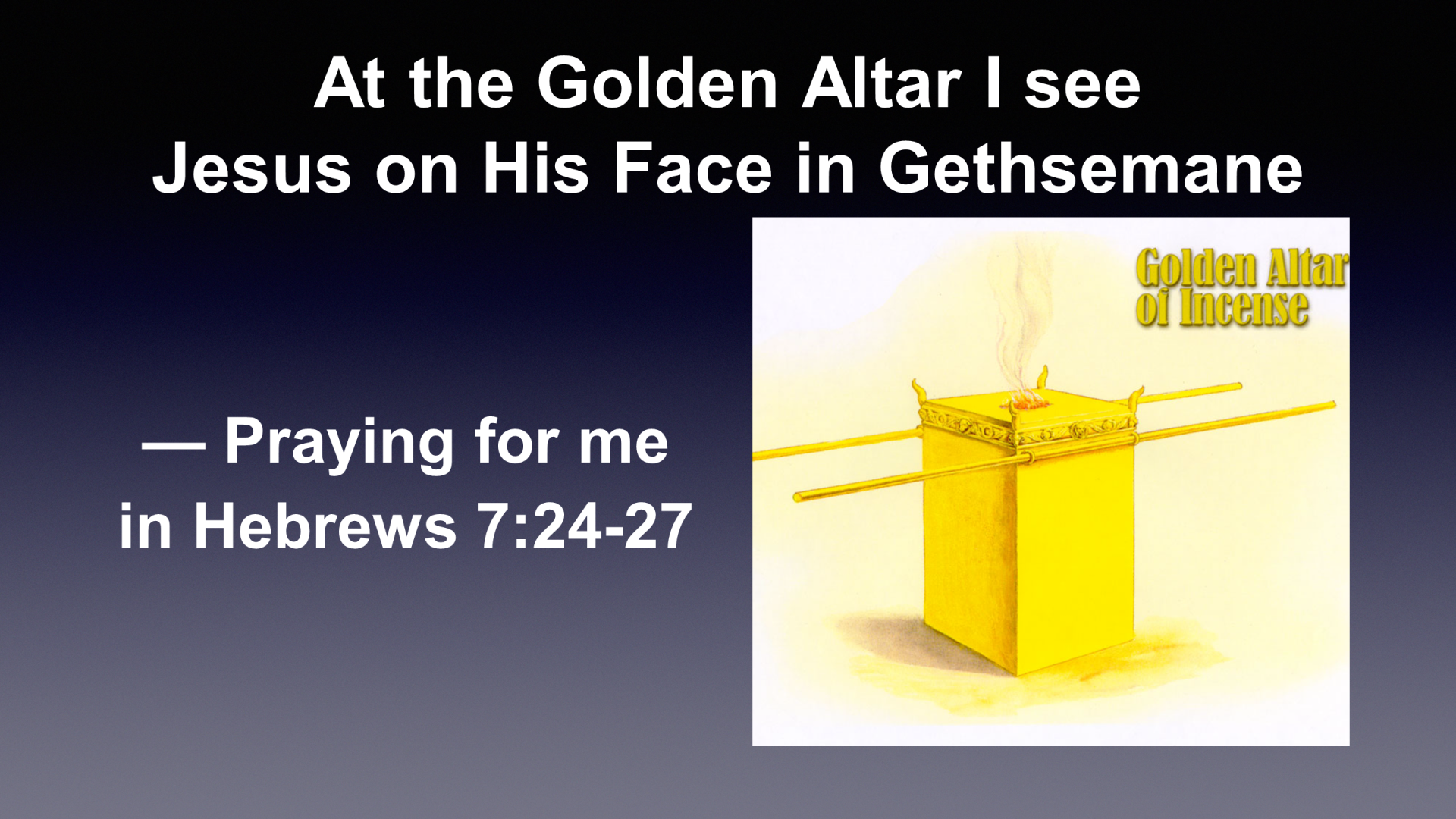
Farther in and to the center of the Holy Place was THE ALTAR OF INCENSE. It, too, was of gold-overlaid acacia wood, one and one-half feet square and about three feet high. On this altar were placed the burning coals from the bronze altar in the courtyard, where sacrifice was made. These three pieces of furniture also picture Christ. Everything in the outer courtyard was connected with salvation and the cleansing of sins.
- Jesus accomplished His sacrificial work on earth, outside God’s heavenly presence.
- The outer court was accessible to all the people, just as Christ is accessible to all who will come to Him.
- But in His heavenly sanctuary He is shut off from the world, temporarily even from His own people.
- From His heavenly place now, Jesus lights our path (pictured by the golden lampstand), He feeds us (pictured by the table of sacred bread), and He intercedes for us (pictured by the altar of incense).
At the Golden Altar I see Jesus on His face in Gethsemane – praying for me in Hebrews 7:24-27 But He, because He continues forever, has an unchangeable priesthood. 25 Therefore He is also able to save to the uttermost those who come to God through Him, since He always lives to make intercession for them. 26 For such a High Priest was fitting for us, who is holy, harmless, undefiled, separate from sinners, and has become higher than the heavens; 27 who does not need daily, as those high priests, to offer up sacrifices, first for His own sins and then for the people’s, for this He did once for all when He offered up Himself.
“Sweet Hour of Prayer” Hymn #433
Hebrews 7:24-26 on screen: 24But He, because He continues forever, has an unchangeable priesthood. 25Therefore He is also able to save to the uttermost those who come to God through Him, since He always lives to make intercession for them. 26For such a High Priest was fitting for us, who is holy, harmless, undefiled, separate from sinners, and has become higher than the heavens;
Mercy Seat
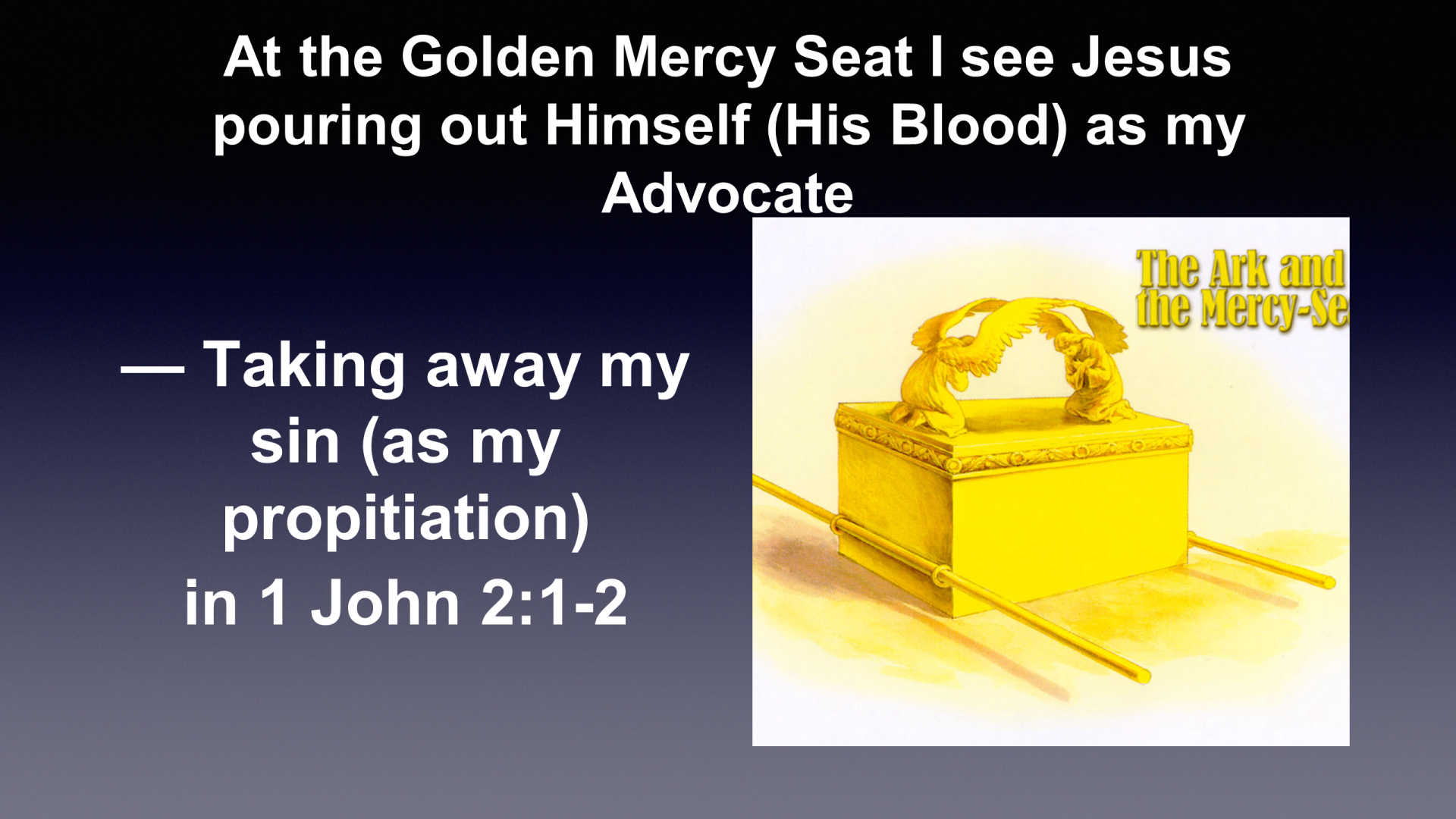
In this holiest of earthly places was only one piece of furniture, the ark of the covenant. On the lid was the mercy seat, on which were the cherubim of glory, angelic figures made of solid gold. It was between the wings of those angels, on the mercy seat, that God met men. “And there I will meet with you; and from above the mercy seat, from between the two cherubim which are upon the ark of the testimony, I will speak to you about all that I will give you in commandment for the sons of Israel” (Ex. 25:22). If God and man were to meet it could only have been there.
At the Golden Mercy Seat I see Jesus pouring out Himself (His Blood) as my Advocate- taking away my sin (propitiation) 1 John 2:1-2 My little children, these things I write to you, so that you may not sin. And if anyone sins, we have an Advocate with the Father, Jesus Christ the righteous. 2 And He Himself is the propitiation for our sins, and not for ours only but also for the whole world. Romans 3:25 whom God set forth as a propitiation by His blood, through faith, to demonstrate His righteousness, because in His forbearance God had passed over the sins that were previously committed,
Ark of the Covenant:
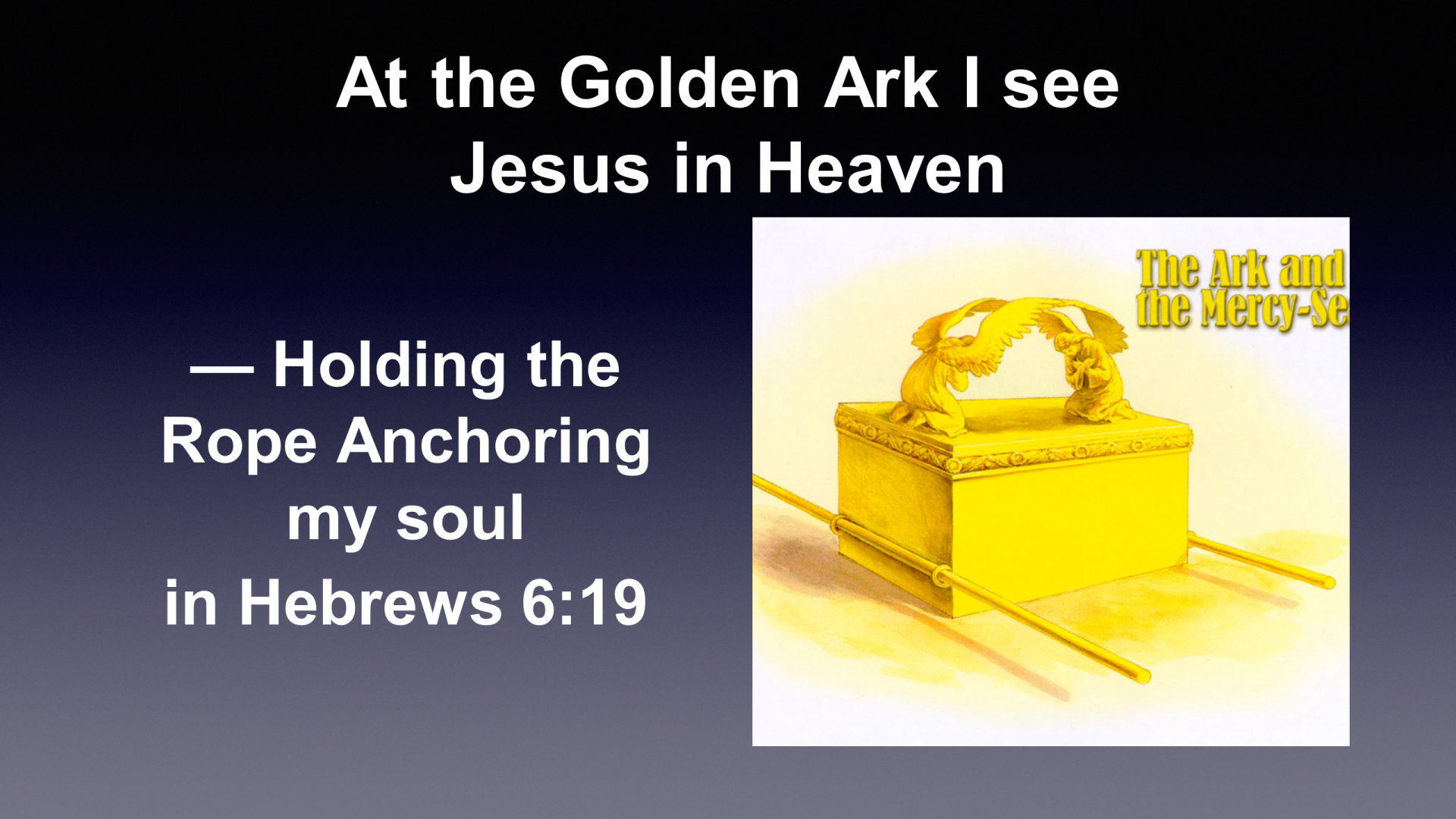
The central, in fact the only, thing in the Holy of Holies was THE ARK, which represents Jesus Christ, the true mercy seat. Made of acacia wood overlaid with gold, it was about three feet nine inches long, two feet three inches wide and two feet high.
When we meet Jesus Christ as Savior, we are ushered into the presence of God, into the true Holy of Holies. God no longer communes with men between the wings of cherubim on a gold mercy seat. He communes with men in His Son, by whom the veil was torn in two. Jesus Christ is the mercy seat. Only on the basis of the blood of a goat would God have fellowship with Israel, and only on the basis of the blood of Christ will God have fellowship with men. John, in using the term “propitiation,” in 1 John 2:2, relates Jesus to the mercy seat, since that very is used for mercy seat in the Septuagint translation of Exodus 25:17[1].
At the Golden Ark I see Jesus in Heaven holding the rope anchoring my soul in Hebrews 6:19 This hope we have as an anchor of the soul, both sure and steadfast, and which enters the Presence behind the veil,
Hebrews 10:19-25 Therefore, brethren, having boldness to enter the Holiest by the blood of Jesus, 20 by a new and living way which He consecrated for us, through the veil, that is, His flesh, 21 and having a High Priest over the house of God, 22 let us draw near with a true heart in full assurance of faith, having our hearts sprinkled from an evil conscience and our bodies washed with pure water. 23 Let us hold fast the confession of our hope without wavering, for He who promised is faithful. 24 And let us consider one another in order to stir up love and good works, 25 not forsaking the assembling of ourselves together, as is the manner of some, but exhorting one another, and so much the more as you see the Day approaching.
Hebrews 13:8, 15-16, 20-21 on screen: 8Jesus Christ is the same yesterday, today, and forever. 15Therefore by Him let us continually offer the sacrifice of praise to God, that is, the fruit of our lips, giving thanks to His name. 16But do not forget to do good and to share, for with such sacrifices God is well pleased. 20Now may the God of peace who brought up our Lord Jesus from the dead, that great Shepherd of the sheep, through the blood of the everlasting covenant, 21make you complete in every good work to do His will, working in you what is well pleasing in His sight, through Jesus Christ, to whom be glory forever and ever. Amen.
Passing of the Cup
“There is a Redeemer” (D,Eb) P&W #111
“And Can it Be” Hymn #203
[1]MacArthur, John F., The MacArthur New Testament Commentary, (Chicago: Moody Press) 1983.