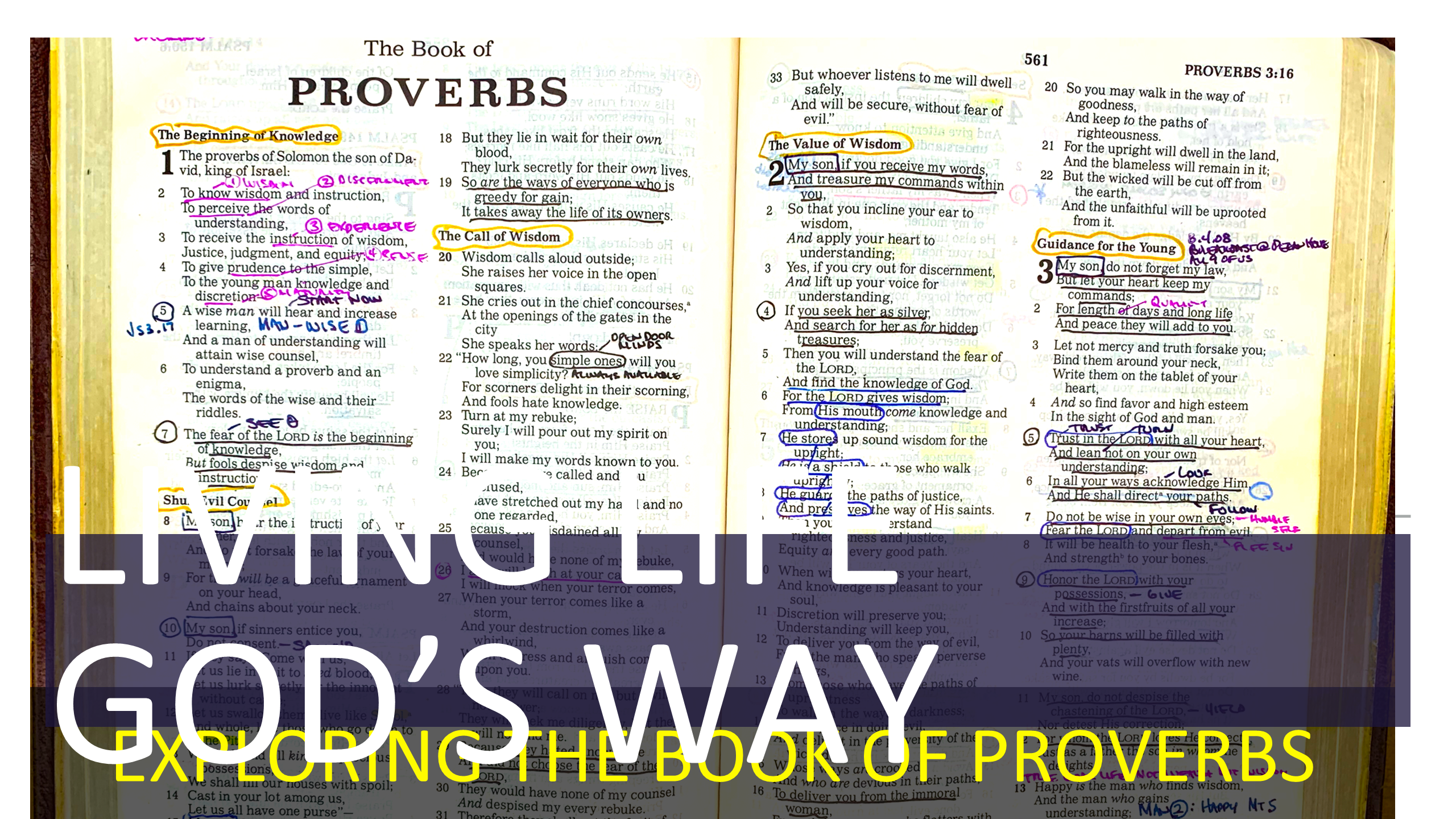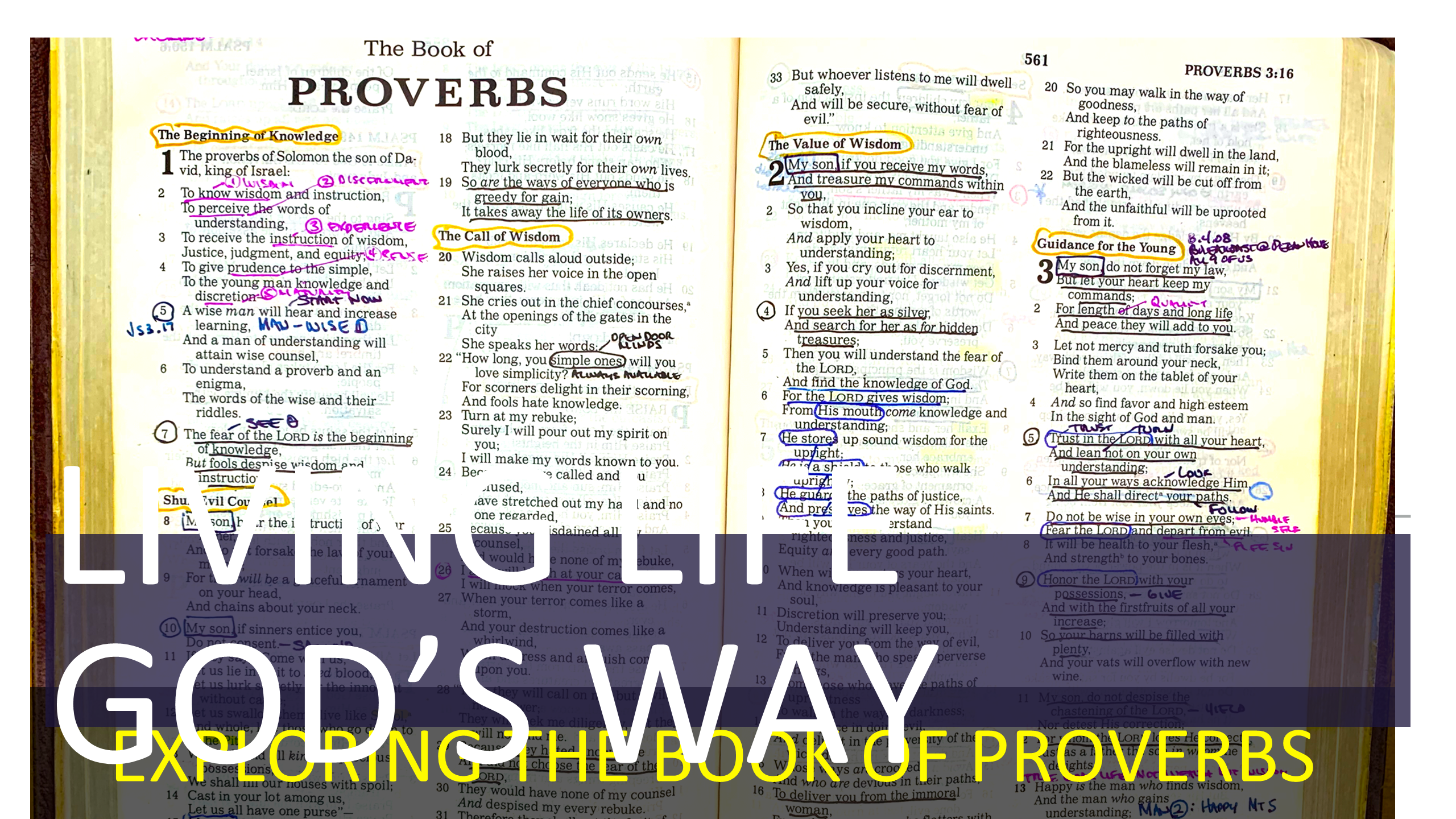
WOL2025 – Proverbs-03
250311AM
Transcript
WOL2025 – Proverbs-03 – How Did Solomon Ruin His Life
Okay, let’s take our Bibles to Proverbs. I’m thankful for the worship, for the introduction, for the reminders of, this is a youth ministry and we’re surrounded by these young people, and we used to be one, all of us here. And to see them carrying on for the Lord, singing their hearts out, teaching, traveling, did you see them climbing those cliffs in Mexico? Look very dangerous to me, but it was a joy. But Proverbs, we are going to stick through all week long and it is the brighter, ever brighter path for life is everything that surrounds these 915 verses.
Always a contrast reminding us there’s two parts that people choose: the pathway forking, and they have to choose either the path of the just, which is the bright one. It shines brighter onto the perfect day, onto the day when we see Him as He is, and we’re conformed to His image, and we are finally glorified. Or the way of the wicked is like darkness, and they don’t know why everything is getting worse and their life is deteriorating.
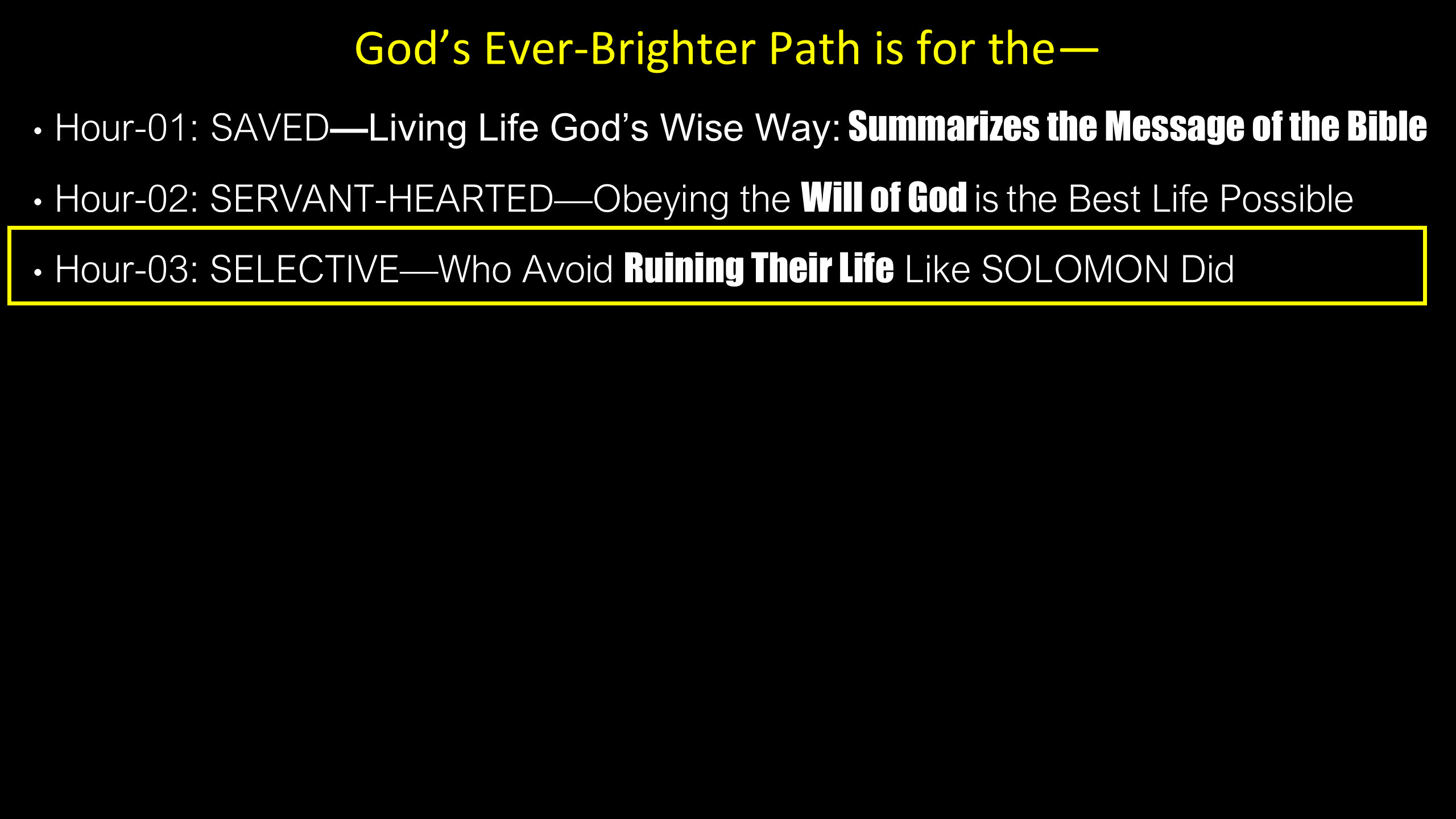
And so basically, God’s ever brighter path is for the, and on Sunday, we saw it, was for the saved because wisdom, this life that God offers us is just for the saved, and living life God’s way just summarizes the whole message of the Bible. All Scripture is given by inspiration of God. All Scripture is profitable for doctrine, reproof, correction, instruction, and righteousness. It’s the whole Bible. The whole Bible is God’s life He offers us, and we have to choose which way we go. Then yesterday we looked at servant heartedly, obeying the will of God. It’s the best life possible. That God has revealed His will to us. And we just have to choose what to do.
So now let’s start looking at the second word. Open your Bibles and look at the second Hebrew word. What’s the second word of Proverbs? In Hebrew, the first word is the word proverb, and in English it’s translated the Proverbs of, so that’s the first Hebrew word. What’s the second one? It’s the next one in English. Yeah. What’s the next word in your Bible? Good. Those of you brave enough to, I love it. I love getting, when I teach the young people both here and in New York, I love it when they’re so engaged. They just respond. That’s exciting because the Scriptures are before us, and God wants us as we heard in the prayer to respond to Him.
So, Solomon ruined his life. Do all of you remember the good old days of Walkthrough the Bible? Remember all those motions? Did any of you do that? The walk? Yeah. Yeah. Do you remember the motions, Saul? No heart. David? Whole heart. Solomon, what? Half heart. Do you remember? That’s how they summarized the first three kings of the United Kingdom. We’re looking at Mr. Half Heart this morning, and basically God’s ever brighter path is for those who select through life. We keep coming to choices to go God’s way or our own way, God’s way, or our friend’s way or the world’s way or whatever. That other path, and it’s hard. Maybe we’re sanctified more than the young people. I’m not sure, you know that we’re all fully engaged with the Lord, but you know what, if you’re not feeling that tension, then that’s good, but the younger people constantly feel that tension between God’s way, which is by faith, and man’s way. And seeing the world the way that most the majority do. Well, the select people, those that select God’s way, those that, that stay on that ever-brighter path, avoid ruining their life like Solomon did, and Solomon did ruin his life.
God’s message in Proverbs is there’s just two ways, the way of salvation, which is wisdom, the way of damnation, which is foolishness.
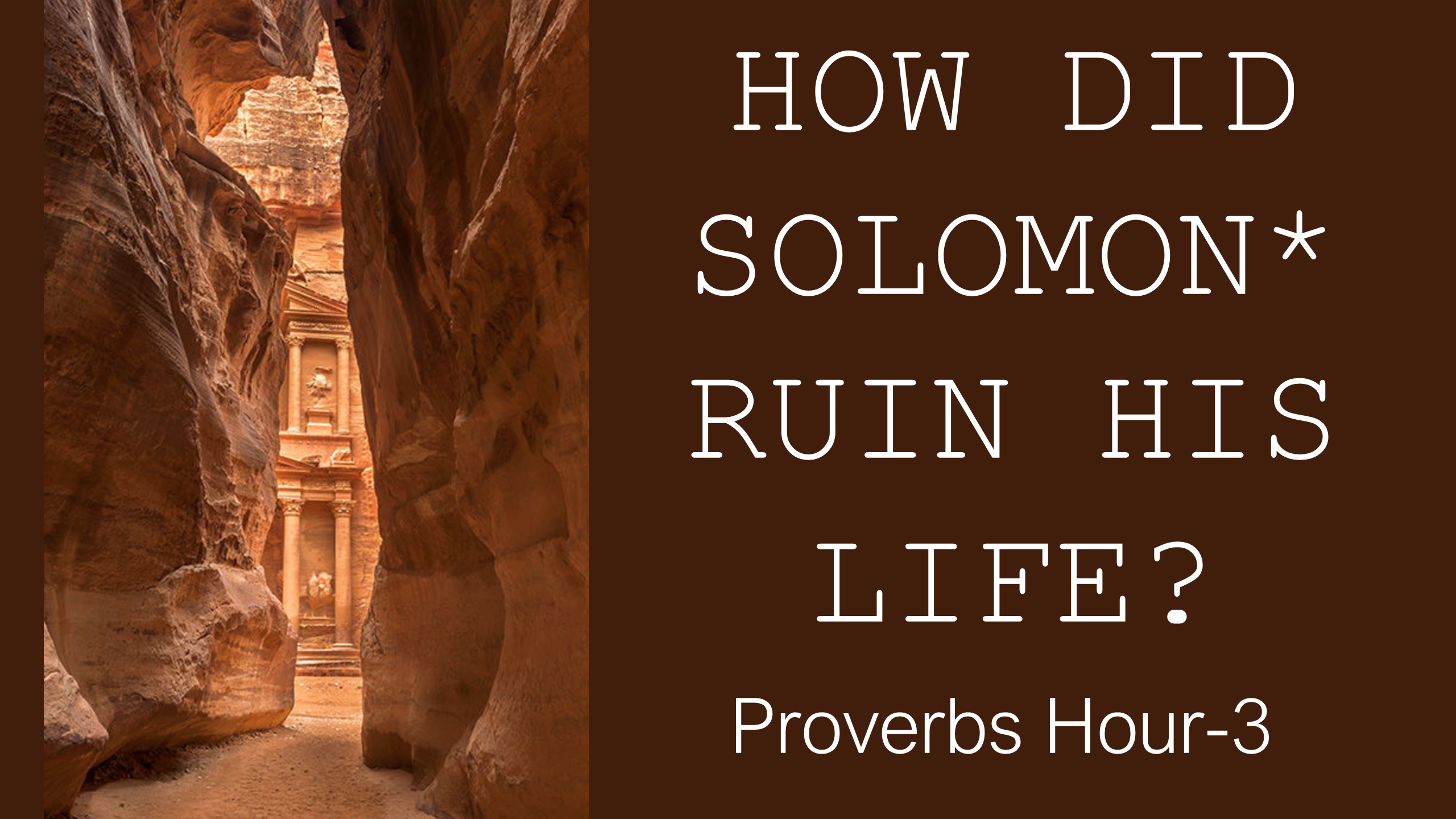
But what we really need to spend our time on, and let’s see, it’s 9:29, so we have 31 minutes and one second. How did Solomon, the wisest and richest man of the day, it says, among all the kings of the Earth, he was the richest, and the Lord gave him wisdom like He had given no one else. So wisest and richest. How did he ruin his life?
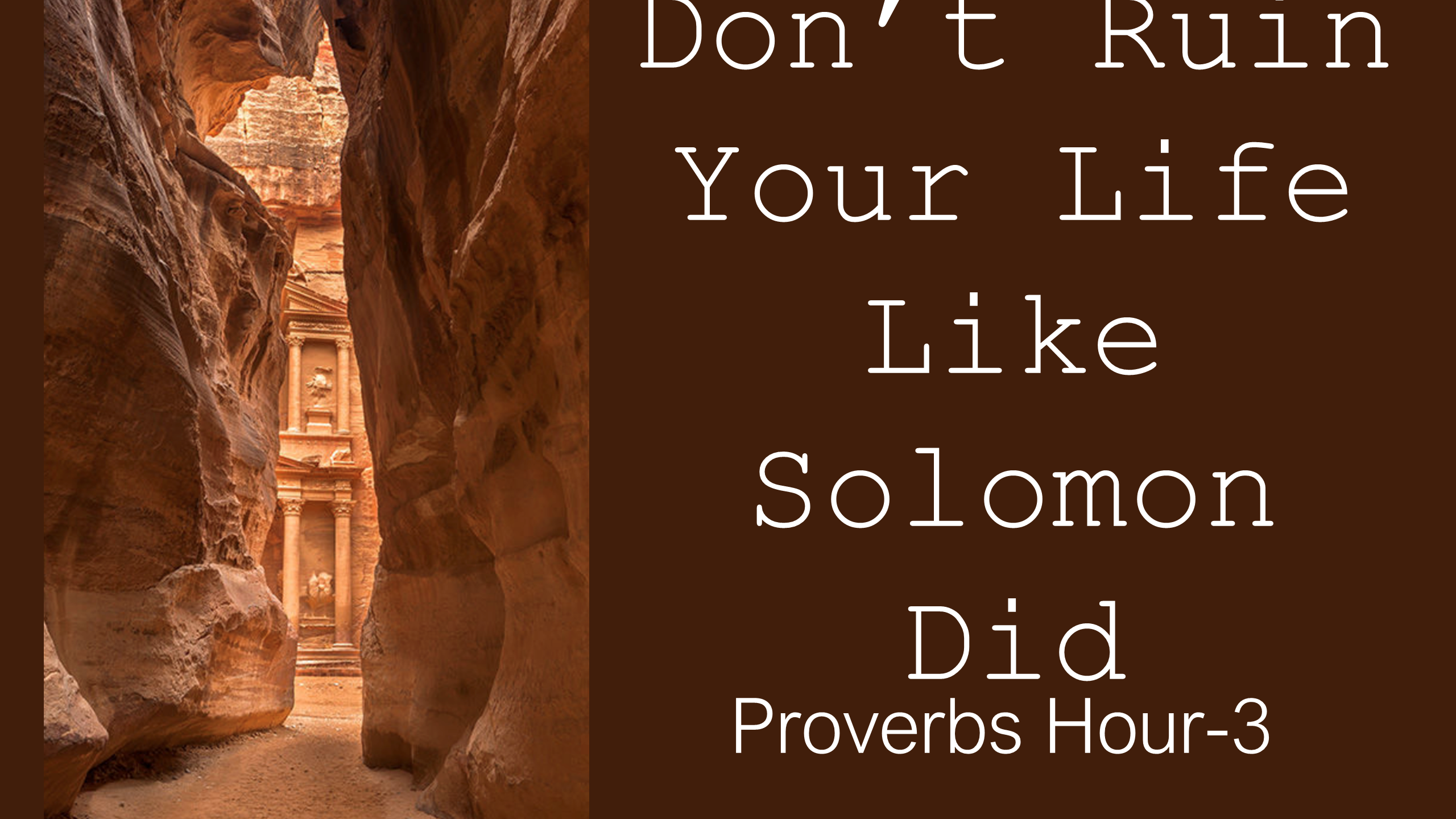
By the way, that picture, if we were doing a quiz, and a game show or something, that picture is an anachronism because on the left is the Treasury and Petra, which the Nabataeans built maybe in the 4th century B.C., but I like it anyway, it’s in Jordan and it’s fun going there. But Solomon, of course, was in the, the 10th century B.C. So, it’s in anachronism, but I like the picture.
But how did Solomon ruin his life? Now we all know that the Scriptures tell us that it was his wives that pulled his heart away from the Lord. In fact, all of you that go to Israel that’s one of the first things when you’re in Jerusalem, you go up on either the Mount of Olives or somewhere, around the Temple Mount, and almost always the guides will go look over there. Do you see what’s on top of that hill? It’s the Hill of Evil Council. Now, what’s on there today when you’re looking into Mount of Olives and standing on the temple Mount, there is the United Nations building. They have their headquarters, the UN’s headquarters for the whole occupied territories and West Bank and all that stuff is right there on the hill of Evil Council, but it’s a reminder that’s where Solomon’s wives lived. He didn’t let them live in Jerusalem. He put them up there and built and let them have all their altars and everything for their false gods right there. Not in Jerusalem. Wasn’t that nice? He didn’t pollute Jerusalem, but his wives polluted him, and basically that’s an essence of why he wasted his life.
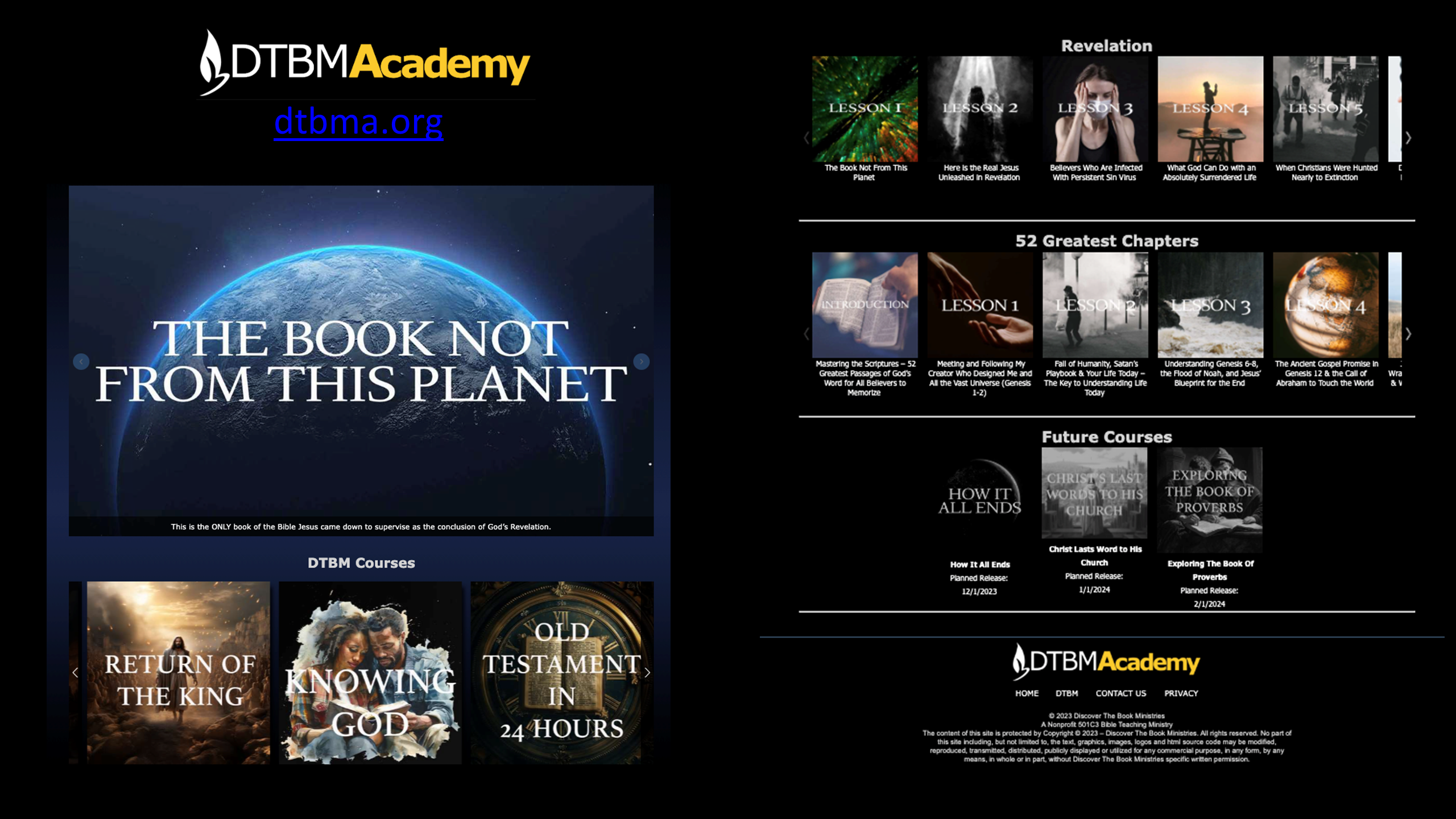
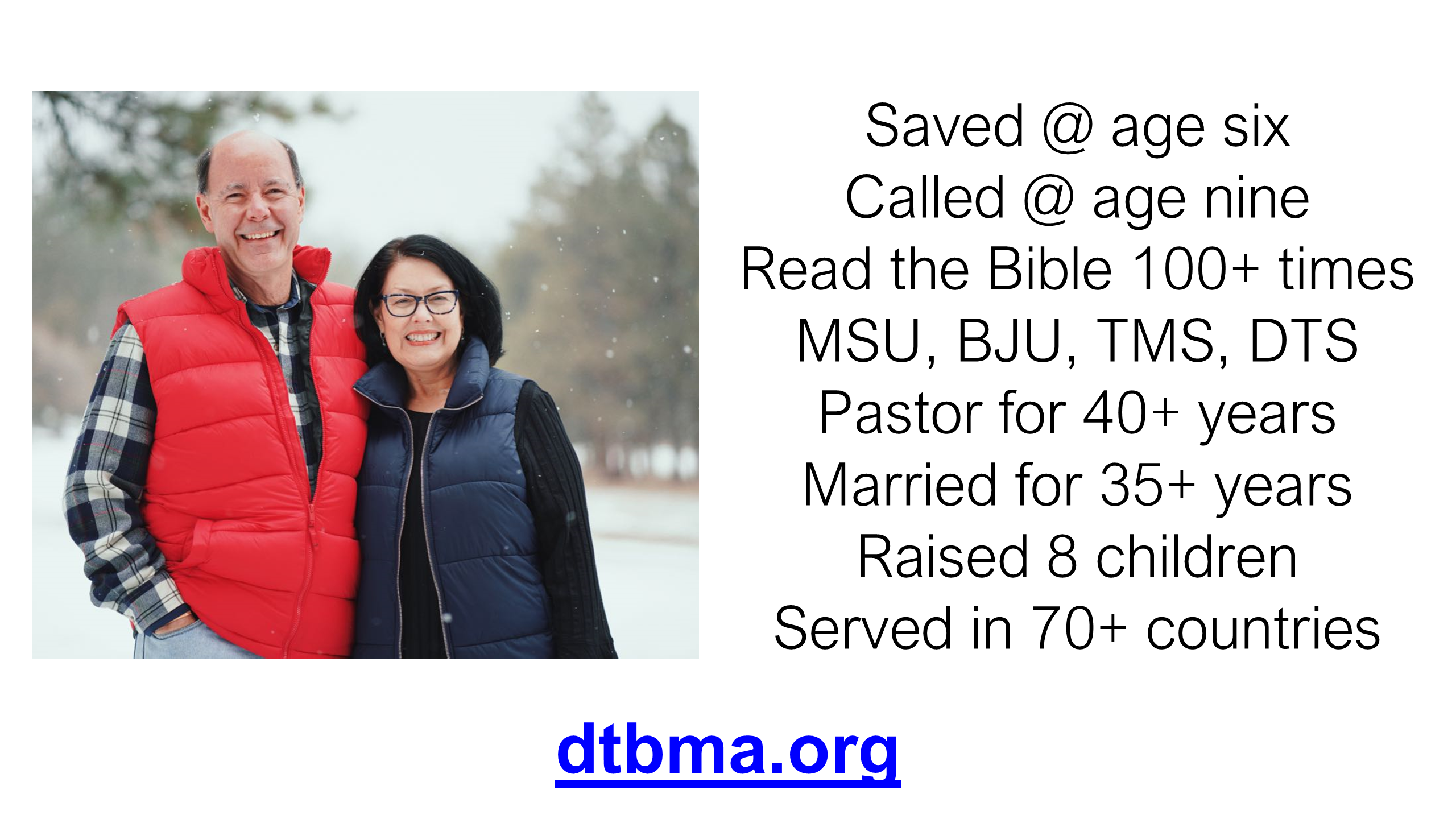
Now, yesterday I talked to one of you, the nurse that has the bible studies and she said, you’re going to put your web address up there. Yeah. It’s in the upper, the tiny yellow there. The DTBM Academy, and it’s dtbma.org, is one of our favorite facets of our ministry. Bonnie and I travel, we teach in Bible institutes. We’ve been to about what, six, seven? I don’t know. The Philippines and Hungary and Argentina and New York and Florida. Where am I leaving out? Oh, Jeju in Korea. And where else? And Canada. So, we’ve been to a lot of them, but there’s a lot more. We’ve only been to half of them, but everything we’ve ever taught in all of these courses around the world are right there at the academy. And our most popular course is the second one down is called the 52 Greatest Chapters. And the only reason I’m telling you that is I’m saying if you are not part of a small group Bible study, you ought to think of spending a year together with someone and going through the entire Bible, and we’ve distilled down the whole Bible into 52, the 52 key chapters. Now it’s arbitrary. We pick them, the chapters were put in the Bible in the 12th century. So, there were no chapters when it was written. The Archbishop of Canterbury, Stephen Langton, put those in as a help to get the Church of England to read through the Bible. And so, he divided up the Bible into 1,189 chapters and you know that, but he wanted them to read the Bible. Now, the verses didn’t come around until the 16th century with the first printer, Robert Estienne, and he was doing that. But the chapters are great divisions, and we have, for our classes, divided the whole Bible into 52 portions. And it’s the key. It’s like these 52 chapters summarize everything in the Bible, every systematic theological point, everything you can think of all the attributes of God are in there. Every major event is described, and of course, ten of them are prophetic. And so, it’s just very exciting. But that’s where they are. And they’re the slides, they’re the videos, they’re the audios, and there’s, the best part is it’s a transcript that totally parallels with every slide. So just for you to see that.
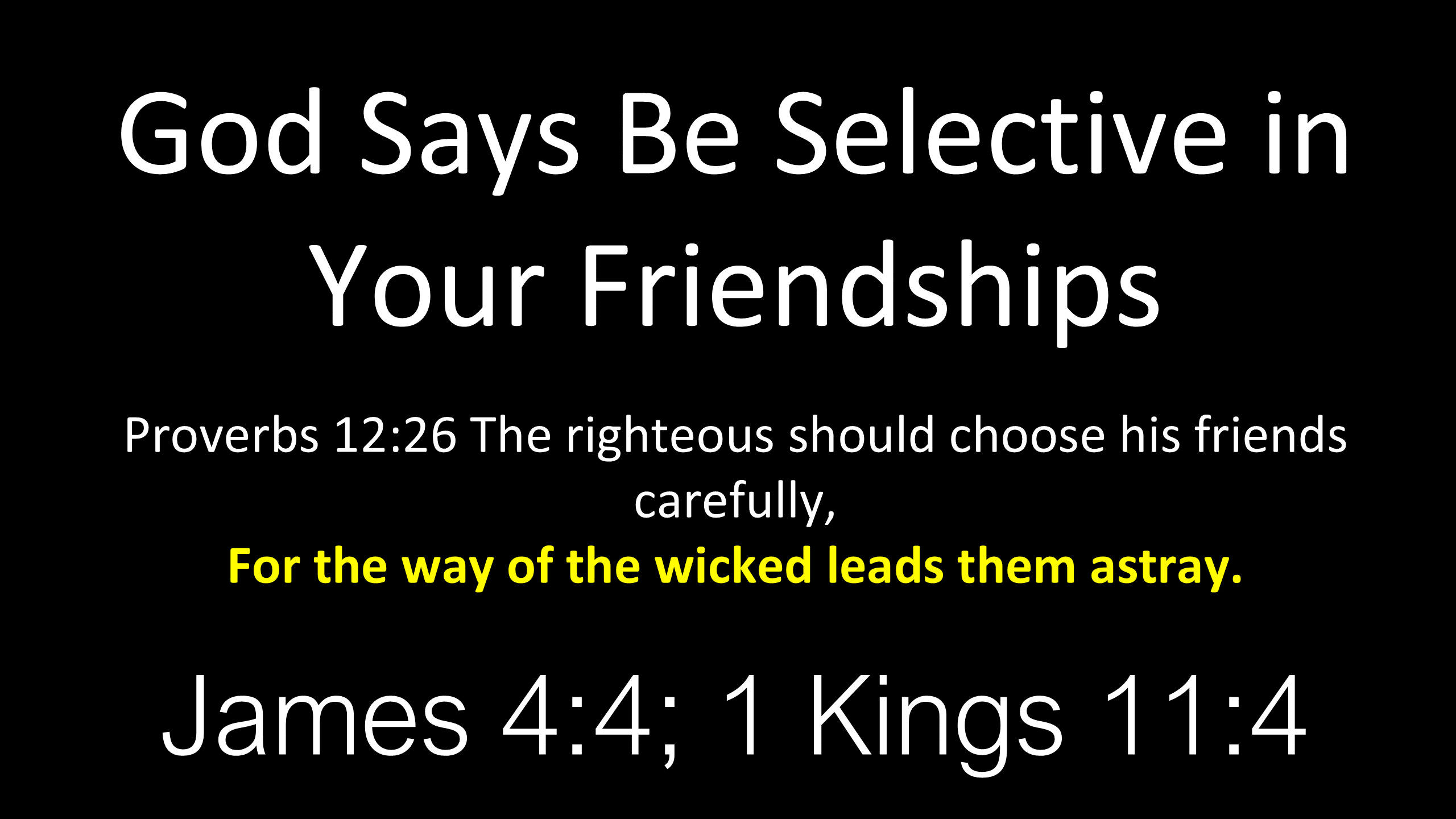
But let’s jump into Proverbs the second word, I already read you, the Proverbs of Solomon, the son of David, King of Israel. Now, what we’re looking at this morning is the selective element. Look what it says in chapter 12 verse 26, Proverbs 12:26. God says something that’s very interesting and I had to, this morning I went back, and I thought, is it that blunt? And this is what it says. “The righteous should choose his friends carefully…”
Remember, righteous? Righteous, just, wise. All of these are synonyms of the people that are God’s, the people that are saved, the people that are responding to God. The people that, as we saw earlier, have allowed His Spirit to transform them, we would call them saved. Okay? “The righteous should choose his friends carefully, for the way of the wicked leads them astray.” Now I like James 4:4. Remember we talked about that on Sunday? That’s the very first New Testament epistle that was written. And when you read through that, look how punchy James is. It’s 108 verses 54 imperatives. So, half the book. If you know anything about the Greek language, an emphatic command is called an imperative in Greek. It’s one of the ways grammatically you can tell something. James 4:4 is one of those. And look what it says. “Adulterers and adulteresses, do you not know that friendship…” There we go. Look, the way of the wicked leads them astray. Choose your friends carefully. James says, wait a minute. More than individual people, “friendship with the world is enmity with God. Whoever therefore wants to be a friend of the world, makes himself the enemy of God.” God says, be selective in your friendships. James catapults that to the highest level. And he says, not just people, the system of Satan. Don’t become, don’t befriend the system of Satan. So, I wrote in my Bible, I’m a Bible writer right there. When I was studying this with my small group, I said, because they all asked me, why does it say adulterers and adulteresses? I thought this was written to Christians. What? I thought God told Solomon this too, and he was, chosen of God and God gave him wisdom and. How can God say something that sharp to the people of the first church in Jerusalem? So, I wrote, why adultery? Because God is our husband. The world is a prostitute seeking our affections that belong only to the Lord. So, when we pray for worldly pleasures, it is wrong. That’s because, see how it starts.
Where do war… In James 4:1, where do wars and fights come from? Do they not come from your desires for pleasure, that war in your members? You lust and don’t have you murder and covet and cannot obtain? You fight in war, yet you do not have because you do not ask. Now, verse three, you ask and receive and do not receive because you ask amiss. That you may spend it on your pleasures. When we are so befriending of the system of this world that we’re always asking God for things that are not tied to eternal, not tied to the Lord, not seeking His glory, we are seeking what I wrote here. The world is a prostitute seeking our affections that belong only to the Lord. And when we pray for worldly pleasures, it offends God. Have you ever thought about that? How much people spend their life longing for what we see on television? What are all the shows about on television? The Houses of the Rich and Famous, the Lifestyles of the Rich and Famous, the one of the most famous HBO shows now is on all these rich and famous people staying in $10,000 a night suites. And living in sin and drunkenness and immorality. And that is a popular show that is in the New York Times every day, the latest episode is dropping. That’s an evidence of picking the wrong friends.
Look at 1 Kings 11:4, because that’s where we pick up with Solomon what happened, and in 1 Kings chapter 11. And verse 4 is the indictment on Solomon. It says, “For it was so when Solomon was old, that his wives turned his heart after other gods, and his heart was not loyal to the LORD his God, as was the heart of his father, David.” Solomon didn’t obey the Lord. He wasn’t selective with his friendships. He befriended at the highest level these pagan women, and they finally swung him away from the Lord and he wasn’t loyal to the Lord.
Now remember Solomon was the wisest and the richest. Solomon was the author of 3000 Proverbs. The Bible tells us he wrote 1005 songs. That’s in 1 Kings, chapter 4, verse 32. God gave him wisdom that surpassed all the noted wise men of his day. 1 Kings 3:12 says that he was greater than, and it names off all these sages. Proverbs 1:1 says, it’s the Proverbs of Solomon, the son of David, the King of Israel, and he had it all. Riches. In fact, if you calculate, do you remember when David died? Just before he died, he gave to the Lord one million talents of silver. Do you know how much a talent is? It’s sixty pounds, between sixty and a hundred pounds, and so he had sixty million pounds of silver. David did. And a hundred thousand talents of gold, so he had six million pounds of gold. Do you know how much that is? Trillions? It’s even more than Musk has, and Bezos and all the other rich and famous, and Bernard Arnault, of Paris. All the three richest people in the world, much more than all three of them put together. That’s how much David had, and he gave it to his son. So how did Solomon get to be the richest? His dad gave him the one of the largest fortunes ever amassed in the ancient world. He gave it to his son, and he started out. With all that just for you.
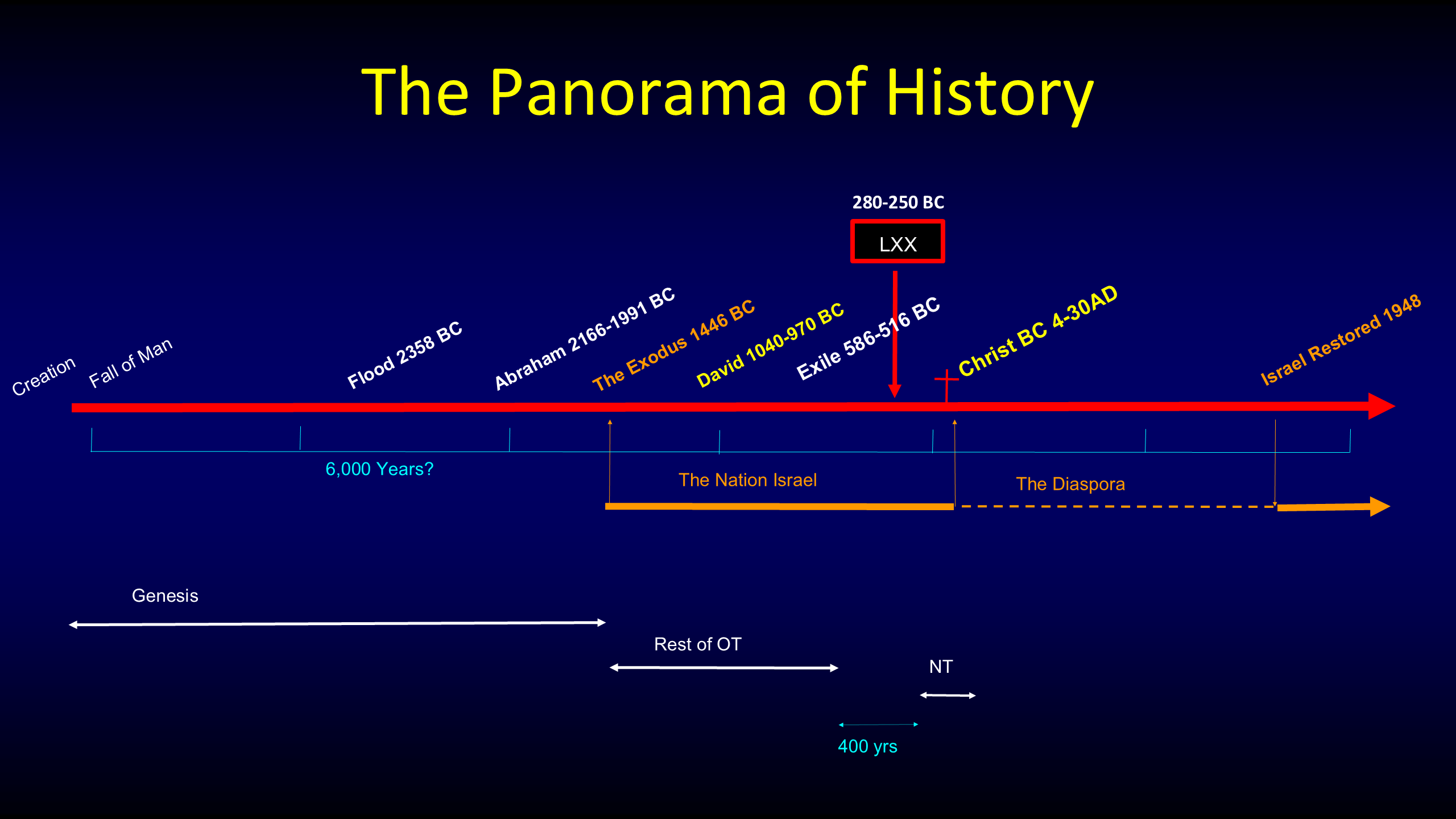
I was a history major in school, I love history. But you know the Bible, this is the panorama of history, according to God. Creation, fall of man, the flood, Abraham’s life, the Exodus, David, and then right after that, right in the middle of that yellow, tiny, you can hardly see David is where Solomon is. And after that, the exile, the Septuagint, that’s the Greek translation. The reason I put that in there is that’s the Bible Jesus used. Think about that. Jesus used a translation primarily in His ministry when He taught. He used a translation, not the original. Have you ever thought about that? A lot of people, they say, if I could only learn Greek and Hebrew, I could finally understand, the Bible, you don’t need to learn. Greek and Hebrew. Jesus primarily taught from, and so did we find the apostles from the Greek translation. The Septuagint, which is right there in the third century B.C. And then of course, Christ’s ministry. And then Israel’s restored as a nation in 48 and were somewhere by that red arrow. So basically, Genesis covers about half of all known history, revealed history, the rest of the Old Testament’s there, the New Testament’s right there. There’s 400 years of silence and we’re right there in the middle. In the time of David and Solomon.
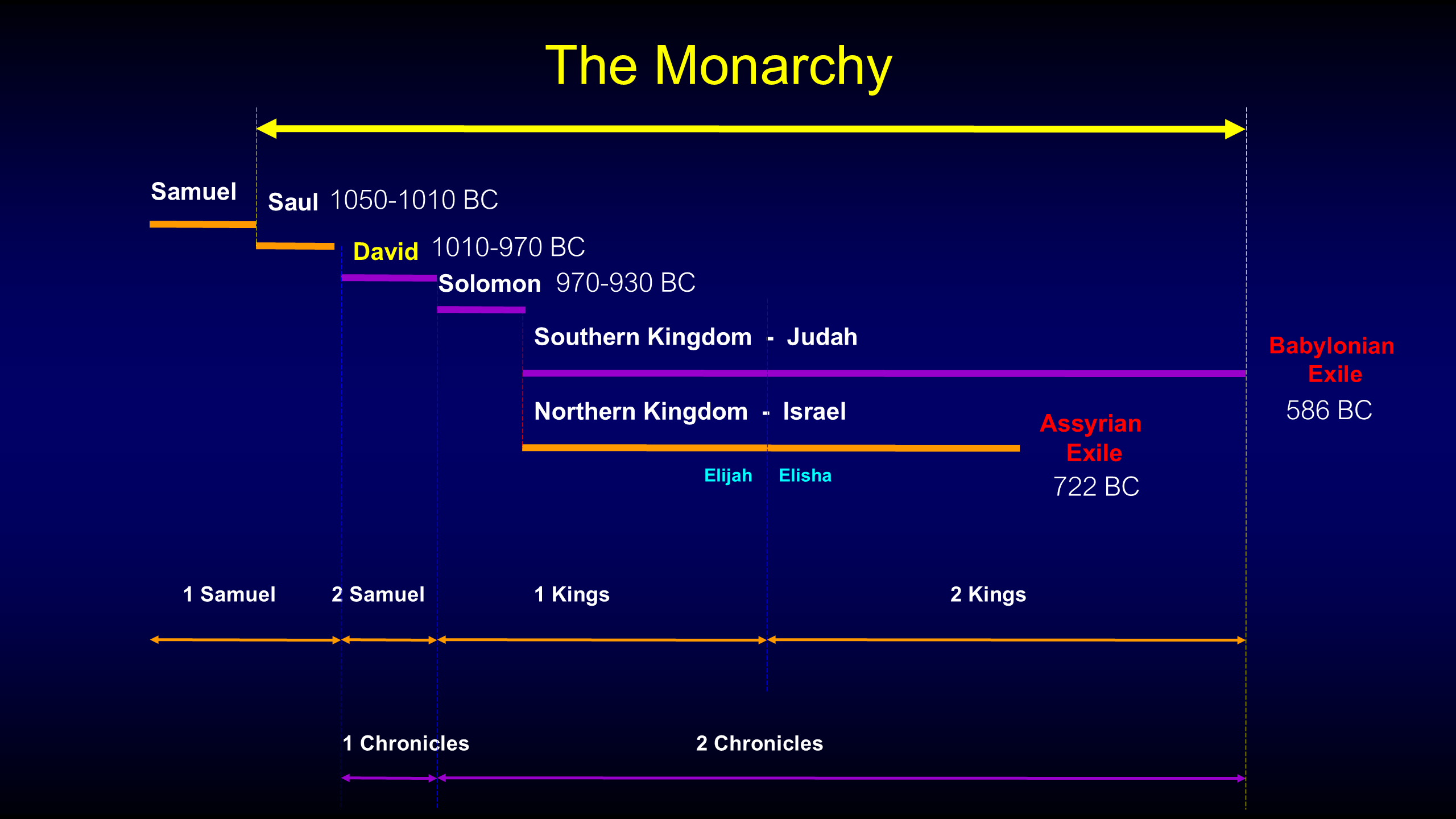
And this is where Saul, Paul tells us, served forty years. That’s what Paul said in Acts in one of his messages, he says that King after King Saul served for forty years, so there’s Saul’s reign. David served forty years. Solomon served for forty years, and we’re right there at the end of that hundred and twentieth year of the monarchy. And of course, Solomon’s son, it split the Northern Kingdom was conquered and viciously, killed and dragged away into captivity by the Assyrians, and then the Babylonians came and finished off the Southern Kingdom in 586. And you can see the books that are written there.
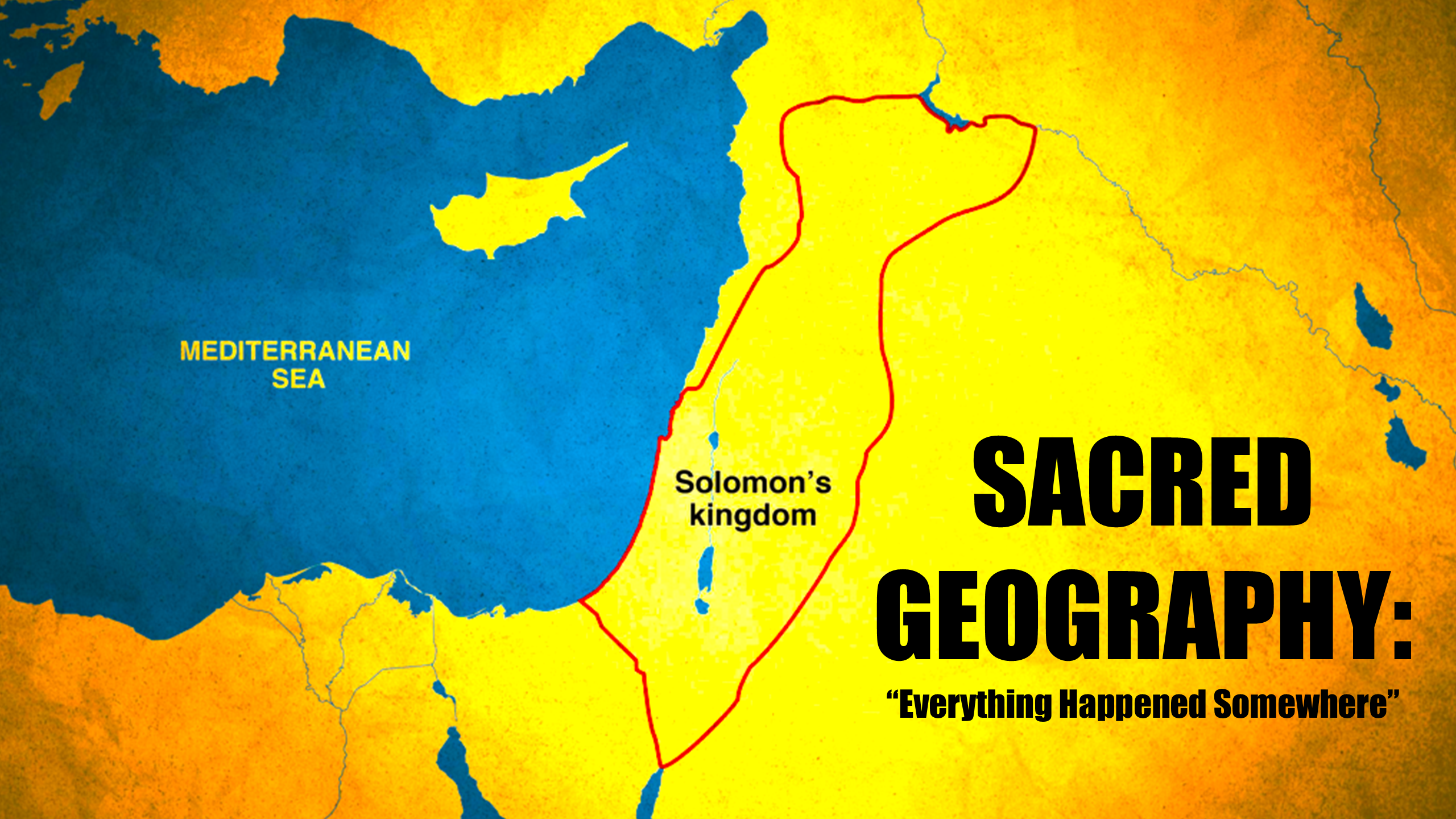
But what is the Biblical context for Solomon? Think of sitting behind the books that Solomon wrote and looking through them at the history behind them, what we’re sure of the Bible reveals is Solomon’s reputation was widespread throughout the ancient world. Do you remember the Queen of Sheba heard about him? She lived a thousand miles away and she traveled through the deserts to come see him because all the traitors were talking about this guy in Jerusalem. His fleet was known to all the ports of the world. The Bible tells us that they brought back all these exotic animals and woods and everything else. The ships were based in Elath, and they would go from what we would say, modern day Gibraltar, all the way around the horn of Africa, because when you read what they were bringing on a map, they were traversing all the known world of the day. So, into Solomon’s court were vast and rare treasures, exotic goods from the fabled east and all these animals, things from the jungles of Africa. What’d he get? Ivory. And he made his beautiful throne out of it. Vast caravans were coming and bringing, because he was like a focus of wealth and accomplishment.
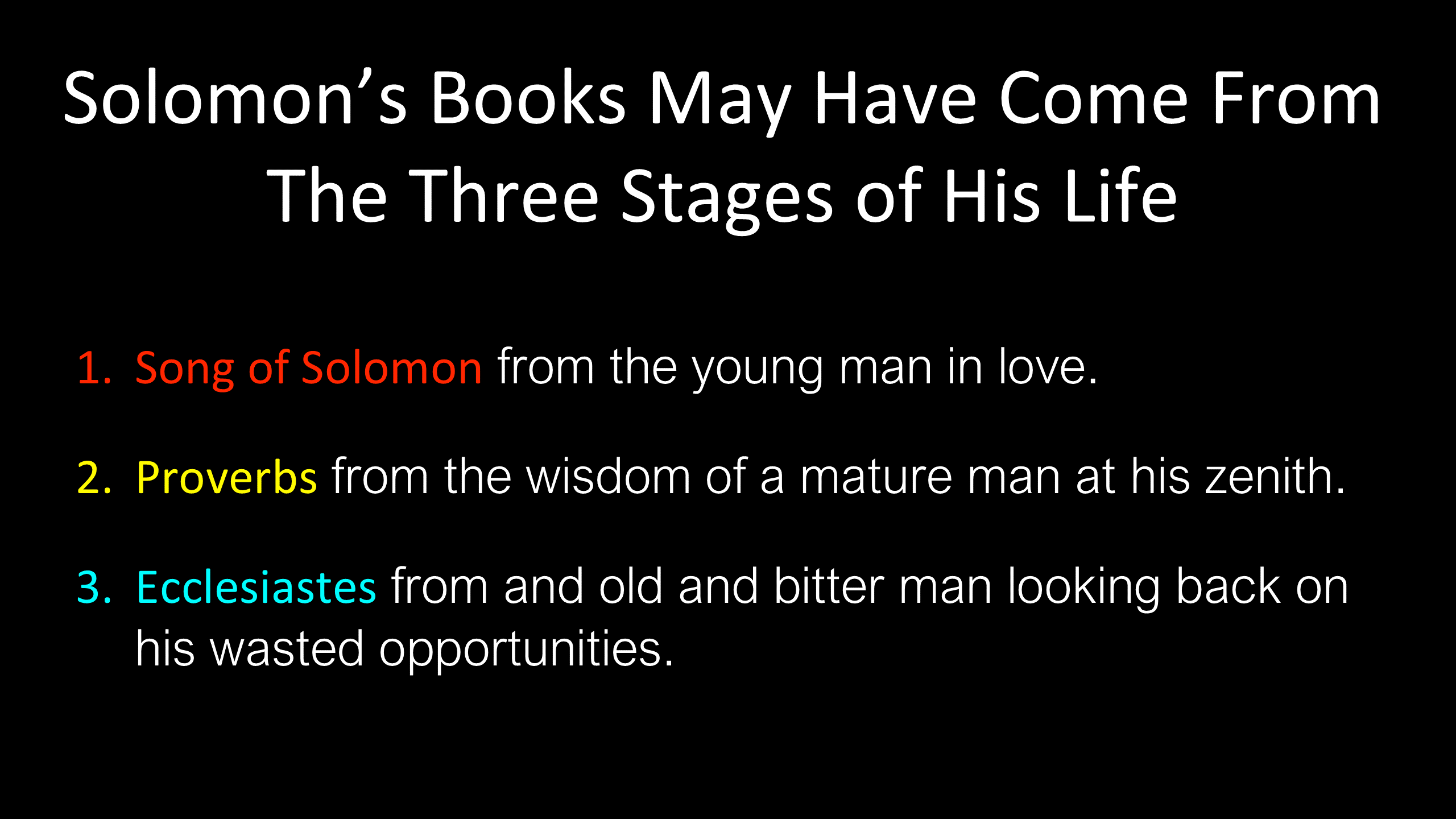
And Solomon wrote three books. God used him, inspired him to write three books, and most likely those books kind of mark the stages of his life. First the Song of Solomon is from the young man in love, canticles it’s called, or The Song of Solomon. I love that. When I teach that book, one of the most amazing parts, I mean, it’s an amazing book. And there’s the whole us being engaged to Christ, and all the beauties of that. But there’s also the beauties of marital love and they’re both beautifully packaged. But do you know the short version of Song of Solomon? They didn’t have Facebook then. So, most people had never seen Solomon. He was the king. He inherited that huge wealth. He had farms all over the place and he went to work in one of his vineyards briefly. Remember he was always pursuing knowledge and everything and he wanted to see how the whole grape deal worked. And so, he went to work in the vineyard and he’s on one side of the grapevines, tying them and trimming them. And there’s this young lady on the other side and they get to be really good friends. If you read Song of Solomon, they’re really good friends and all of a sudden, he disappears. And by the time you get to, you know about the eighth chapter, she’s going crazy. She said, I thought you loved me, and you went away and all this stuff. And all of a sudden, while she’s going through that storm, the boss of the vineyard says, watch out. The owners coming today. And everyone, lined up. And the owner happened to be the king of Israel. And it describes him coming with all of his armor and the headdress he was wearing. And all the horses. And he comes on his chariot and all the workers stand like this, because he’s the owner and the king, and he comes inspecting the troops and he gets down the line and he takes his helmet off and he looks into the eyes of one of the workers that he had been trimming with, and she goes, you are [Dr. Barnett uses body language to emphasize her shock]?. He went [Dr. Barnett uses body language to emphasize Solomon’s reply]. That’s the happy ending. They’re happily ever after, at least for a while. She’s only one of a thousand of his wives, but it’s a great story. And that’s the song of Solomon.
What we’re looking at is Proverbs. It’s from the mature man at his zenith. The book of Proverbs is the wisdom of the man that the whole world is coming to, and he’s seeing God’s power and then Ecclesiastes is from an old and bitter man, looking back. Ecclesiastes is not one of the more, it’s a philosophy, a theology actually of life. Song Solomon is a theology of love. Proverbs is a theology of living. Ecclesiastes is a framework, a philosophical framework of life. But when Solomon gets, his personal tenor of this book is old, bitter regretful kind of book.
But how does Solomon, now we’re down the last twelve minutes because this is the essence, how did Solomon ruin his life? The Bible tells us very clearly. In fact, here’s another one. If you haven’t looked at Deuteronomy 17:18, I want to read it to you because this is part of all Scripture and it’s for all of us, but it was very clearly for Solomon, and this is what he neglected. Deuteronomy 17 and verse 18. “Also, it shall be. When he sits on the throne of his kingdom…” This is the rules from God through Moses to the future kings. Deuteronomy 17:18, “When he sits on the throne,” when he becomes the king in his kingdom, “he shall write for himself a copy of this law from the Book that’s before the priests,” the Levites.
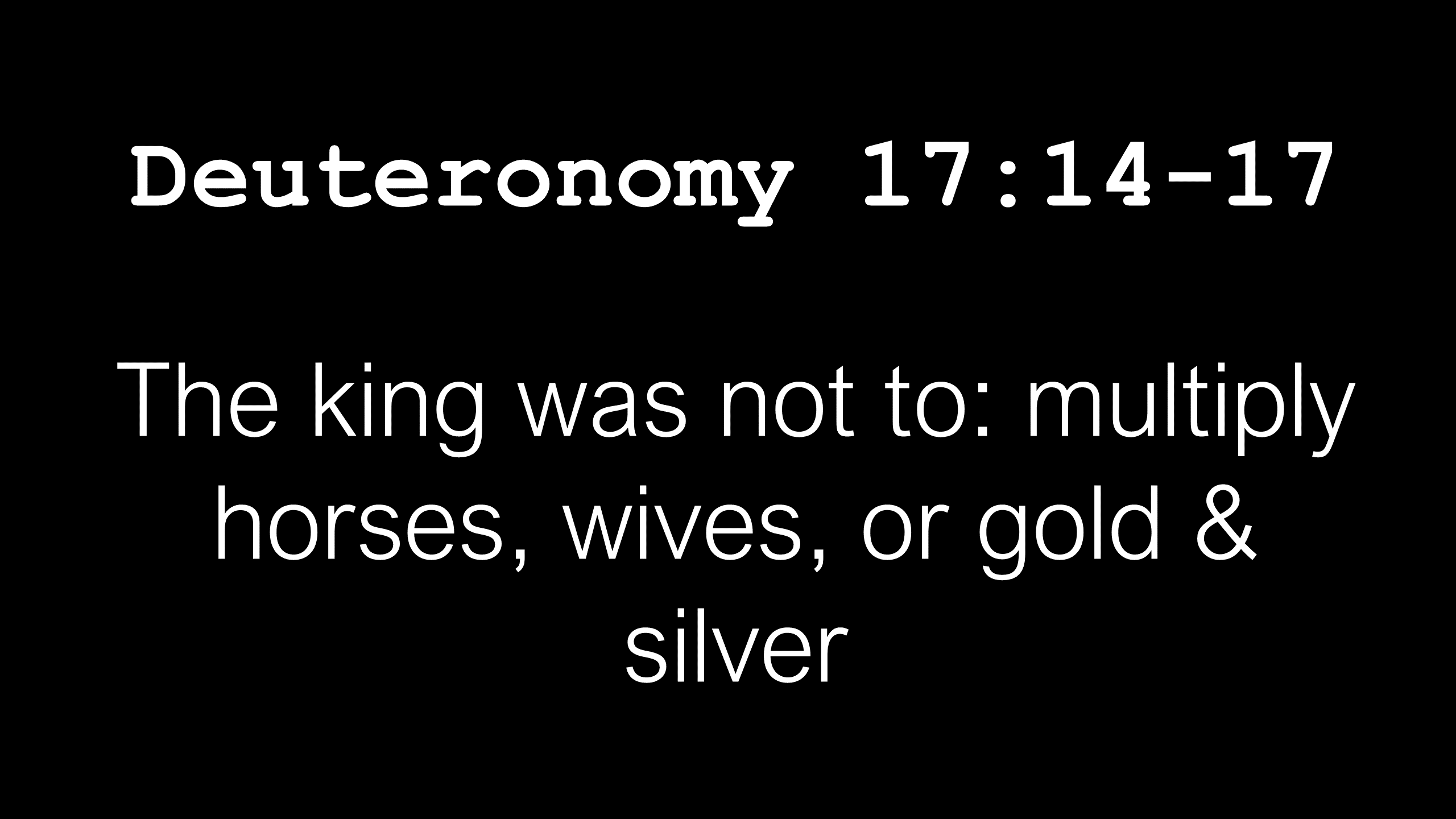
If Solomon had done that when he became king in 1 Kings 1:38 to 40, you know what he would’ve seen? He would’ve seen that the Bible says, don’t multiply horses, don’t multiply wives, don’t multiply gold and silver. In fact, if you look that’s starting in verse. 16 of Deuteronomy 17, “He shall not multiply horses.” Verse 17. “He shall not multiply wives,” again in verse 17. “Nor shall he greatly multiply gold and silver for himself.” What did Solomon do? All three of those disobeyed the Lord. Thousand wives, chariot cities with thousands of horses, and gold and silver so much that silver was like stones on the ground. They had so much of it, it was like too much, and it was not even special. Gold was starting to lose its luster. He had so much of everything.
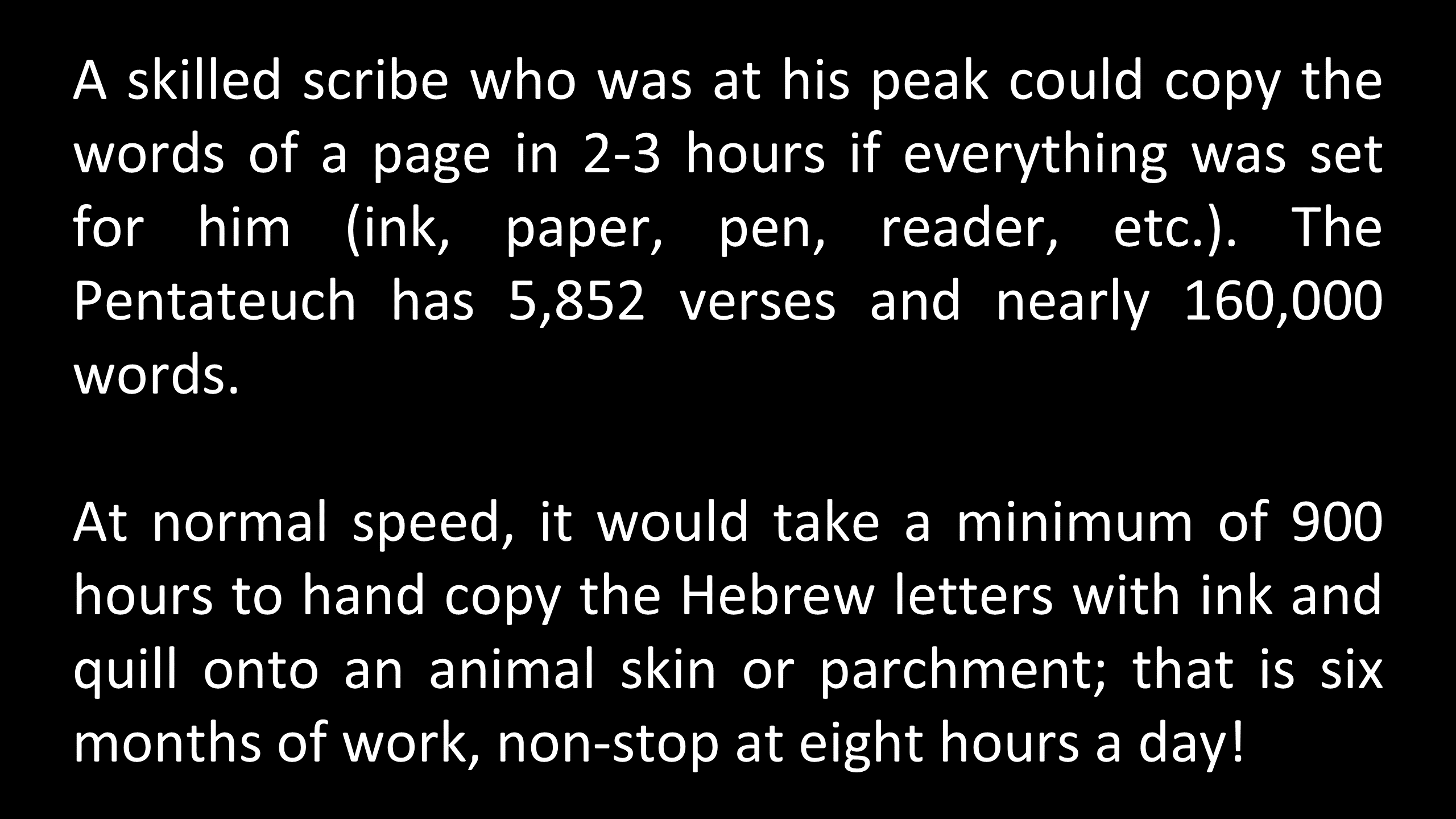
The wisdom that God gave to Solomon, he neglected to obey it. When he became the king, he didn’t follow God’s road that God had left for him. Let’s just basically think about what the Lord asked him to do. When he became King, he was supposed to make this copy. Personally, make a copy of the Bible. A skilled scribe who is at his peak, could copy the words of a page in two to three hours if everything was set out for him. If he had his ink, his paper, or parchments or whatever, a pen, a reader to read it to him. The Pentateuch, that’s what the king was supposed to copy, that’s the first five books.
If you, in my Bible, if I go through the end of Deuteronomy, it’s 192 pages. It’s that much to copy those 5,852 verses, almost 160,000 words. At a minimum, if you had no problems and you were really sharp, it would take you nine hundred hours. Now think about it, 192 pages, 5,852 verses, 160,000 words, nine hundred hours, which would be six months of eight-hour days.
God says, when you’re becoming king, that’s your high priority. Before you start ruling, do that. You know what most of us would say, too much work. That’s too hard. That’s inconvenient. I’m going to be king. I’ve got to get my mansion. I’ve got to get my army. I’ve got to get my wives. I’ve got to get my wealth. I’ve got to protect my people. You want me to spend eight hours a day for the first six months of my all-important reign, copying the Bible? God warned those who wanted to be useful, that there were pitfalls and temptations and distractions that would limit their usefulness and lessen their rewards, and he wanted them to get the Bible, His Word, from His mouth into their life.
Deuteronomy 17:14 to 17, the king was not to multiply horses, wives, or gold or silver, and he disobeyed all three. It also appears he didn’t do this. He didn’t. He didn’t do the copying deal. There’s no talk of it. You know what we see David doing is he’s really into, he not only knew the Scriptures, he’s quoting them, he’s singing them, he’s writing songs about the Scripture. David was into this. Solomon, not so much. What did God want him to do?
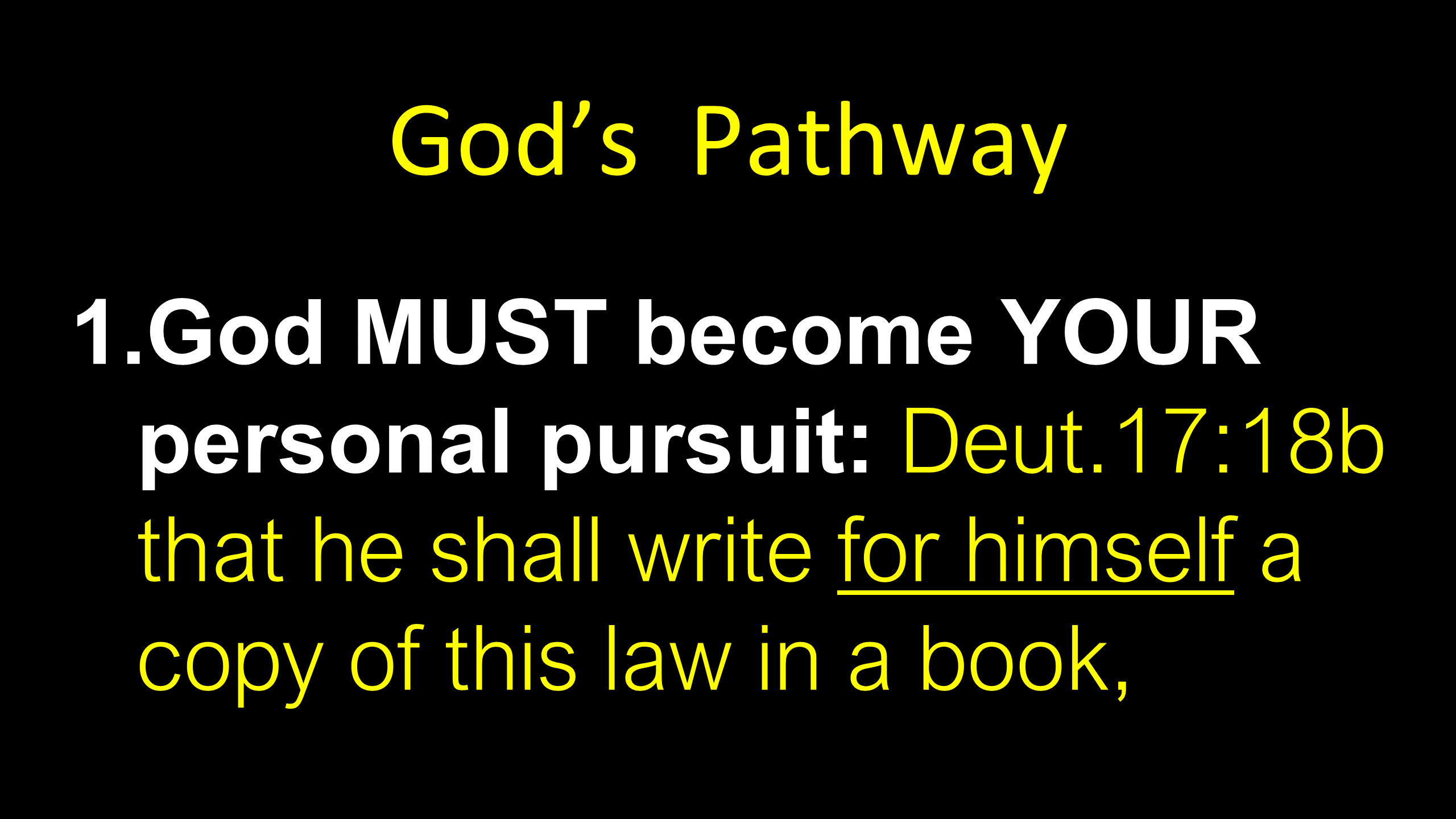
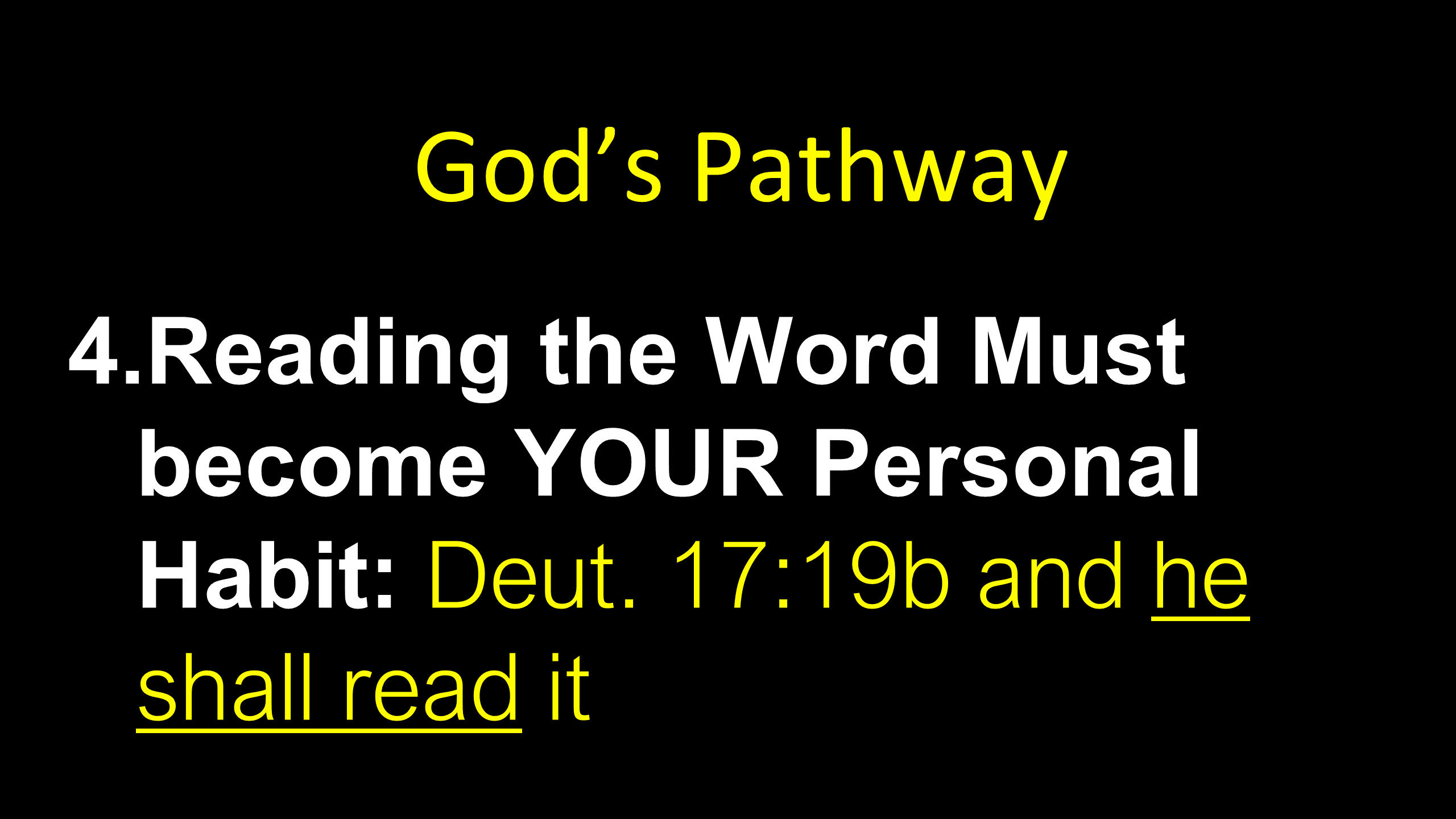
Just real quickly, let me take you through Deuteronomy 17. God must become your personal pursuit. It says in Deuteronomy 17:18, he shall write for himself. This is not for the nation. The way God wants Solomon to be successful is for him to personally pursue the Lord. God pursued him. God revealed Himself to him. God had these dreams and visions and ask him what he wanted, so God did His part. He showed Himself to Solomon and He asked Psalm, do one thing. I want you to pursue Me.
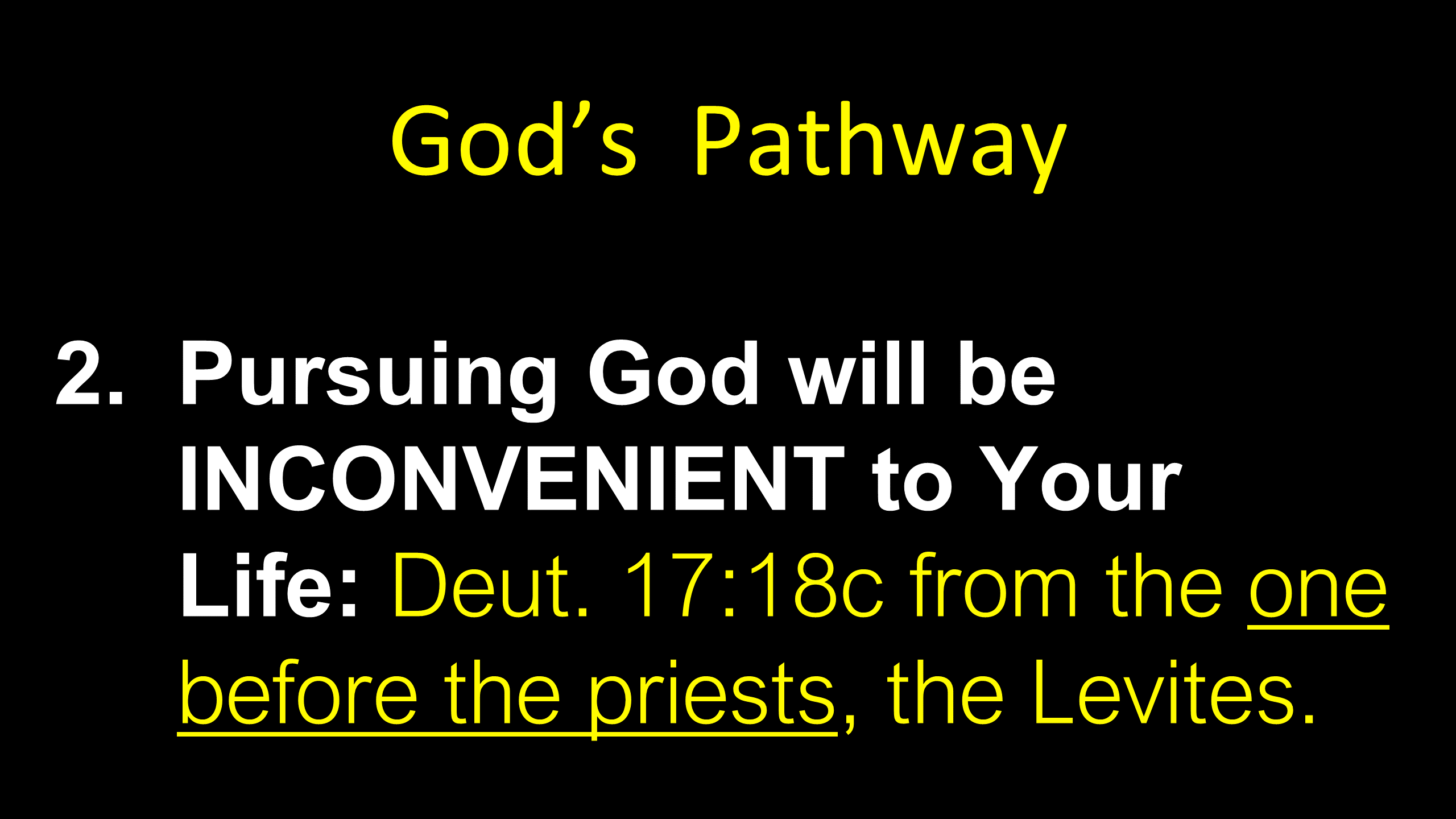
The second thing He asked him; he was supposed to copy a Book that you only could find in one place. So, God wanted him to get out of his palace and go over to that tent where all the animal smells were, where there’s blood splattered everywhere, where it smells like burning animals and those priests, and get the book that’s before the priest. Now, how do we know our Bible has been preserved? Because it was always in the possessions of the priests, and the prophets. It was kept in the Tabernacle. It was kept in the Temple. That’s where each time, what Moses wrote and what Joshua added on, and everything that Samuel wrote all the way through, was kept. And they kept it before the priest. It was kept in the Tent; it was kept in the Tabernacle. It was kept later in the Temple. And when the Temple was destroyed, the priest took it. And you remember, they went back and had hidden it, and Hilkiah found it, hidden in the Temple. Pursuing God was very inconvenient. The priests weren’t supposed to bring it to him. He was supposed to go there. And so, for the beginning of his kingship, he was supposed to be constantly going to the place of the presence of God, and all of a sudden, the nation would’ve seen, wow. It’s every day he keeps going over there and he’s pouring over those old scrolls, what is going on? It was very inconvenient to seek God. It still is. Do you ever think of that? It’s hard. It’s so easy to just, go online, watch the television, do whatever. It’s very inconvenient to go into the presence of the Lord.
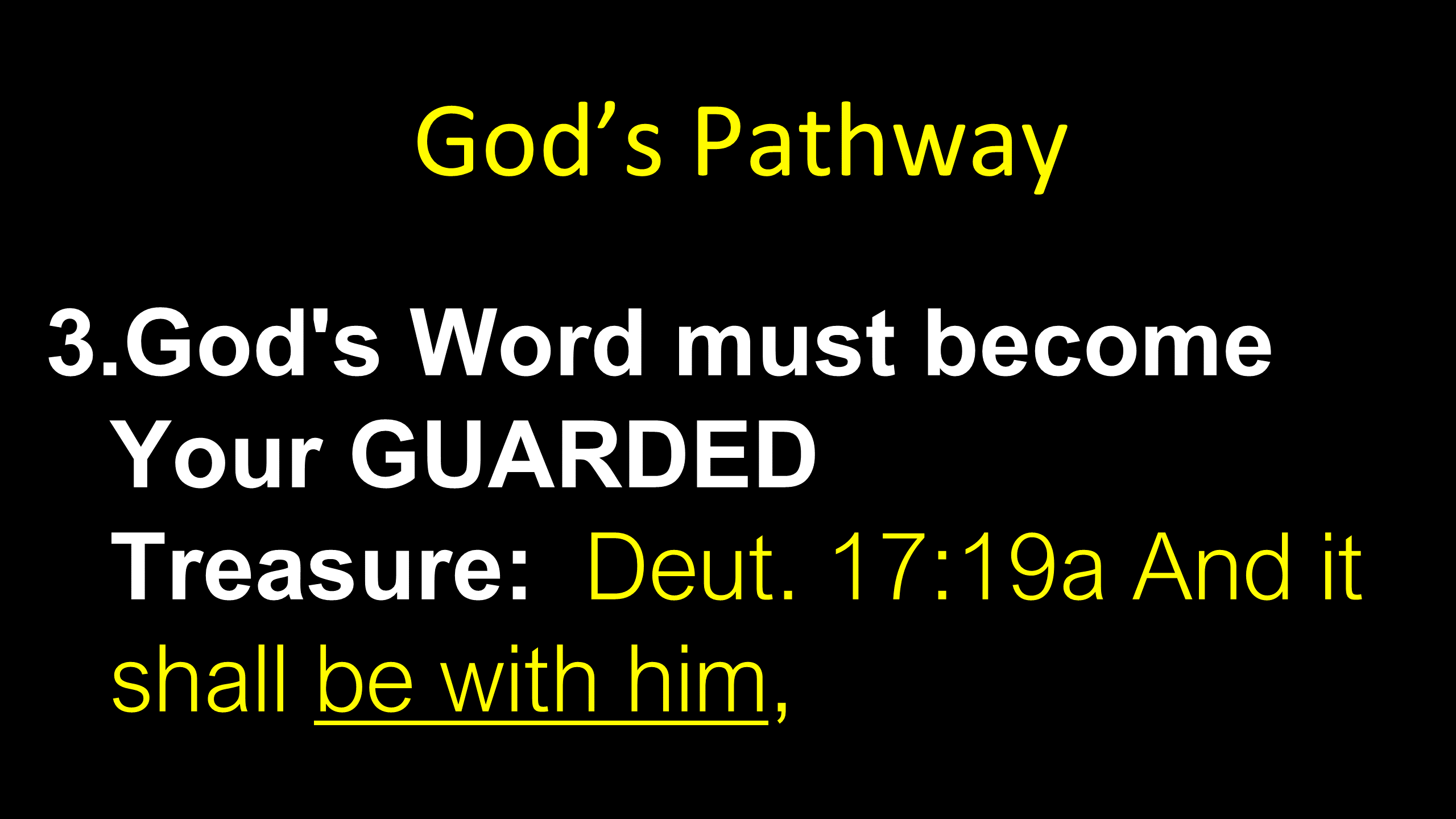
The third thing, God’s Word must be guarded. It shall be with him. This copy he was making; he was supposed to keep it with him. He was supposed to travel around with it. Amazing. It was his guarded treasure.
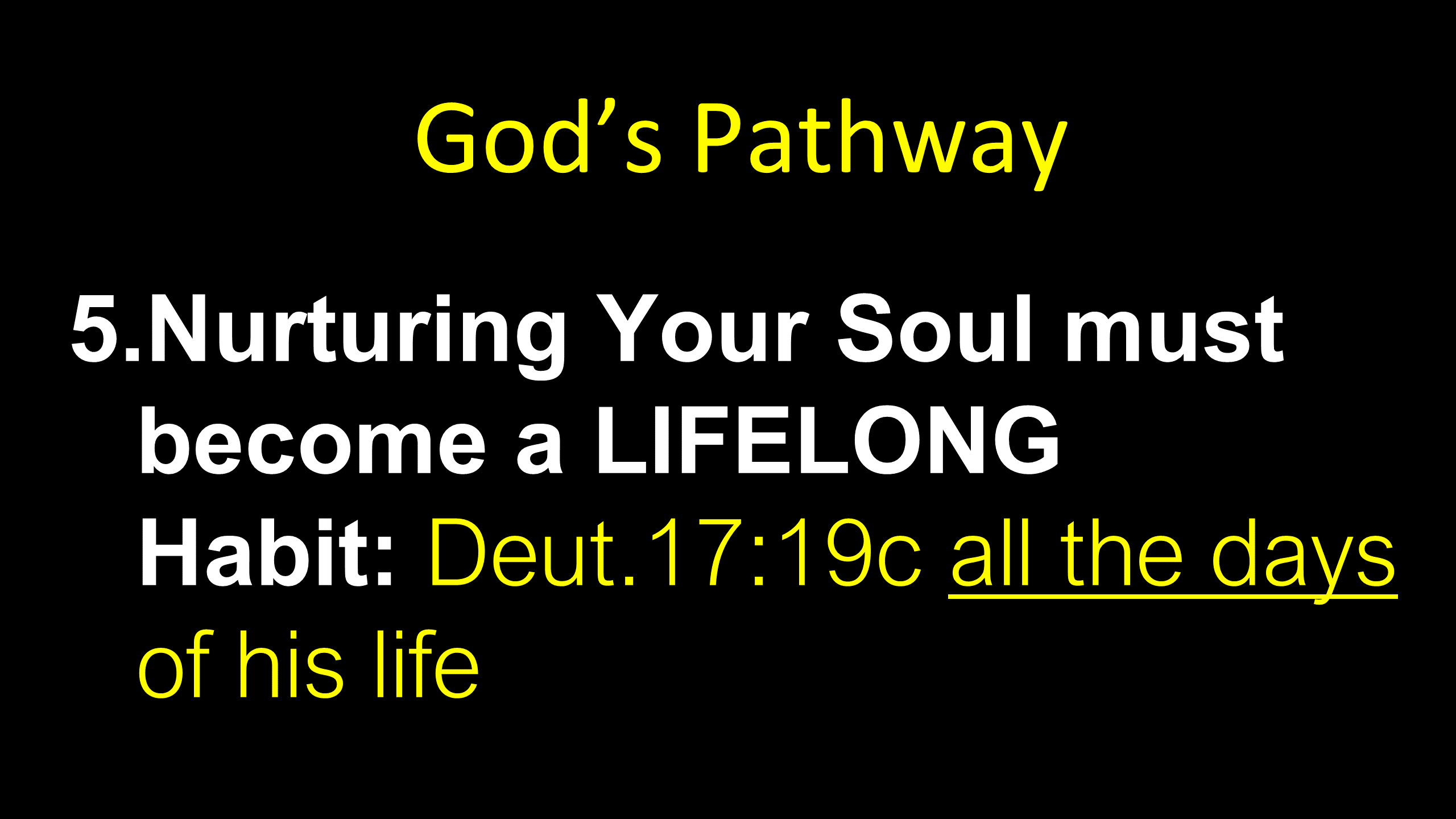
The Word was so important to him, and you don’t just carry it, read it. He was supposed to become a lifelong lover of the Scriptures. Reading the word must become, God said to Solomon, your personal habit, you should treasure it. You should seek Me through it. You should guard it, and it’s supposed to be lifelong.
All the days of his life, he was supposed to be carrying around this Book, reading this Book, treasuring this Book. It was a lifelong habit.
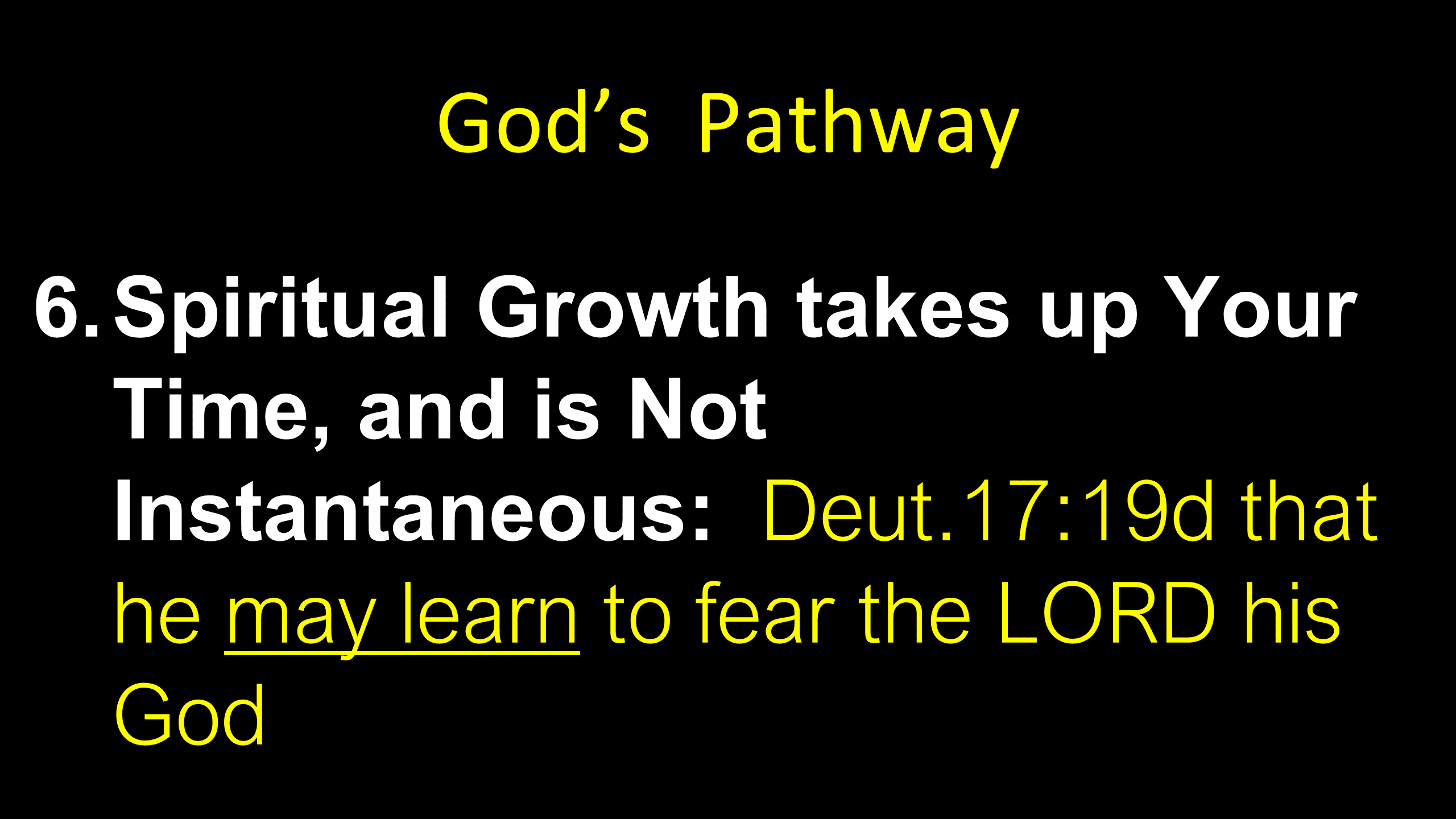
It continues in verse 19. Why? Spiritual growth isn’t instantaneous. This guy heard the voice of God. Solomon did. He had this vision twice with the Lord. He had all the this around him. But Spiritual growth takes time and it’s not instantaneous. God says, you’re going to learn to fear the Lord through this process of this writing and reading and carrying around.
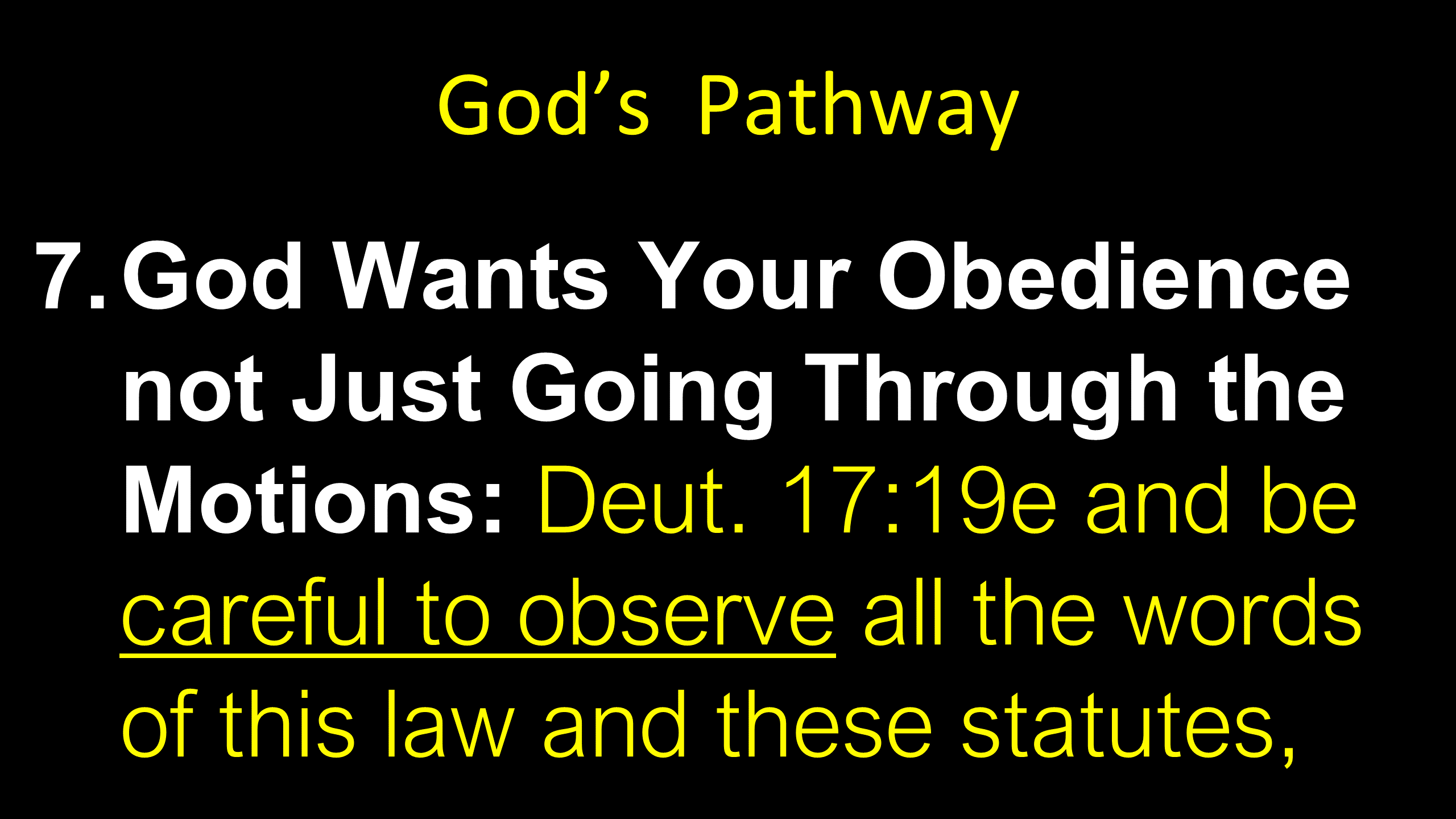
God wants your obedience not just going through the motions. Verse 19 continues and be careful to observe all of this law and these statutes. God says, I want you. I want you pondering My desires, how you can fulfill them.
Number eight, I love this. And a couple days from now, we’re going to, this is the next theme we’ll see in Proverbs about humility and pride and that whole thing. God expects us to choose humility. Deuteronomy 17:20, the first part of it says that “his heart may not be lifted above his brethren”. Did you know it’s very easy if you’re king to have your heart lifted above your brethren? It is also very easy if you’re a leader, if you’re a corporate person, if you’re an owner, if you’re a titan in business or whatever, it’s very easy if you’re in the ministry. The clergy-laity, clergy-laity. That was one of the earliest controversies in the church, and that’s why the apostle Peter said, clothe your, he uses the word for tying around the apron of a slave. That’s 1 Peter 5; elders are supposed to tie on the apron of slave wore. The way Paul put it is this, he said, “Therefore is the elect of God, holy and beloved, put on humility.”
See, humility is kind of like this shirt. I’m prone to habit and when I travel, and Bonnie and I travel constantly, I would wear the same thing every day. Bonnie told me that I’m, you could ask her afterward. I would wear the same thing every day. You know what she does? She hides my clothes. They disappear, and I go, where is? She goes. That one is washed, that one is ironed, that one is now, you can’t have that other one. It’s going to be washed, or whatever. Did you know I went this morning and opened quietly and looked, and she had them ironed and ready and they were right there, and I looked, and my shirt from yesterday was gone. There was this one. What did I do? I chose to close myself with this shirt. Did you know that’s what God says humility is? “Put on, therefore, as the elect of God, holy and beloved, humility”. We have to choose that our heart not be lifted up, that we not think life is about us, that we not think that everything focuses on us, that we look not merely on our own things, but on the things of others.
And then, the last one, God expects us not only to choose humility, the king was supposed to do that, but He wants us to submit Deuteronomy 17:20, “that he might not turn aside from the commandment to the right hand or to the left.”
And what would happen if he does that? That he might prolong his days. It’s a blessing from God to have this lifestyle. And his children would be blessed in the midst of Israel.
If you know the story, there’s a stark contrast. David ended his life giving everything to the Lord and to Solomon, and his life is summarized in the Psalms. Solomon ended his life with his son being very proud and pompous and splitting the kingdom. David invested his life with God. The 23rd Psalm is like his testimony of what life is like.
God wrote his epitaph. Did you know that? Acts 13. It says, when David had served God’s purpose in his generation, God. That’s the inspired Scripture of Acts 13:22. The man after My own heart, 13:36, he fulfilled My purposes. God’s epitaph was David was after My heart and fulfilled My purposes.
What’s Solomon’s epitaph? The last thing he wrote is Ecclesiastes 12. Have you read that lately? It says you’re going to get old and sore and nothing’s going to work, and the windows aren’t going to work. And the ears aren’t going to, the eyes, the ears, the digestive system, the pump, it describes every system of the body. They’re all going to wear out. And you’re going to say that life was vain, and Solomon was wise. He said old age is difficult and hard and evil. Solomon’s inspired look at the pains and fears and troubles of old age as a remarkable portrait of what all of us have to face. It’s a nice reminder that life is hard, but how did David put it? He says, hey, I’m looking forward that, that the Good Shepherd has led me my whole life. And He’s prepared a place for me. He’s going to take me home, and I will dwell in the house of the Lord forever. And Solomon said the bloom is fading and the chompers don’t work, et cetera, et cetera.
Do you know what the message of Proverbs really is for us? Don’t ruin your life like Solomon. Every day is a choice. Be selective.
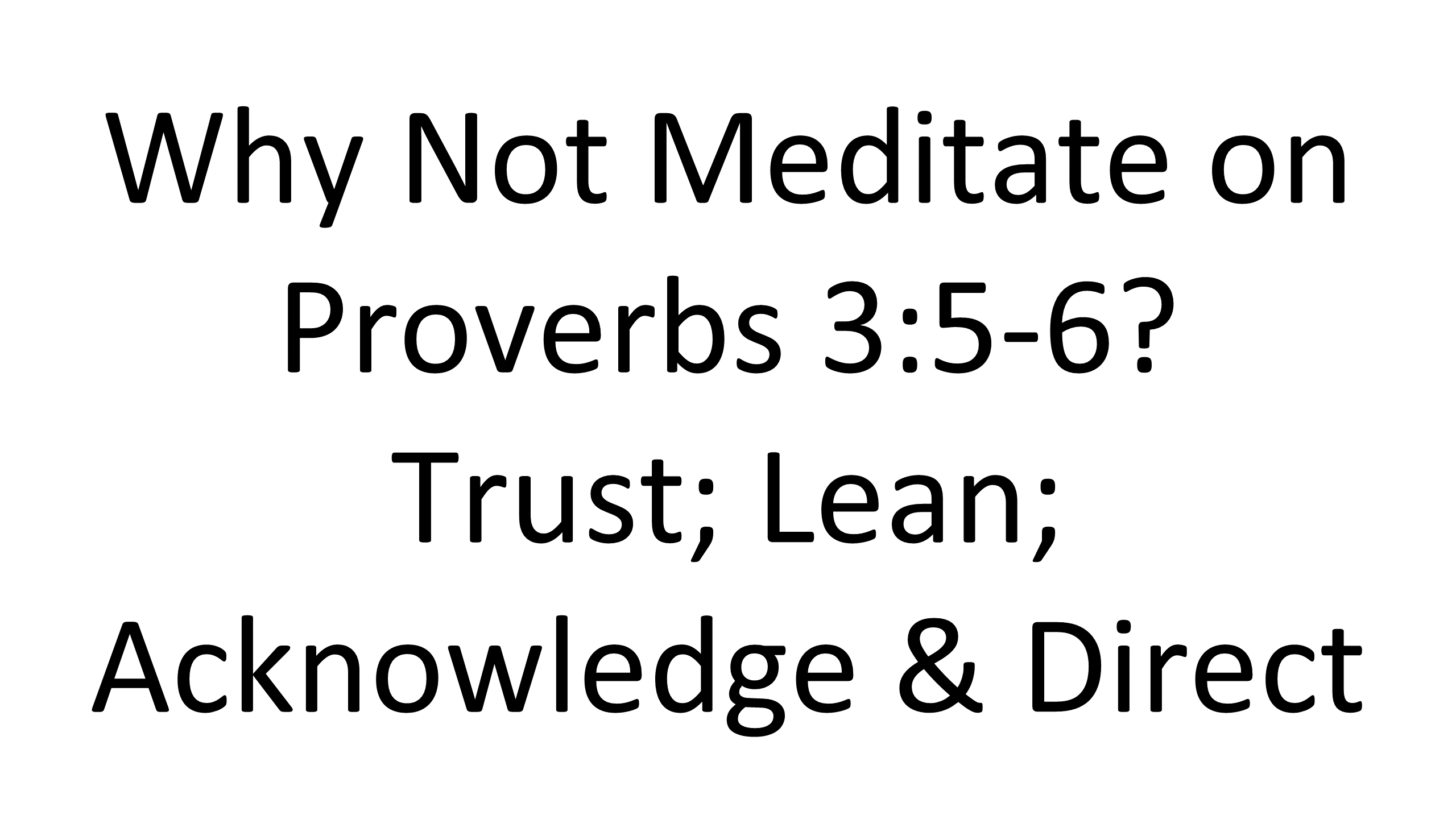
What’s one of the best ways to remind ourselves? The best-known verse. And I’m going to close with this: a Hebrew lesson on four words in Proverbs 3. God designed your DNA and mine. He knows our length of days. He knows the details of our life. He has a perfect plan. He only asks one thing. Follow Me.
Trust in Hebrew means to lie helplessly face down. So that first part of trust in the Lord means I come to the Lord, absolutely unable to navigate the difficulties of life and I fall before Him. I lie down and I say, Lord, I trust You. I come in submission and humility.
Lean not on your own understanding means don’t support yourself. Lean not means allow God to hold you up. So don’t lean on yourself to make through life. We have to lean on something. God says, lean on Me, so trust means come totally, needy. Lean means cling to Him, not the walker, not the cane, to Him. You understand what I mean? Metaphorically.
Acknowledge means be aware of God, the knowledge of God, fellowship, communion. In all your ways acknowledge Him. That means I want to; I want You to infiltrate every part of my life. It’s like, letting Him in everywhere. That old “My Heart, Christ Home” by Robert Boyd Munger, that poem, that little booklet.
And He shall direct your paths, that word means guide. Have you ever been on a cave, or anything treacherous? You really stay behind the guide. You don’t know how to get out of there. You don’t know how to navigate it. God says I want to be the guide. That was yesterday, Psalm 16:11. “You show me the path of life.” So, God says, meditate on trusting Me, coming helplessly, leaning on Me. Don’t hold yourself up, cling to Me. Acknowledge Me. Let Me infiltrate your mind to have that Book ever with you. Constantly invite Me, My wisdom from My mouth, and I’ll guide you through life.
So really the lesson from Solomon, the second word of Proverbs is, don’t ruin your life like Solomon did. How? Let God be your guide. Let God select your friends. Let God give you the wisdom from above, and as we’ll see in the next few days, it affects every part of life. The way we talk, the way we meditate on things, what we invest our time in, our money, all of our relationships. God says, I want to be a part of all of it.
Let’s bow for word of prayer and ask for the Lord to lead us. Father in Heaven, I thank You for Solomon and for giving us so much insight into his life. He had it all and he squandered most of it and ended up being an example of someone that started so well, and didn’t finish well. And I thank You that the very last thing he wrote down is, remember now thy Creator in the days of thy youth, when it’s early on, when you’re making those decisions so that at the end we can hear the conclusion of the whole matter. All that matters is fear God and keep His commandments. For that’s the whole duty of man. We’re so glad that Solomon, at least his last written words, were right. And he said to do what Your Word says to follow You. So, I pray we would, and I pray that You would stir our hearts to be even more engaged in Your Word, and the lives of others, and sharing, and encouraging, and exhorting, and upholding one another, as we go through this life together. In the precious name of Jesus, we pray, and all God’s people said, amen.