
If the video above is not available, here are two other ways to view:
Imperatives of the Crucified Life
060319PM
DSS-16
Transcript
.jpg)
1 Corinthians 11, from 17 all the way down through verse 34, is the instruction; the New Testament ordinance, as we call it. It was mandated to be perpetually observed in the Church with communion, and that is wonderfully portrayed starting in verse 17 through 34. You follow along, and I will read this.
.jpg)
Now, in giving these instructions, I do not praise you since you come together, not for the better, but for the worse. First of all, when you come together as a church, I hear there are divisions among you, and in part I believe it. Remember, the communion was supposed to be a time, it says in chapter 10, that we partake of one bread and one cup. It’s when we remember our oneness. He’s saying, you’re not remembering your oneness in verses 17 and 18.
Verse 19, for there must also be factions among you that those who are approved may be recognized among you. Therefore, when you come together in one place, it is not to eat the Lord’s supper. For in eating, each one takes his own supper ahead of others, and one is hungry, and another is drunk. I can just imagine this. Remember, the Church had everything from slaves to senators. So, they were coming in for these banquets, and everyone brought what they were used to.
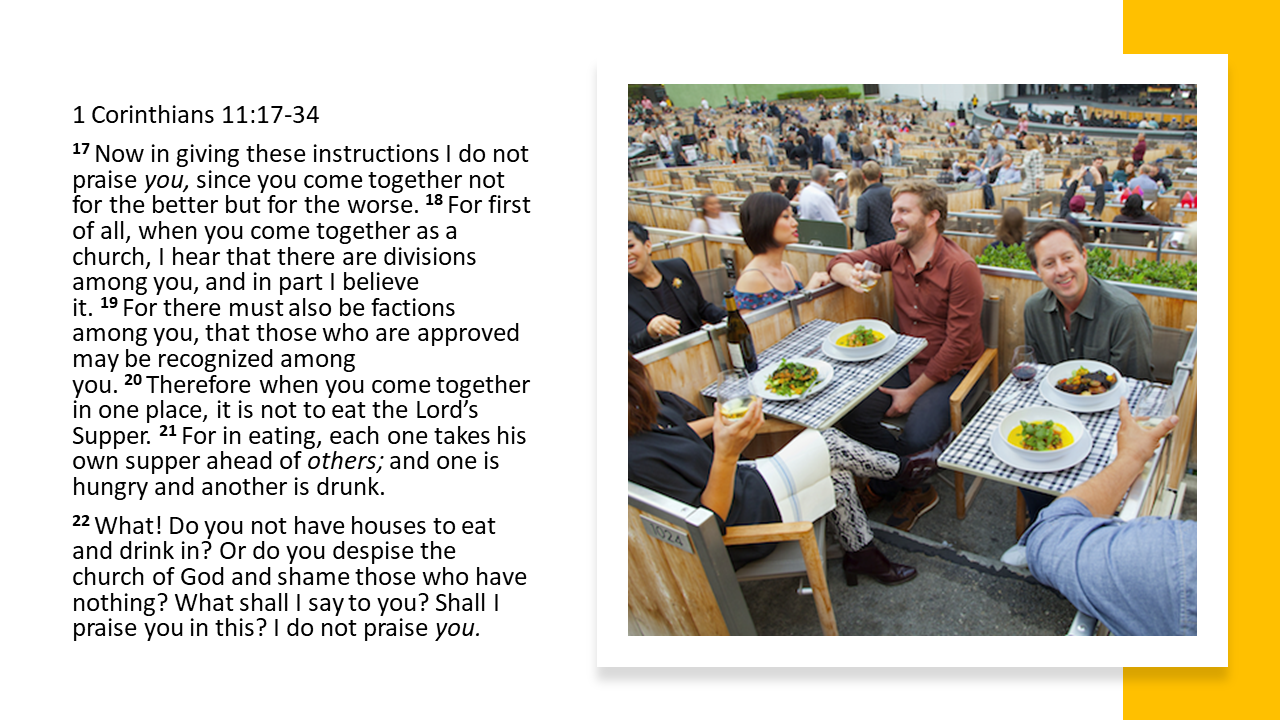
Once when we were at Grace, we used to take the senior citizens to the Hollywood Bowl, if you’ve ever heard of that. It was a big concert, but it was made in such a way that you brought your own meal. You would just set up at the Hollywood Bowl and watch the concert, and you would eat. You had all these different places. People would bring candelabras, they’d have candlelight, and those things that have ice in them with big bottles of stuff sticking out. Other people would be munching on a Whataburger; they don’t have Whataburger, it’s called In-N-Out Burger over there. They were eating, and it reminded me of communion right here.
Some would take their supper ahead of others. One is hungry, verse 21; another is drunk. In other words, there was no thought. They didn’t come thinking of the others. They didn’t come, not wanting to offend or trouble the others. They just came and did their thing, and it was totally individual; it wasn’t a unity. Verse 22, what? Do you not have houses to eat and drink in? Or do you despise the Church of God and shame those who have nothing? What shall I say to you? Shall I praise you in this? I do not praise you. So, that was the agape feast, and it wasn’t very agape-ish. That’s self-sacrificing love, and they weren’t doing that. So, he just chided them and bawled them out for that.
.jpg)
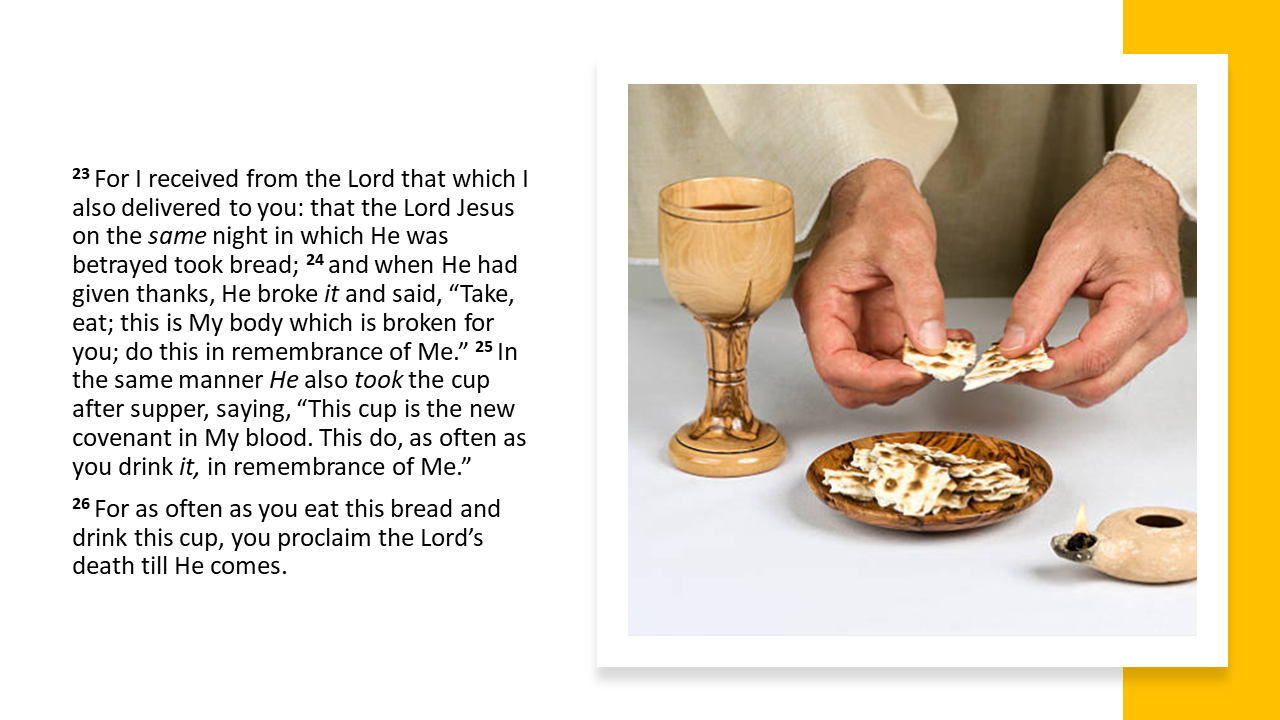
Now, in verse 23, for I received from the Lord that which also I delivered to you, that the Lord Jesus, on the same night in which He was betrayed, took bread. Remember that was a part of the Passover meal. On the same night, just before the crucifixion, just before the resurrection. And when He had given thanks, verse 24, He broke it, and He said, take, eat, this is My body, which is broken for you. Do this in remembrance of Me.
Now, in verse 23, he said, I received from the Lord. The first facet of communion is that we look at it from the perspective of the Lord. We look upward, and we think this is a gift from the Lord that we celebrate communion. The first facet is that we were invited by the Lord. So, that’s the upward aspect. But in verse 24, we do this in remembrance of Him. The important part of communion, after we realize the Lord invited us, is to look back because communion is looking back at the fact that He gave Himself for me. That’s a past event, and so we, because He said that, do this in remembrance of Him. He gave Himself. He died in our place. He shed His blood for my sins and for yours.
Verse 25. In the same manner also, He took the cup after supper, that’s after the Passover supper. He had already eaten the meal, and this was something new, He added. He took the cup, and He said, this cup is the new covenant in My blood. Do this as often as you drink it in remembrance of Me. That backward look back at the cross again. For as often as you eat this bread and drink this cup, you proclaim the Lord’s death.
Now, He turns us to look in a different direction. We looked at God who invited us, and we look back at the cross. But now, look what He says, until He comes. Communion is when we look all the way forward. It’s kind of like when we realign our sights. It’s when we remember what we’re here for. Thank You for inviting us. We remember the cross. Then Jesus said, I’m coming for you. It’s like all of a sudden, we have what we’re here for, reminding us again.
.jpg)
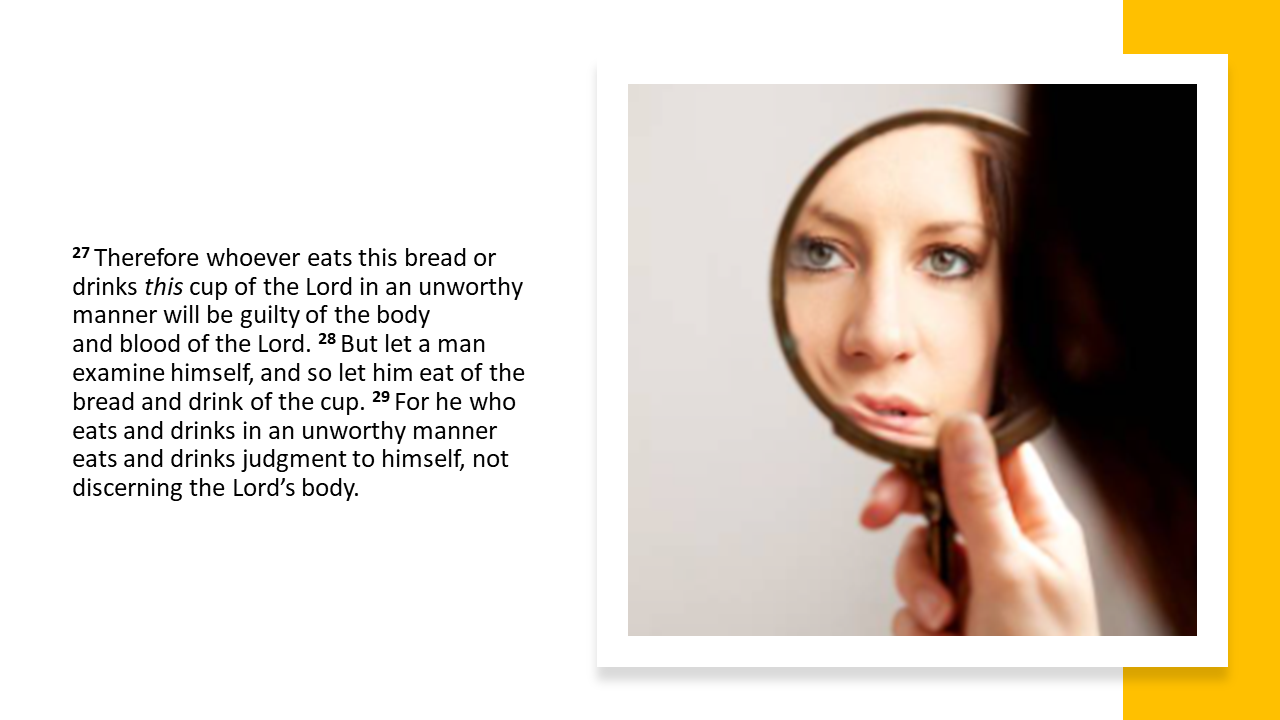
Now, verse 27. Now comes the part that often we fail to do, and that’s the other look: up at God who invited us, back at Christ who suffered for us, forward until He comes. We’re supposed to live for Him, but there’s an impediment. We can’t do that if we don’t do that final step, and that’s this inward look. Verse 27, whoever therefore eats this bread or drinks this cup in an unworthy manner will be guilty of the body and blood of the Lord. So, if you don’t want to incur guilt or wrath, verse 28 says, but let a man examine himself. Much about communion is this inward look. It’s not when we look at each other, it’s when we look inside, and we say, Lord, I want to examine myself.
And let him eat the bread and drink the cup for he who eats and drinks in an unworthy manner eats and drinks judgment to himself, not discerning the Lord’s body. In other words, because the Lord is holy, we’re supposed to be holy, and we’re supposed to have clean hands and pure hearts. So, if we haven’t gotten cleaned up, then there’s going to be a response from the Lord, basically chastisement for us if we come in an unworthy manner. So, verse 30 explains that.
.jpg)
This is one of the several passages: here, in James 5, in 1 John 5, and in Revelation 2 are all places this is brought up. For this reason, many are weak and sick among you, and many sleep.
Now, what is the context of that? Was it a sickly, unhealthy congregation? No, it was a congregation that way back up in verses 17 to 22 was uncaring, thoughtless, doing their own thing, wanting what they had, letting someone starve next to them when they had abundance. They were drunk and overeating while someone in the same body was starving. They didn’t care. They were unattached. They were uncaring. They were thoughtless. They were heartless. They didn’t have that mercy. But because of that, and because they didn’t crucify the flesh, which makes us say, hey, if they don’t have anything too bad. They don’t work hard enough. I work hard. It’s mine. That attitude that was not seen as fleshly and dealt with caused many to become weak. Verse 30, many modifies the next many, to become sick, and many to sleep. I don’t mean what I see on Sunday mornings now and then. I don’t mean falling asleep in the service. This is death.
This, by the way, happens to be the three stages of chastisement. God convicts, and if the person does not respond to that conviction, He starts, as it says in chapter 18 of Matthew, afflicting them, tormenting them, causing them to have problems. If there is no response to that, the next step right here is weakness. They can never get their strength up. Then there’s a sickness that there doesn’t seem to be any reason for, but it’s just a sickness that won’t go away. Some die what we would call a premature death.
If we were to judge ourselves, verse 31, we would not be judged. See, the Lord judges us if we don’t judge ourselves. If we don’t examine ourselves and turn from sin, repent of it, say no to sin, ask the Lord to remove it, come to our spiritual oncologist and say that selfishness has taken root and that malignancy, I want You to take away. Or lust has taken root, or this merciless spirit, or this uncaringness, which is what he’s talking about in 17 to 22. I am untouched by the needs of others, and I want You to remove that. I want to have a heart of compassion. I have a careless heart. If we don’t come to Him, then He said He will judge us. If we don’t want to be judged, we need to judge ourselves. That judgment is coming to the cross and seeing ourselves as He sees us.
If you’ve ever gone into a place where they have black lights so you can see the color coming out of rocks, you know how rocks turn colors when they have black lights on them or other things? You come into a science exhibit. I love walking into those because as soon as you walk in, all of a sudden, all the lint just is glowing on your clothes, or your shoestrings if they’re white, or these people that do the ultra-white bleach their teeth just glow in the dark. Anything white just glows on you. That reminds me that when we come before the Lord, and we come to the cross all of a sudden, we can see the flesh, the unmortified pockets of pride of us wanting comfort and convenience and security, and we think of ourselves and all those other manifestations of the flesh.
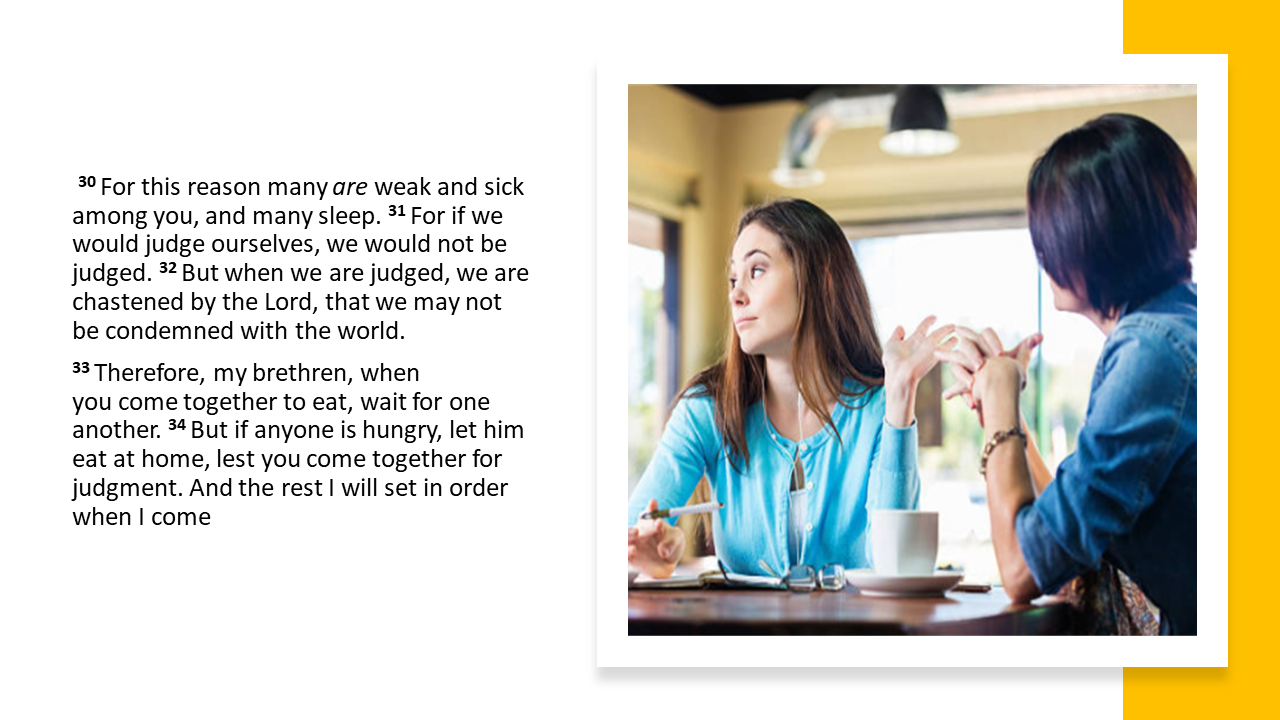
But if we, in verse 31, judge ourselves, we wouldn’t be judged. But when we are judged, we are chastened by the Lord that we may not be condemned with the world. Therefore, my brethren, here’s what we’re supposed to do. Verse 33, when you come together to eat, wait for one another. The whole idea is to have a whole different spirit. It’s not for me. This is not my deal. This is His deal, the Lord, and I’ve come here as a part of a body that I’m sharing with. If anyone isn’t hungry, let him meet at home, lest when you come together for judgment, and the rest I’ll set an order when I come. What He’s saying is, don’t be heartless and thoughtless, come aware of those around you.
.jpg)
But let me describe the two sides of salvation again. If we use Paul’s words from Romans, we’re talking about justification and sanctification. At communion, we remember our justification, what Christ did for us on the cross. Sanctification is what He is doing for me because of the cross. I am asking Him to strip off the old garments because at the cross, He totally paid the price for my sin. He totally forgave me. He totally broke the power of sin.
At communion, we remember our justification that was completely finished in me the instant I was saved. That means I don’t get any closer to the Lord by doing holy responses. I don’t get closer. I can’t get closer to the Lord. When you are in sin, you are as close to the Lord as when you are not in sin, and when I’m not in sin. It is not that we somehow get more love and closer. It’s just that the benefits, our sins, and iniquities separate us from the blessing. But when we were justified, we were placed close. Nearer no nearer I could not be for in the person of Jesus Christ. I’m just as near as He. That’s the truth that instantly our justification was completely finished, but sanctification is the ongoing process never completed on Earth till I meet Jesus face to face at death or His coming. That’s because I love Him. I want to come with cleaner and cleaner hands, purer and purer heart. Not positionally, not to get saved more and more and more and more, but to be conformed more and more and more, to have more and more responsiveness to Him.
At communion, we remember justification that was activated the moment I trusted in the person of Christ in His finished sacrifice. Sanctification, however, grows with each obedient choice I make, empowered by the Holy Spirit. At communion, we remember that my position was declared right in God’s sight, but my practice will be made right as I make choices to be conformed to Him.
.jpg)
Let’s pray. Father, You’ve told us that we can draw near to You in full assurance of faith, having our hearts sprinkled from an evil conscience and our bodies washed with the pure water of Your Word. So that we may, at Your throne of grace and mercy, Your throne of Christ’s sacrifice, and You mercifully not giving us what we so greatly deserve. That we would come before You with great gratitude and also with great love for those around us. Help us to minister to one another. In Jesus’ name we pray, Amen.
Notes
Stand and read 1st Corinthians 11:17-34 and pray.
 Christ’s work on Calvary forever gave us the power and authority so we can stop anything that enslaves us and so that we can start anything He asks us to do!
First open your Bible to a Scripture that God is using to help you mortify your old life, something He is stripping away from your life or clothing you with!
Second, find someone that you can ask about one burden they bear, and in the spirit of Galatians 6:2, bear it with them.
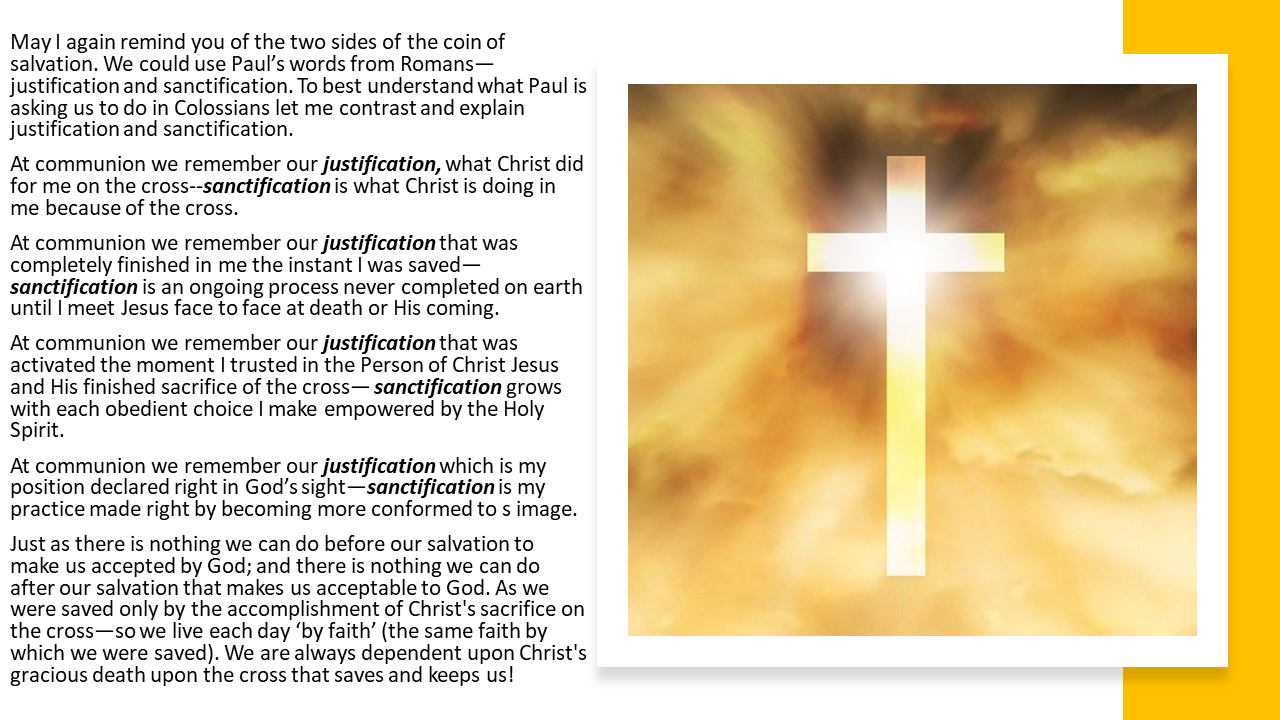
May I again remind you of the two sides of the coin of salvation. We could use Paul’s words from Romans—justification and sanctification. To best understand what Paul is asking us to do in Colossians let me contrast and explain justification and sanctification.
- At communion we remember our justification, what Christ did for me on the cross–sanctification is what Christ is doing in me because of the cross.
- At communion we remember our justification that was completely finished in me the instant I was saved—sanctification is an ongoing process never completed on earth until I meet Jesus face to face at death or His coming.
- At communion we remember our justification that was activated the moment I trusted in the Person of Christ Jesus and His finished sacrifice of the cross— sanctification grows with each obedient choice I make empowered by the Holy Spirit.
- At communion we remember our justification which is my position declared right in God’s sight—sanctification is my practice made right by becoming more conformed to s image.
Just as there is nothing we can do before our salvation to make us accepted by God; and there is nothing we can do after our salvation that makes us acceptable to God.
 As we were saved only by the accomplishment of Christ’s sacrifice on the cross—so we live each day ‘by faith’ (the same faith by which we were saved). We are always dependent upon Christ’s gracious death upon the cross that saves and keeps us!
“Our participation in the process of sanctification comes only after we’ve been totally accepted and made right before God through faith in Jesus. So yes, we work hard at obeying God’s word. We read our Bibles. We pray. We meditate on Scripture. We memorize Scripture. We share the gospel. We serve in our church. We fast. God commands us in His Word to do many things, and our obedience is both pleasing to Him and brings His blessing to our lives. But not one adds to our justification, our standing before God, our eternal life. Only grace sustains lasting change and sanctification . Through the cross we overcome not only the guilt of sin, but the power of sin as well1.
Colossians 3 is built around 14 imperative commands. Remember that God never commands me to do what He hasn’t already given me the grace to accomplish by faith through His Spirit!
Let’s walk back through this chapter, see what Paul relates to us from the Lord, and then pause and ASK the Lord to unleash these powerful spiritual qualities in our lives today.
If then you were raised with Christ, seek those things which are above, where Christ is, sitting at the right hand of God. 2 Set your mind on things above, not on things on the earth. 3 For you died, and your life is hidden with Christ in God. 4 When Christ who is our life appears, then you also will appear with Him in glory. 5 Therefore put to death your members which are on the earth: fornication (NIV sexual immorality), uncleanness (NIV impurity), passion (NIV lust), evil desire, and covetousness (NIV greed), which is idolatry. 6 Because of these things the wrath of God is coming upon the sons of disobedience, 7 in which you yourselves once walked when you lived in them.8 But now you yourselves are to put off all these: anger, wrath (NIV rage), malice, blasphemy (NIV slander), filthy language out of your mouth: 9 Do not lie to one another, since you have put off the old man with his deeds, 10 and have put on the new man who is renewed in knowledge according to the image of Him who created him, 11 where there is neither Greek nor Jew, circumcised nor uncircumcised, barbarian, Scythian, slave nor free, but Christ is all and in all:12 Therefore, as the elect of God, holy and beloved, put on (NIV clothe yourselves with) tender mercies (NIV compassion); kindness; humility; meekness (NIV gentleness); longsuffering (NIV patience);13 bearing with one another: and forgiving one another, if anyone has a complaint against another; even as Christ forgave you, so you also must do.14 But above all these things put on love, which is the bond of perfection. 15 And let the peace of God rule in your hearts, to which also you were called in one body; and be thankful. 16 Let the word of Christ dwell in you richly in all wisdom, teaching and admonishing one another in psalms and hymns and spiritual songs, singing with grace in your hearts to the Lord.17 And whatever you do in word or deed, do all in the name of the Lord Jesus, giving thanks to God the Father through Him. 18 Wives, submit to your own husbands, as is fitting in the Lord. 19 Husbands, love your wives and do not be bitter (NIV harsh) toward them. 20 Children, obey your parents in all things, for this is well pleasing to the Lord. 21 Fathers, do not provoke (NIV embitter) your children, lest they become discouraged. 22 Bondservants, obey in all things your masters according to the flesh, not with eyeservice, as men-pleasers, but in sincerity of heart, fearing God. 3 And whatever you do, do it heartily, as to the Lord and not to men, 24 knowing that from the Lord you will receive the reward of the inheritance; for you serve the Lord Christ. 25 But he who does wrong will be repaid for what he has done, and there is no partiality. NKJV
 You and I are to live by the same simple faith that saved us. Paul tells us this truth in Colossians 2:6.
Colossians 2:6 As you therefore have received Christ Jesus the Lord, so walk in Him, NKJV
Now join me in Romans 6, as we see how to live the life of killing our flesh, mortifying our flesh—and living the crucified with Christ life!
Romans 6:11 Likewise you also, reckon yourselves to be dead indeed to sin, but alive to God in Christ Jesus our Lord. NKJV
Romans 6:11 In the same way, count yourselves dead to sin but alive to God in Christ Jesus. NIV
Romans 6:11 Even so consider yourselves to be dead to sin, but alive to God in Christ Jesus. NASB
Now, in simple faith that saved you repeat that to yourself. (Just like my old pastor John MacArthur always used to tell us ‘preach the Gospel to yourself!’) Say something like this:
Even if I do not feel it, understand it, or even at times want it I WILL by faith, believing YOU consider myself dead to sin. Or in times of need, “Lord I operate on what I know is true, you have made me dead to sin.”
When I truly prayed, asking in simple faith for Christ to save me—whether I felt a strong emotional feeling or not, God began His work within me. I started changing from the inside out. The same is true with these imperatives.
God never commands me to do what He hasn’t already given me the grace to accomplish by faith through His Spirit!
Now go through the same process the rest of the way through Romans 6—
- I will not let sin reign…
- I will not present my members…
- I now by faith present myself to You God…
- I present myself to You Lord as you slave…
- I ask You to enslave my members (my mind, my emotions, my desires, my body, what ones are out of control? If they are out of control they aren’t under Christ’s control…)
1 C. J. Mahaney, The Cross Centered Life, Sisters, OR: Multnomah Publishers, 2002, p. 31-34.
Slides
Check Out All The Sermons In The Series
You can find all the sermons and short clips from this series, David’s Spiritual Secret here.
Looking To Study The Bible Like Dr. Barnett?
Dr. Barnett has curated an Amazon page with a large collection of resources he uses in his study of God’s Word. You can check it out here.