
NR8-10 WFM-03
010819PM
When Jesus walked into Jerusalem as the crowds swelled the city’s population for the Feast of Tabernacles, He was planning on making His greatest offer to Israel in His ministry. To perhaps the largest crowd of all, this happy celebration drew faithful Jews from all over the Land and even the world. And here, at the great feast God had given to Moses to write 1,500 years earlier as a testimony of Christ, Jesus arrives and offers Himself to any and all who would listen.
Have you found Jesus as your light? Last time we studied what it meant to be trusting Jesus. This morning we need to study what it means to be following Jesus. To do so, join me again in the remarkable setting of this great I AM THE LIGHT declaration by Jesus. To do so we must ask the 1st Question. Okay, here we go. WHERE WAS JESUS when He declared He was the Light of the World? The answer? In the Courtyard of the Temple of Herod. What do we need to do? We need to watch Jesus against the backdrop of the Divinely prescribed Worship of Israel, that is the 1st key to walking in the Light.
To understand the magnitude of Christ’s declaration that He was The Light of the World we need to turn back to the second book of the Bible. Remember when we studied Creation a while back? We saw that there are only two chapters9 in the Bible are devoted to the creation story, whereas some fifty chapters focus on the Tabernacle (see especially Ex. 25-40). Why did God give so many details about the Divinely prescribed worship for Israel? Clearly the Tabernacle is important and demands attention in our study, because it is a giant portrait of Jesus Christ. Everywhere you look in the Tabernacle you can see Jesus Christ the Lord!
Walk again with me through Exodus 37-38 this morning. The courtyard of the Tabernacle was one hundred fifty feet long and seventy-five feet wide. As we walk around it on a Scriptural Tour we can find every object we see in some way points to Christ. And also His great I AM declarations are featured in this sacred place.
- EXODUS 37:1-9 THERE WAS ONLY ONE WAY TO GOD. Jesus reflected this when He declared I AM THE WAY, THE TRUTH, AND THE LIFE. The only object10 in the Holy of Holies was the ark, which represents Jesus Christ, the true mercy seat. When we meet Jesus Christ as Savior, we are ushered into the presence of God, into the true Holy of Holies. God no longer communes with men between the wings of cherubim on a gold mercy seat. He communes with men in His Son, by whom the veil was torn in two. Jesus Christ is the mercy seat. Only on the basis of the blood of a goat would God have fellowship with Israel, and only on the basis of the blood of Christ will God have fellowship with men. John, in using the term “propitiation,” in 1 John 2:2, relates Jesus to the mercy seat, since that very word ??????????? is used for mercy seat in the Septuagint translation of Exodus 25:17.
- EXODUS 37:10-16 THERE WAS ONE SOURCE OF FOOD IN THE TABERNACLE OF GOD’S PRESENCE. Jesus reflected this when He declared I AM THE BREAD OF LIFE. On the right was the table on which was the sacred bread, or show-bread. This table, like the base of the altar, was of acacia wood overlaid with gold. It was three feet long, one and a half feet wide, and two and a quarter feet high. Every Sabbath twelve loaves of fresh bread were set on it, one for each of the twelve tribes. At the end of the week, the priests, and only the priests, were allowed to eat the loaves.
- EXODUS 37:17-24 THERE WAS ONLY ONE SOURCE OF LIGHT IN THE TABERNACLE OF GOD’S PRESENCE. Jesus reflected this when He declared I AM the LIGHT of the world. Still moving west across the courtyard, we come to the Tabernacle proper-forty-five feet long, fifteen feet wide, and fifteen feet high. The holy place took up two-thirds of this area, which means that the holy of holies was a perfect fifteen-foot cube. Only priests could go into the Holy Place, in which were three pieces of furniture. On the left, as the priest entered, was a solid gold lampstand having seven branches, each filled with the purest olive oil.
- EXODUS 37:25-28 THERE WAS ONE PLACE OF A CONSTANT OFFERING RISING TO GOD FROM THE TABERNACLE OF GOD’S PRESENCE. Jesus reflected this when He declared I AM THE VINE, and we are to abide in Him or we amount to nothing. Farther in and to the center of the Holy Place was the altar of incense. It, too, was of gold-overlaid acacia wood, one and one-half feet square and about three feet high. On this altar were placed the burning coals from the bronze altar in the courtyard, where sacrifice was made. The altar of incense pictures Jesus interceding for us, the perfect Sacrifice becoming the perfect Intercessor.
- EXODUS 38:1-7 THERE WAS ONE SACRIFICIAL ALTAR IN THE TABERNACLE OF GOD’S PRESENCE. Jesus reflected this when He declared I AM THE GOOD SHEPHERD WHO GIVES MY LIFE FOR MY SHEEP. So Jesus our Lamb offered Himself for us. The first article of furniture in the outer court was the bronze altar. It was made of acacia wood sheathed with bronze. It was seven and a half feet square, stood four and a half feet off the ground, and was topped with a bronze grate. The coals were placed underneath the grate and the sacrifice was placed on top. On the four corners of the altar were horns, to
which the animal was bound when it was being sacrificed. The bronze altar is again a perfect picture of Jesus Christ, who Himself was a sacrifice for sin.
- EXODUS 38:8THERE WAS ONE PLACE OF CLEANSING IN THE TABERNACLE OF GOD’S PRESENCE. Jesus reflected this when He declared I AM THE RESURRECTION AND THE LIFE, He shed His blood to cleanse us from our sins, we are washed in His blood. Once we have received forgiveness for our sins through Christ’s sacrifice of Himself, we still need His daily cleansing that restores fellowship and joy. So the next piece of furniture in the court was THE LAVER or basin, also made of bronze. In it the priests would wash their hands, and even sometimes their feet, as they went about the bloody services of sacrifice. Here is a picture of Jesus Christ as the cleanser of His people.
- EXODUS 38:9-20 THERE WAS ONE ENTRANCE TO THE TABERNACLE OF GOD’S PRESENCE. Jesus reflected this when He declared I AM THE DOOR: There was only one entrance into God’s earthly presence, a single gate, on the east side that was thirty feet wide and seven and a half feet high, allowing a large number of people to enter at the same time. It is a graphic picture of Jesus Christ, who said, “I am the way” and “I am the door.” Just as there was only one entrance to the Tabernacle, there is only one way to God-the only Way and the only Door, Jesus Christ. Christianity is exclusive, not because Christians make it so but because God has made it so. Throughout the centuries, of course, Christians have made the earthly church exclusive in many wrong ways. But God has intentionally made His spiritual, eternal church exclusive. It can be entered only through Jesus Christ.
Now think over just exactly what it was that Jesus was saying. Remember, WHEN did He make this declaration? That makes all the difference to feel the magnitude of what He declared! It was after the entire nation had just relived for 14 days the great exodus deliverance and wilderness experience. And then after all that Christ was saying to all of them by association:
- I AM the pillar of fire that came between you and the Egyptians.
- I AM the cloud that guided you by day in the wilderness.
- I AM the pillar of fire that illumined the night.
- I AM the cloud that enveloped the Tabernacle.
- I AM the glorious cloud that filled Solomon’s Temple at a Feast of Tabernacles 1000 years ago.
- I AM all of the great events you have been celebrating, the Light you seek – IT IS HERE, it is ME!”
“I am the light of the world. Whoever follows me will never walk in darkness, but will have the light of life” (John 8:12). He is everything suggested by the sublime metaphor of light — and much more.
- The apostle John tells that Jesus went up to Jerusalem to celebrate the Feast of Tabernacles at the temple. In Jesus, God came in the flesh to celebrate with his people. On the last and greatest day of the Feast of Tabernacles, God incarnate stood in his temple calling out to his thirsty people to come to him and drink (Jn 7:37). How ironic that his unrecognized voice was a disturbing presence in the festivities that had for so long been celebrated to welcome his presence!
- To be a follower of Christ is to give oneself body, soul and spirit into the obedience of the Master; and to enter upon that following is to walk in the light. We need the heavenly wisdom to walk the earthly way. The man who has a sure guide and an accurate map is the man who is bound to come in safety to his journey’s end. Jesus Christ is that guide; he alone possesses the map to life. To follow Jesus is to walk in His light safely through life and afterwards to enter into glory.
The Feast of Sukkot During Old Testament11 times, God instituted a religious calendar for the Israelites to follow. The seventh day, the seventh year, and the end of seven “seven years” were significant to Him. Within each year, there were seven specified feasts (Leviticus 23), which included the Feast of Sukkot (or Tabernacles).
- The week long celebration of Sukkot began after the fall harvest, a time to be especially THANKFUL FOR GOD’S BLESSINGS. Following God’s command, the people came to Jerusalem and built booths of olive, palm, and myrtle branches (Nehemiah 8:15), which provided shade.
- The people were to leave enough space in the branches so that they could see the sky, REMINDING THEM OF THEIR WILDERNESS YEARS. These booths (sukkot; plural: sukkah) gave the feast its name.
- For seven days, the people ate, lived, and slept in these booths. It was A TIME TO PRAISE GOD FOR HIS PAST GIFTS of freedom, land, and bountiful harvests. In fact, God commanded them to “rejoice” before Him (Leviticus 23:40).
- A special element of the celebration of Sukkot involved living water. Sukkot took place at the end of the dry season, so the rains needed to begin immediately to ensure a bountiful harvest the following year. Thus the celebration of God’s harvest was coupled with the people’s fervent prayers for the next year’s rains. The priests, too, added a ceremony that included a prayer for rain. During this ceremony, a procession of priests marched from the temple to the Pool of Siloam, which was fed by the Spring of Gihon. One priest filled a golden pitcher with water, and the procession returned to the temple. At that time, the priest carrying the pitcher stood near the top of the altar and solemnly poured the water into one of two silver funnels leading into the stone alter for the daily drink offerings. At this time, the people accompanied by the Levitical choir began a chant that meant, “O Lord, save us by sending rain as well.” In this way, they asked God for live-giving rain. Four great menorahs (more than seventy-five feet high) were also placed in the women’s court of the temple. They commemorated the miraculous burning of the Holy of Holies after Judah Maccabee defeated the Greek army of Antiochus and reclaimed Jerusalem.
In the context of Sukkot, the water ceremony, and the menorahs blazing with light, Jesus presented the message of His new kingdom. He had traveled to Jerusalem for Sukkot (John 7:10) and had taught great crowds thronging the temple (John 7:14). On the “last and greatest day of the Feast” (John 7:37), during the water ceremony, the chanted prayers, and the plea made through the offering of living water, Jesus stood and said, “If anyone is thirsty, let him come to me and drink. Whoever believes in me, as the Scripture has said, streams of living water will flow from within him” (John 7:37- 38). So, the setting in which Jesus chose to give this lesson, and the similarity of His meaning to Jewish tradition, meant that His shouted promise in the temple must have had stunning impact: “Let him come to Me!”. Sukkot is a feast that will be fully realized in heaven. There, God’s people will experience living water (Revelation 7:17), His eternal presence (Revelation 21:22), and the light of God (Revelation 22:5). Whereas Sukkot taught the Jewish people to be joyful, in anticipation of heaven, imagine the most joyful celebration that ever existed lasting for eternity. That, indeed, is heaven!
JESUS: THE LIGHT THAT REMINDS US OF OUR FRAILTY. Not only did the temporary booths symbolize the tents in which the Israelites lived while they were divinely protected by God in the desert, but they also represented mankind’s earthly bodies, temporary dwelling places for our eternal souls and spirits.
THE FEAST OF TABERNACLES SPEAKS OF CHRIST’S BIRTH. Most of the Jews who made their way to Jerusalem during the time of the second Temple had no idea that God Himself had just tabernacled Himself among them. Jesus Christ, the second person of the Trinity, had stepped into a temporary tabernacle of flesh in order to bring all men to Himself. The apostle John tells us, ” And the Word became flesh and dwelt among us, and we beheld His glory, the glory as of the only begotten of the Father, full of grace and truth” (John 1:14 NKJV). Writing to a primarily Jewish audience, John used the Greek word sk’ enos (shelter or covering) and the metaphor of a tabernacle to describe Christ’s incarnation. The same word appears in Revelation 21:3, when the New Jerusalem comes down from heaven and God says, “Behold, the tabernacle of God is with (men, and He will dwell with them, and they shall be His people. God Himself will be with them and be their God.”
Many Bible scholars, and I count myself as one of them that believe that Jesus was born during the time of the Feast of Tabernacles.
- It is a fact that it’s not logical that shepherds would be outside during the month of December-the flocks were brought in to warm, sheltering caves as soon as the fall harvest was completed.
- There are other indications that Jesus was born on the Feast of Tabernacles. Look at Luke 2:10. The angel appeared to the shepherds and said: “Do not be afraid, for behold, I bring you good tidings of great joy which will be to all people.”
- The phrase ” great joy” would have been automatically associated with Sukkot, for it was known as the Season of Our Joy.
- Likewise, the phrase “to all people” would remind the Jewish hearer that Sukkot was also known as the Feast of the Nations. Two strong themes of Sukkot in one short message!
- Another clue that points to a Sukkot nativity is the fact that Bethlehem was so crowded there was “no room in the inn.” Luke explained the crowded conditions by saying that every family had gone to their home city to be taxed, but the Romans were nothing if not logical. If you wanted to gather taxes, would you do it in the dead of winter or right after the harvest, the farmer’s “payday”? Because Bethlehem is less than four miles from Jerusalem, it is logical that the little city would be crowded with pilgrims on their way to the Temple to celebrate Sukkot.
- Finally, since Jesus’ ministry on the cross was so vividly portrayed by the rituals surrounding Passover, Unleavened Bread, and First fruits, isn’t it reasonable to assume that the Feast of Tabernacles illustrates His birth? The apostle John certainly thought so, for he didn’t hesitate to evoke images of tabernacles to explain Christ’s incarnation.
THEFEASTOFTABERNACLESPROCLAIMSCHRISTASOURSALVATION. There’s one other image from the Temple celebration of Sukkot that 1’d like you to see. To commemorate the drawing of water from the rock at Horeb (Ex. 17:1- 7), on the morning of the first day of the festival and every day thereafter, a priest carried a large golden ewer from the Temple mount down to the spring of Siloam. Surrounded by jubilant worshipers, he drew water from the pool, then returned to the Temple, walking through the water gate, which led to the inner court. A great cheering crowd waited for him near the altar. Priests blew the ceremonial silver trumpets, and other priests chanted the words of Isaiah: “Therefore with joy you will draw water From the wells of salvation” (12:3 NKJV). Don’t miss the significance, my friend- “salvation” in Hebrew is yeshua, the same word we translate “Jesus.”
On the first through the sixth days, the priest and his joyful processional circled the altar once, but on the seventh day they circled the altar seven times! The highlight of the ceremony occurred when the priest stood and poured the water on the altar. While the water washed away the blood of the morning’s sacrifices, a long line of priests, all bearing willow branches, sang psalms of praise.
The water ritual, known as Simcha Bet Ha-sho-evah (the Rejoicing of the House of Drawing Water) prophetically illustrates:
- The time when the Holy Spirit will be poured out upon Israel.
- It also illustrates the truth that Jesus Christ, the Giver of living water, came to earth at Sukkot.
Jesus told the Samaritan woman at the well, “If you knew the gift of God, and who it is who says to you, ‘Give Me a drink,’ you would have asked Him, and He would have given you living water. ..Whoever drinks of this water will thirst again, but whoever drinks of the water that I shall give him will never thirst. But the water that I shall give him will become in him a fountain of water springing up into everlasting life” (John 4:10, 13-14 NKJV).
Like all devout Jewish men, Jesus attended the Feast of Tabernacles in Jerusalem. On the last day of one Sukkot festival, He stood and cried out to the crowd: “If anyone thirsts, let him come to Me and drink. He who believes in Me, as the Scripture has said, out of his heart will flow rivers of living water” (John 7:37-38 NKJV). The apostle John goes on to explain that Jesus spoke about the Holy Spirit, which had not yet come.
Can’t you just see it? Jesus and His disciples had just attended the glorious celebration inside the Temple. They had sung psalms with the priests, had perhaps followed the golden ewer of water seven times around the altar. They watched the liquid stream over the altar, cleaning away the blood of goats and rams from the morning sacrifices. As the rustlings of a thousand palms filled the air, foreshadowing the palms that would be lifted to hail Him when He would enter Jerusalem to die at Passover, Jesus spoke in a commanding voice and explained the ritual the Jews had just witnessed.
He was the Light of the World, the Living Water, the Word made flesh to dwell among them. He would soon be the Passover Lamb, the Bread Without Leaven, the First fruits. As our sinless High Priest, He would atone for sin once and for all. Hundreds in the Temple that day heard Him …but only those with understanding believed. Do you? For I will pour water on him who is thirsty, And floods on the dry ground; I will pour My Spirit on your descendants, And My blessing on your offspring. -Isaiah 44:3 NKJV
The references in John 7:37 We can now in some measure realize the event recorded in John 7:37. The festivities of the Week of Tabernacles were drawing to a close. “It was the last day, that great day of the feast.” It was on that day, after the priest had returned from Siloam with his golden pitcher, and for the last time poured its contents to the base of the altar; after the “Hallel” had been sung to the sound of the flute, the people responding and worshiping as the priests three times drew the threefold blasts from their silver trumpets just when the interest of the people had been raised to its highest pitch, that, from amidst the mass of worshipers, who were waving towards the altar quite a forest of leafy branches as the last words of Psalm 118 were chanted a voice was raised which resounded through the Temple, startled the multitude, and carried fear and hatred to the hearts of their leaders. It was Jesus, who “stood and cried, saying, If any man thirst, let him come unto Me, and drink.” Then by faith in Him should each one truly become like the Pool of Siloam, and from his inmost being “rivers of living waters flow” (John 7:38). “This spake He of the Spirit, which they that believe on Him should receive.” Thus the significance of the rite, in which they had just taken part, was not only fully explained, but the mode of its fulfillment pointed out.
The effect was instantaneous.
- It could not but be, that in that vast assembly, so suddenly roused by being brought face to face with Him in whom every type and prophecy is fulfilled, there would be many who, “when they heard this saying, said, Of a truth this is the Prophet.
- Others said, This is the Christ.”
- Even the Temple-guard, whose duty it would have been in such circumstances to arrest one who had so interrupted the services of the day, and presented himself to the people in such a light, owned the spell of His words, and dared not to lay hands on Him. “Never man spake like this man”, was the only account they could give of their unusual weakness, in answer to the reproaches of the chief priests and Pharisees.
- The rebuke of the Jewish authorities, which followed, is too characteristic to require comment. One only of their number had been deeply moved by the scene just witnessed in the Temple. Yet, timid as usually, Nicodemus only laid hold of this one point, that the Pharisees had traced the popular confession of Jesus to their ignorance of the law, to which he replied, in the genuine Rabbinical manner of arguing, without meeting ones opponent face to face: “Doth our law judge any man before it hear him, and know what he doeth?”
The Bible speaks often of the glory of God—the visible appearance of His beauty and perfection reduced to blazing light.
- His glory appeared to Moses in a burning bush in Midian (Ex. 3:1–6),
- in a cloud on Mt. Sinai (Ex. 24:15–17),
- and in a rock on Mt. Sinai (Ex. 33:18–23).
- The glory of God also filled the tabernacle (Ex. 40:34),
- led the people as a pillar of fire and cloud (Ex. 40:35–38),
- and also filled the temple in Jerusalem (1 Kin. 8:10, 11).
- When Aaron made the first sacrifice in the wilderness (Lev. 9:23-24), as a priest, the “glory of the Lord appeared to all the people.”
In these manifestations, God was revealing His righteousness, holiness, truth, wisdom, and grace—the sum of all He is. However, nowhere has God’s glory been more perfectly expressed than in His Son, the Lord Jesus Christ (John 1:14). It will be seen on earth again when He returns (Matt. 24:29–31; 25:31).12
Our Lord’s I AM statement was also related to the Feast of Tabernacles, during which the huge candelabra were lighted in the temple at night to remind the people of the pillar of fire that had guided Israel in their wilderness journey. In fact, John has combined three “wilderness images”: the manna (John 6), the water from the rock (John 7), and the pillar of fire (John 8). To “follow” the Lord Jesus means to believe on Him, to trust Him; and the results are life and light for the believer. The unsaved are walking in darkness because they love darkness (John 3:17ff). One of the major messages in this Gospel is that the spiritual light is now shining, but people cannot comprehend it—and they try to put it out (John 1:4–5)13
JESUS THE LIGHT THAT PROTECTS US: Psalm 105:39-41 He spread a cloud for a covering, And fire to give light in the night. 40 The people asked, and He brought quail, And satisfied them with the bread of heaven. 41 He opened the rock, and water gushed out; It ran in the dry places like a river.
JESUS THE LIGHT THAT COMFORTS US: Psalm 105:39-41 He spread a cloud for a covering, And fire to give light in the night. 40 The people asked, and He brought quail, And satisfied them with the bread of heaven. 41 He opened the rock, and water gushed out; It ran in the dry places like a river.
JESUS THE LIGHT THAT PROVIDES FOR US: Psalm 105:39-41 He spread a cloud for a covering, And fire to give light in the night. 40 The people asked, and He brought quail, And satisfied them with the bread of heaven. 41 He opened the rock, and water gushed out; It ran in the dry places like a river.
JESUS: THE LIGHT THAT GUIDES US. “By day the LORD went ahead of them in a pillar of cloud to guide them on their way and by night in a pillar of fire to give them light, so that they could travel by day or night” Exodus 13:21 who went in the way before you to search out a place for you to pitch your tents, to show you the way you should go, in the fire by night and in the cloud by day. Deuteronomy 1:33
And then the most stupendous thing happened as they entered the wilderness—an immense pillar of cloud formed in the sky before them to lead the way. At sunset it became a pillar of fire, so that every night Israel was lighted by its swirling orange glow (13:20–22). What a spectacle that must have been against the backdrop of the star-studded desert sky. Wild exaltation gripped the people. What a fabulous beginning! What hopes! What dreams! Soon they would be in the Promised Land, bury Joseph’s bones, and there forever enter their rest.
JESUS: THE LIGHT THAT WARNS US. It all began so well—but ended so poorly. It is not how you start, but how you finish! Of the 600,000 men (the million-plus Israelites who began so well), only two over the age of twenty ever got to the Promised Land—and that was forty years later. The rest fell, disappointed corpses in the desert. The grand and terrible lesson of Israel’s history is that it is possible to begin well and end poorly. In fact, this tragic human tendency dominates much human spiritual experience.
JESUS: THE LIGHT THAT REFINES US. Fire is a symbol of God’s presence throughout the Bible, beginning with Moses and the burning bush (Exodus 3:2–4) and continuing with the consuming fire on Mount Sinai (Exodus 24:17). The fire at Pentecost indicated God’s presence, just as its resting on Israel demonstrated a corporate unity. However, a new significance came when the fire divided into flames dancing over the individual apostles. The Spirit now rests upon each believer individually. The emphasis from Pentecost onwards is on the personal relationship of God to the believer through the Holy Spirit. The inner pillar of fire burns away our dross, flames forth from our inner being, and brings to us a sense of God’s presence and power. The fire of God!
9 Drawn from MacArthur, John F., The MacArthur New Testament Commentary: Hebrews, (Chicago: Moody Press) 1983.
10 All of this material on the Tabernacle adapted and quoted from MacArthur, John F., The MacArthur New Testament Commentary, Hebrews, (Chicago: Moody Press) 1983.
11 Ray Vander Laan, Faith Lessons On The Life & Ministry Of The Messiah. Leader’s Guide, Zondervan Publishing House, Grand Rapids, Michigan, 1999, p. 318-20.
12 John F. MacArthur, Jr., The MacArthur Study Bible, (Dallas: Word Publishing) 1997. 13Wiersbe, Warren W., The Bible Exposition Commentary, (Wheaton, IL: Victor Books) 1997.
Transcript
This evening we’re going to go to the 8th chapter of the Gospel by John, but you don’t have to turn there because I’m going to put it up on the screen for you. We’re going to study the implications of Jesus Christ as the light of the world on our life, to apply it. I’m just going to read through it with you. Chapter 7 is the message of Christ presenting Himself for the second time. Now, remember this is His presentation, His Gospel presentation of Himself. He said, I am, and we saw in chapter 6, the bread of life. In chapter 7, He says He’s the water, and in chapter 8, the light.
So, chapter 7 starts, After these things, Jesus walked in Galilee. A little clue for you to know chronology, Passover and the Feast of Tabernacles are exactly six months apart. Chapter 6 was Passover, we saw that. Six months have passed between chapter 6, the last verse, and chapter 7, the beginning. For He did not want to walk in Judea, because the Jews sought to kill Him. So, in the north, they wanted to make Him king, in the south they wanted to kill Him.
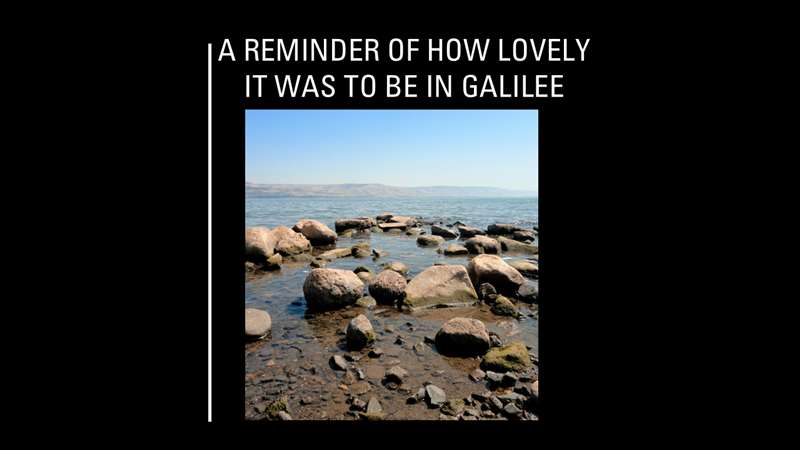
The next slide picks us up with a reminder of how lovely it was to be in Galilee. There is no comparison. Those who go to the land know that when you’re in the north you’re in an area that just breathes the beauty of what you think of Christ, His parables, His ministry, walking on the water, calming the sea. When you get to the south, to Jerusalem, it’s compressed, and it’s full of people, and it’s a city. So, Jesus walked in Galilee around this sea.
The next scripture reminds us in verse 2, Now the Feast of Tabernacles was at hand. Remember that the scriptures, especially the Gospel by John. It emphasizes a biblical chronology because God had given a road map for the life of Jesus Christ. It’s interesting, and tonight I’m not going to go through this, we’ll do it more toward Christmas, but there are many clues in the Gospels as to when Jesus was born. We’re almost assured it wasn’t December 25th, because that was the Roman feast that Constantine incorporated to draw the Empire together. Most likely, Jesus was born at the Feast of Tabernacles. The Word became flesh and shaken, it tabernacled, He tabernacled among us. Also, that’s when shepherds would be out in the fields with their flocks. Also, at the Feast of Tabernacles Bethlehem was overrun with people, as well as Jerusalem, because that’s when all the people came to celebrate, and they overflowed five miles south. It was at the Jewish Feast of Tabernacles. This is just a little insight into how compact this one-mile circumference city was, and it was dense, it was far denser and filled with people back then.
The next slide reminds us of how John continues. He says his brothers, remember Jesus had four unbelieving brothers, who did not believe till after the resurrection They were actually adversaries to Christ, so Jesus grew up in a home where there was conflict and everything else, which makes Him even more an example for us. But His brothers were mocking Him. They said, Depart from here and go to Judea, that Your disciples, obviously were not, may also see the works that You’re doing, for no one does anything in secret. You can just tell they were mocking Him. If You do these things, show Yourself to the world. Remember two of them wrote monumental books in the Bible, James, the brother of our Lord, pastor of the church in Jerusalem. Jude, defender of the faith, writer of that little postcard at the end of the New Testament. But His brothers, even those two, and Jesus also had two sisters, did not believe in Him.
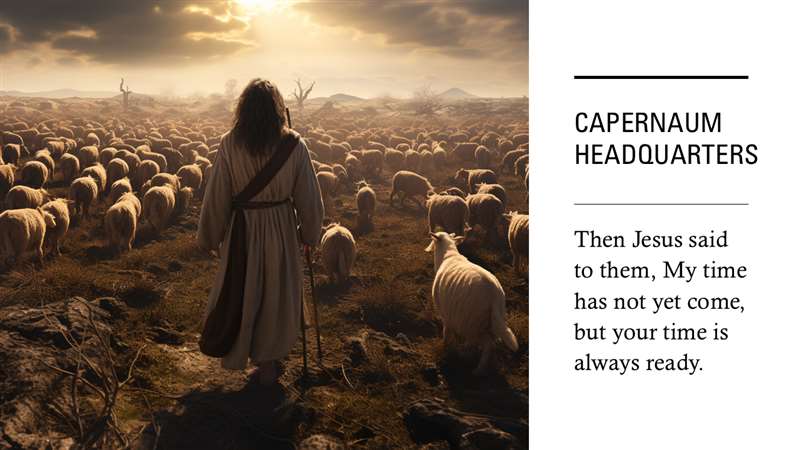
The next slide takes us to them saying, depart from here, get out of the tranquility of the Sea of Galilee. People in the north were vibrant and they were very committed to the scriptures. Jesus had a great following up here. They said, get out of here and go show your stuff down south.
The next slide reminds us of what happened. Remember, there’s the Sea of Galilee right there. The cutout shows us Jesus was headquartered in Capernaum. He goes 70 as the crow flies about 100 miles as the bus drives, straight through the center. He would not have come down the Jordan River Valley. He would have come from the Sea of Galilee here, cut over, and gone the same way Abraham came into the land, the same way Isaac would have come through the land, the same way Jacob would have left the land and come back, and the same way that Joseph would have walked. So, Jesus followed the way of the patriarchs and went to Judea.
The next slide shows us verse 6 of the 7th chapter of John, which says this, Then Jesus said to them, My time has not yet come, but your time is always ready. This is just the new Davidson Center Hollywood version of what the Temple looked like. The wealthy Jews in Los Angeles have funded a state-of-the-art surround sound, digitally produced Temple, and it’s fascinating. This is what that colonnaded hall, each of these columns here, in this Herodian-built colonnaded hall, would have been. It is the one that is still present. It’s in the area called the Russian compound in Jerusalem. It’s still in the ground being chiseled out, but it is over sixty feet high. That’s without the base, and the capital up there. So, this was the largest colonnaded hall of the ancient world, much greater than the Parthenon. This was the greatest, largest, most spacious temple of the ancient world. Jesus said it’s not time for Me to come up because He wanted to precisely come up when it was time for Him to reveal Himself.
The next slide reminds us of what verse 7, or chapter 7 continues. You go up to the feast, this feast. We’re going to talk about which feast. I’m not yet going up to this feast, for my time has not yet fully come. Jesus was operating on God’s timetable, and that’s what this whole feast is reminding us of. It’s such a lesson for us.
The children of Israel were to follow the Lord’s leading. Just to encourage you as you read the Bible, all those little details that sometimes we skip over are very critical. Did you know that there was a prescribed distance that they were to follow behind the glory cloud? The Shekinah, the pillar that we’re going to talk about tonight. They were not supposed to get right up on it, acting as if they knew just where the Lord was leading them. Also, they weren’t to dawdle back. They were to stay in step as the Lord led them. There’s a real lesson for us that we’ll see from this tonight. Jesus exhibits that. He says, My time hasn’t fully come and when He said these things to them, He remained up north in Galilee.
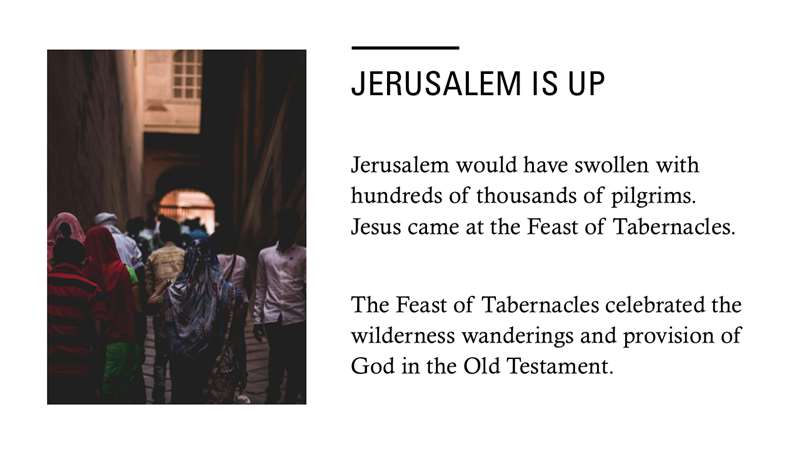
The next slide tells us what happened to them. In verse 10 they got into this mass of people up here. Again, the computer-generated Davidson Center. Jerusalem would have swollen with hundreds of thousands of pilgrims. That’s why they spilled over into the outlying communities. That’s why at the time of Christ’s birth, there would have been no rooms in Jerusalem or Bethlehem because this was the greatest time to go to Jerusalem. It was just before the rainy season. It was the end of the harvest. That’s when Caesar would have collected taxes. You wouldn’t have collected taxes in December when it was pouring down rain and nobody had any money left. You would have collected them in September, or October when the harvests were just in, and everybody had been paid. So, there are a lot of clues as to why Jesus came at the Feast of Tabernacles.
Notice what it says, But when His brothers had gone up. Remember always, Jerusalem is up. Also, I was sharing with someone this week, that it’s interesting how God gives directions in the Bible. When you’re reading the Bible about north, south, east, and west in the Old Testament, it’s not the words north, south, east, and west. The words are frontwards, that’s looking out the door of the Temple or Tabernacle. That would be east, because the door, the gate, opened toward the east. So whenever in the Bible it says they came from the east, it says they came from in front. Whenever it says they came from the west, it says they came from behind. Whenever it says they came from the north, it says they came from the left. Whenever it says they came from the south, they came from the right. Why is that? Because God writes the Old Testament as if He is enthroned over the Temple. In front of Him, looking out, is east, behind Him is west, to the right is south, and to the left is north. That’s the perspective God has because this place is so important to Him. Jesus also went up to the feast, but not openly, as it were in secret. Let’s look at what that feast was.
The next slide gives us a little concept, and I’m going to give you a quick overview of what the Jewish people celebrated at the Feast of Tabernacles and why it was so important. The slide we missed said that the Feast of Tabernacles celebrated the wilderness wanderings and provision of God in the Old Testament.
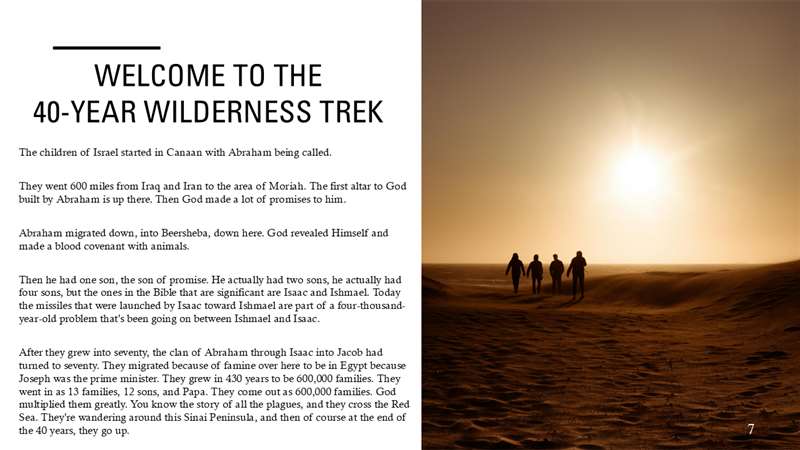
The next slide says, Welcome to the 40-Year Wilderness Trek. Now let’s look at that right here. You remember the children of Israel actually started up here in Canaan with Abraham being called from way over here. They went 600 miles from Iraq and Iran to the area of Moriah. He set up the first altar right there at the top of that little orange street, right there. The first altar to God built by Abraham is up there. Then God made a lot of promises to him, we’ve talked about that. Abraham migrated down, into Beersheba, down here. God revealed Himself and made a blood covenant with animals. Then he had one son, the son of promise. He actually had two sons, he actually had four sons, but the ones in the Bible that are significant are Isaac and Ishmael. Today the missiles that were launched by Isaac toward Ishmael are part of a four-thousand-year old problem that’s been going on between Ishmael and Isaac.
After they grew into seventy, the clan of Abraham through Isaac into Jacob had turned to seventy. They migrated because of famine over here to be in Egypt because Joseph was the prime minister. They grew in 430 years to be 600,000 families. They went in as 13 families, 12 sons, and Papa. They come out as 600,000 families. God multiplied them greatly. You know the story of all the plagues, and they cross the Red Sea. They go down, perhaps Mount Sinai is here, or it could be over here. It could be that they actually went like this, and this is where Pharaoh chased them. There are so many different ideas these days, and a lot of archaeological work is being done. They’re wandering around this Sinai Peninsula, and then of course at the end of the 40 years, they go up.
The next slide shows us some of the big, significant events. They were camped out in the shape of a cross. Remember that? Judah right here was on the east side toward the entrance of the Tabernacle. Here are Benjamin, Ephraim, and Manasseh. You can see the tribes, where they’re laid out. That’s how they had the camp in this wilderness. Remember, God is very orderly, very symmetrical. If you want to explain to your children why they have to clean their room as I did this week, I say because God is the God of order and symmetry. Even down to, they could not throw junk on the ground in the camp. They could not put refuse on the ground. God says do not throw it down. There’s something about God that is orderly. He tells them just where to camp, how far away they should be from the tent, and everything else. They remembered that every year at this feast.
The next slide reminds us of some of the events of being out in Sinai. They had 130 degrees Fahrenheit days. That’s what they have recorded out in the Sinai desert. At night, sometimes it gets down to freezing temperatures. So, imagine being in an area that looks like this. This is not the Grand Canyon. This is the Sinai. This is not the Gobi Desert. This is where God called women with nursing babies, people with their aging grandparents, those with handicapped children, and those with their herds, and all their worldly possessions. He asked them to come walking out here, okay?
The next slide reminds us of the barren, trackless, arid wastelands they had to live in for 40 years. They had no roads to follow. They had no maps to know where they were going. Now remember, there are only three things you need to survive in the Sinai. You need to have food, shelter, and water. They had no food, no shelter, no water. They only needed three things to live out there. They needed food, shelter, and water. You don’t need anything else. They didn’t have any of that.
The next slide reminds us that God gave them, though, a pillar of cloud by day, and of fire by night to guide them. That’s ok. Thanks for being so patient. The three vital things are food, shelter, and water. Did God provide them? Yes. The next slide tells us He gave them manna. By the way, John 6, 7, and 8 all have Old Testament pictures. Chapter 6 talks about manna. Chapter 7, the next thing God gave them was water from the rock. Imagine these rocks right here, Moses going up whacking that thing with a rod, and water coming out.
Let’s look at the next slide. Look at that, there’s water coming right out of the rock. This is literally a rock near the Dead Sea where water comes right out of the rock. What is that? This is called Ein Gedi. It’s one of the most stunning, striking oases you’ll ever see. You go along the most barren and desolate, lowest spot on Earth and it’s dead. It’s called the Dead Sea. All of a sudden you get to this lush, verdant oasis where a small stream of water comes out of the rock, and it just issues into life.
So, God gave them water out of the rock and the cloud. Remember they needed shelter. Even though they had water and even though they had manna, they would have died in the 130-degree heat. Their children would not have thrived. They would have not been able to survive those early days of growing up. So, God gave them a huge 81-square-mile umbrella that went over them like this. You say, how do you know that? Because the Bible says that. I’m going to show you that tonight. That’s what God provided.
Next slide. Remember the tabernacle we talked about this morning? It was 150 feet long, and 75 feet wide. This was a 15 by 15 cube. This is a little bit bigger. It’s not in a relationship there. That was the Tabernacle that went with them in the center of the camp. The next slide shows us what was in it. Remember, we saw Jesus as my only offering that counts, the brazen altar. He is the one who cleanses me. He is the bread of life. He is the one who intercedes for me. He is the light. Also, He is my only way to God. Those pictures, those items were always in the center of their lives. It’s the reason why we encourage our children anytime there’s a service in this church, that they’re a part of it. Why? Because we want to always remind them that the things of God, the Lord’s Day, God’s house, and God’s people are most important. It’s the highlight of the week. That was what God did by putting the Tabernacle in the center of the camp. I’m going to have to go a little faster, I see. We’re only on 26. Okay, let’s go faster.
Again, the Exodus, the quail and manna, Mount Sinai, and the Commandments, the Twelve Spies. They went up, they came back, came around the backside of the Dead Sea, and conquered Jericho. That’s what they remembered.
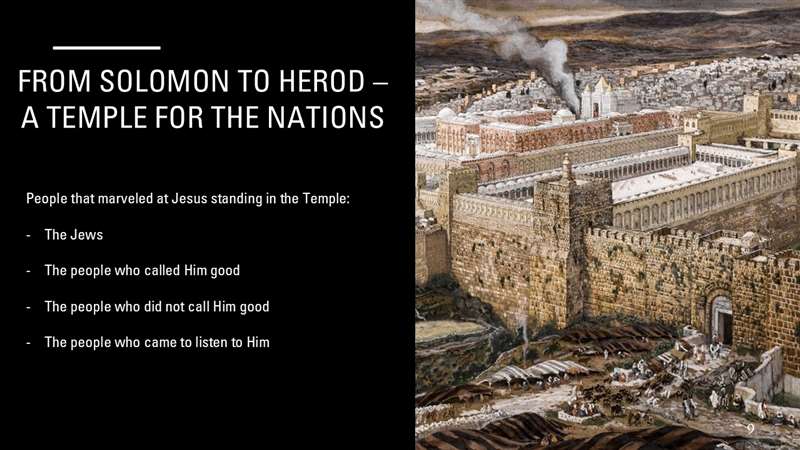
Then, the Tabernacle was reproduced in Herod’s Temple. Solomon’s was in between Zerubbabel’s and then Herod’s. So, Jesus, when it says He was in the courtyard, He would have been walking around in this courtyard here. When He was in the treasury, He would be coming in and out of the main enclosure here, but this was the huge 50, actually today it’s 1200 feet by 800 feet. Back then, they think it could have been a little bit larger, but we’re going by what they’ve excavated. It’s about 40 acres right here in this area.
The next slide reminds us of what John says. Then the Jews sought Him and said, where is He? And after much complaining among the people, they said, He’s good. Others said, no, He’s not. But no one spoke openly of Him. So, the saga continues till we get to verse 14. Now, about the middle of the feast, on day four, Jesus makes His appearance. He waited. Next slide. It says He went up. Now, this is one of the monumental staircases. There are many, again, from the Davidson model. This is amazing. This was the largest freestanding arch in the ancient world. To this day, there’s never been found a greater suspension arch with monumental stones than this one here. This would hold hundreds of people going up a stairway. So, Jesus went up either this stairway or the southern stairway that would come up the main drag there. But Jesus went up into the Temple.
He got up there and started doing what He often did. See here is the Temple proper. This would be the Antonian Fortress off behind there, and Jesus was in this colonnaded area. He would have stood and talked to people who came. When you see Jesus teaching in the Temple, He’s not in this Holy of Holies box here. He is in this colonnaded area. You can see in the blur in the background, crowds of people out there, and Jesus would have talked to various people. As He talked and began teaching, people would have come in to listen. So that’s what He did in the Temple. The next slide reminds us that the Jews marveled. They said this guy didn’t go to school, He has a northern accent. He didn’t go to school. How does He teach like this? So, there were in the hundreds of thousands of people. He was getting through to a lot of people.
The next slide reminds us of the climax of this feast. It says the last day, the great day of the feast. Now I want to show you in this slide what happened. Right here and right here were the entrance doors to the Temple proper. This is the Temple square up here, this 40-acre area.
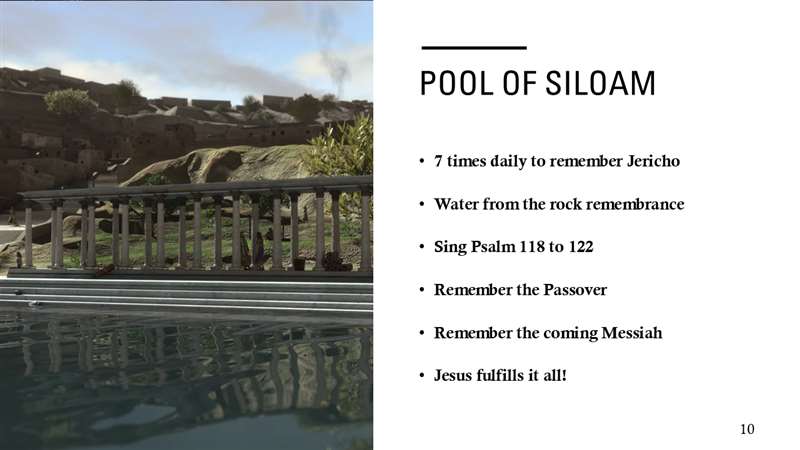
This is the Pool of Siloam, right there. The Pool of Siloam, the entrance to the Temple here. What happened was, every day of the feast, priests would come in procession, down these steps, and walk down this walkway. They would get golden pitchers, and they would lean over, dip them out of the Pool of Siloam, and as the people chanted and followed them, they’d walk back up into the Temple and have the remembrance of the water out of the rock. That happened for seven days in a row. The seventh day though was the big day, and this is when Jesus was on the last day. They didn’t just go down once. They went down once and then walked around the altar with everybody chanting seven times to remember the seven times around Jericho, which was also part of the Great Exodus event.
Okay, next slide. Also, in the courtyard was what we talked about this morning and a couple of weeks ago, the light ceremony with the four grand, huge, tall menorahs. They were taller than those columns, they were blazing, reminding them of the pillar of fire. Next slide. The water ceremony went on daily, back and forth. Remember, they were going to the Pool of Siloam, which means scent. The water came out from underneath the Temple Mount, it flowed through the bedrock in a tunnel cut by Hezekiah, to the Pool of Siloam. That’s why, we haven’t gotten there, but in chapter 9, while all the people are still going back and forth and remembering the feast, where does Jesus have the blind man wash his eyes? The Pool of Siloam. What does He say to him? I’m the light of the world. See, this message goes on throughout the book of John.
Next slide. Can’t you just see it? Jesus and His disciples had just attended the glorious celebration inside the Temple. They had sung Psalms. They would sing the Hallel, the 118th Psalm, and on through the 122nd. They were with the priests. They perhaps had followed the golden pitcher of water seven times around the altar. They encouraged the people, as many as could fit, to follow the priests, and to sing the Psalms and go around and around that great brazen altar. They had washed with the liquid after they marched around. They poured the water out on the altar, and everyone was so excited. The water was streaming over the altar, cleaning away the blood of the goats and rams from the morning sacrifices.
Next slide. The rustling of a thousand palms. What would happen if all the people brought with them foliage, which was a part of the celebration because they made the little booths that they stayed in out of this foliage? So, they would bring them to the Temple, these palm branches, and they would all shake them, make noise with them, and remind them of God’s deliverance and of all the fruitfulness they’d had. So, with a thousand palms filling the air, foreshadowing the palms that would be lifted to hail Him just six months later. Remember Passover and Tabernacles are six months apart. At the next Passover, Christ is crucified. Amazing. They were used to hail Him when He would enter Jerusalem to die at Passover. Jesus spoke in a commanding voice and explained the ritual the Jews had just witnessed.
So here are all these people, and they’re watching the water pour out, they’ve all marched around the altar, and they’re all breathlessly standing there, shaking their little palm branch, when all of a sudden, here comes Jesus. What does He say? He says I’m the light of the world. That’s what you guys are celebrating this week. I’m the light of the world. I’m the living water. I’m the water. I was the rock. The water came from Me. I’m the one that fed the children of Israel. I am the Word made flesh of John 1. I am the Passover Lamb that will be sacrificed in just six months. I am the unleavened bread. I will bear your sins away. I am the First Fruits. I will rise. See, Jesus was claiming to be the fulfillment of all the feasts at this feast.
Next slide. As our sinless High Priest, He would atone for sin once and for all. Hundreds in the Temple that day heard Him, maybe thousands, maybe tens of thousands, but only those with understanding believed. Now the question is, do we? Are you tonight? Do you believe He’s the living water, your only hope, the only one that can give you endless life?
Next slide. For I will pour water on him who is thirsty, Jesus said through the prophet Isaiah. Floods on the dry ground, I will pour My Spirit on your descendants, and My blessings on your offspring. He promised, but only a few would listen.
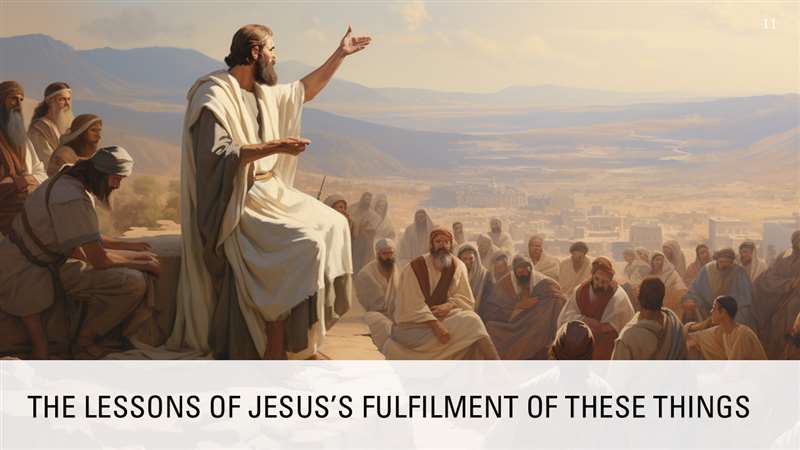
What are some lessons we can learn from this? First, Jesus said, I’m the light of the world, and if you follow Me, you’ll be in the light. Not just for one exciting night, remember they were so excited on that night of the big ceremony, but also for the pathway of your life. Jesus said, all the way through, I will light it. I will show you where to go. The light in the Temple was a brilliant light, but in the end, it flickered out and died. Jesus said, I’m the light, which won’t ever go out, it lasts forever.
The next lesson, when they carried this water from the Pool of Siloam up to the Temple, do you know what the people chanted all the way? They chanted Isaiah 12:3. What does Isaiah 12:3 say? Therefore, with joy, you will draw water from the wells of, and in English it’s salvation, but do you know what the Hebrew word is? Oh, you guys don’t have the Hebrew font. It looks like junk up there. Do you know what it is in Hebrew? Yeshua. Did you know that every day at this feast the people said, Therefore with joy draw water from the wells of Jesus. That’s what they were saying. Didn’t I tell you the feast was speaking of Him? His name was Yeshua, which means Salvation, which is the Hebrew word that they chanted at this feast. So, Jesus came to the feast that was all about Him. He came to the Temple which was a picture of Him. He came at the moment when they were talking about water and light. He says, I’m the light. I’m the salvation. I’m the water. Draw from Me and you’ll have an endless supply. That’s what He offers us.
The next slide has another. He said I’ll give you rivers of water that will flow out of you. The next slide reminds us, that the priests only poured out pitchers of water. Jesus always made a big impression. Here these men went down to the Pool of Siloam, got their little gold pitcher, and they’d walk up with all the people clapping and chanting. They would pour out their little pitcher onto the altar, and Jesus said, that was great. That’s a good picture. But those priests, remembering the water from the rock could only pour out a couple of gallons of water. Next slide, Jesus said, but the Holy Spirit that I will give you will flow out of each one of you like a Niagara Falls.
Have you ever been there? Every time we go east, we find a way to sneak up, usually, and drive across Ontario and go by the Niagara. The kids have stood so many times with the ground vibrating under their feet because of the tons and tons of water and the immensity of that water that is just cascading over that cliff. Do you know what Jesus said? He says, Judaism and religion in general and everything you can crank out it’s like a little pitcher of water. But if you come to Me, you’ll have a river that is endless. It’s like the Niagara Falls. That’s what the Holy Spirit wants to do out, through, and in each one of us.
The next slide reminds us Jesus was the light that protected us. It says in Psalm 105 verse 39, He spread a cloud for covering. Remember that pillar that was the light at night became the parasol by day to protect them from the 130-degree heat. Also, at night it is very possible that the pillar of fire radiated out warmth so that they were not sickened by the freezing temperature at night. It’s just the most amazing system God made. That’s what Jesus reminded them. Do you know what? If God can take care of a bunch of people out in the desert, do you think He can take care of you today in Tulsa? There’s an amazing offer by the Lord, not to pay our rent or to buy us a house, but to provide everything we need in Christ as we trust in Him.
The next one reminds us there were no roads, no maps. The next slide tells us that Jesus said, I want to provide for you. Psalm 105 also says that He spread the cloud for covering and fire and He satisfied them. He gave them water gushing out like a river in the dry places. As you can imagine, the arid Sinai that became an oasis when these people came through. The next one is our final question. Are you following Jesus, the light of the world, as your guide?
The next slide tells us this: the most stupendous thing happened to the children of Israel as they entered the wilderness after they left Egypt. An immense pillar cloud formed in the sky before them to lead the way. At sunset, it became a pillar of fire so that every night Israel was lighted by a swirling orange glow. That’s in Exodus 13, 20 to 22. What a spectacle that must have been against the backdrop of a star-studded desert sky. Wild exaltation gripped the people. What a fabulous beginning, they thought. Wow, what hopes and dreams. They’re going to be in the Promised Land. They’re going to bury Joseph’s bones, and then they’re going to forever enter into their rest. Can you imagine how exciting it was to leave Egypt, but it didn’t have a happy ending?
The next slide reminds us that Jesus said I’m the light of the world, he that followeth Me. Jesus told them that they had to follow that pillar to guide them, and they didn’t. The next slide reminds us that Jesus was the light that guides us in Deuteronomy 1:33. I don’t know if you realize this, God even picked where their tents were put down and He wanted to guide them so much, but they didn’t listen. Here’s the bad news in the next slide. It all began so well but ended so poorly. It’s not how you start, but how you finish that God measures. Of the 600,000 men, the million-plus Israelites, who began so well, only two over the age of 20 out of that whole crowd ever got to the Promised Land. Only two of them out of between one and a half million and three million people. Why? It was 40 years later. The rest fell, disappointed corpses in the desert. The grand and terrible lesson of Israel’s history is that it’s possible to begin well and to be the star of the youth group, and to be the star of the Sunday school, and to be the star of the singles, or to be the star of the adult fellowships, to begin well and to end poorly. Do you know what? The tragic human tendency dominates so much of the human spiritual experience of not following the Lord to the end. That’s part of the lesson of the Feast of Tabernacles. He said you’ll only walk in the light if you follow Me.
Last slide. Fire is a symbol of that pillar of fire of God’s presence throughout the Bible, beginning and going through Exodus 3, and Exodus 24. It shows up again, that little pillar of fire, at Pentecost and indicates God’s presence. However, a new significance came when the flames divided, dancing over the individual apostles. The Spirit now rests on each believer. The emphasis from Pentecost onwards is on the personal relationship of God to the believer through the Holy Spirit. That inner pillar of fire burns away our dross, flames forth from our inner being, and brings us a sense of God’s presence and power. The fire of God, the light, we must follow Him. Last slide, because Jesus said, I’m the light of the world, follow Me.
The question tonight for each of us is, are we satisfied by the water of Jesus? Are we eating of Him every day? Are we following where He’s leading? The victorious Christian life is not going to a camp or a conference or going to some far-off place. It is a series of new beginnings and tonight might be a great time to begin again following Christ.