
If the video above is not available, here are two other ways to view:
Saul – Rejected by God
060219AM
DSS-08
1st Samuel 13
Transcript
.jpg)
Let’s open to 1 Samuel chapter 13. As you’re turning there, we’re looking again at the life of Saul, and we’re going to see this morning a very sobering look at his life. When we finish up in 1 Corinthians 10 later on, we’re going to see the whole purpose God has for giving us these accounts is that we learn lessons. In fact, it says in 1 Corinthians 10, chronicling all the failures and disasters in the lives of the children of Israel, which are the primary component of the Old Testament. Paul said this, he said, these were written for our examples, that we don’t fall after the same terrible, evil desires and lusts that they fell through. So, there is an element in this that is so pressing for us this morning.
.jpg)
Saul portrays for us a man who had everything. He had the anointing of God. He had the heart; God gave him a new heart, as we’ll see in the text. He had the power of the Spirit of God, and yet he squandered and failed in spite of all that because of his unwillingness from his heart to respond and to be God’s man. He had everything externally, but on the inside, he didn’t have a desire to obey God as we’ll see. The Lord of Life, our Creator, God Himself once said something that was very sobering. In fact, in Ecclesiastes, He says this, the day of our death is greater than the day of our birth. That’s a little kind of downer if you’d ask because most people think death is bad and birth is wonderful. It’s celebrated birth, and you’re real somber at death. But God says, no, you’re thinking backward. And why would He tell us that? Because He says at the end, after a life is finished, the real person is known what they really were because they have finished life with all of its opportunities and obstacles, accomplishments and failures, and now their life is ready for review by God, so He said the greatest day is your last and my last. The chilling fact of God’s Word is that the individual life analysis that God Himself then performs, it is like an autopsy. Autopsies for us are autopsies of why someone died. God performs an autopsy why we lived and for what we lived, and God Himself reminds us that the constant theme of the exhortation to us in the Church seemed to revolve around the idea of finishing well at the finish line.
God measures not how we start, but God measures how we finish. And that idea of the finish line, finishing well, our lives surviving the fires of the Judgment Seat, of our receiving a well done good and faithful servant analysis of our race by the Lord Himself, who is the Judge at the finish line, that’s what we’re supposed to be working for. Because none of us can all have a perfect start in life, but God says you can have a perfect finish if you’ll live My way, for My glory, with My grace bringing you along. So, we will get the consequences of our choices here in our life on Earth in Heaven. There is a reckoning day for believers. We do need to have regular investment analyses of our lives. You know how if you are in the market your advisor’s always advising you and maybe changing a little bit your percentiles of what you’re investing in to make sure you have a good balanced return? God wants us to equally be balancing our return for Heaven by analyzing how we’re investing our lives.
Now, that brings us back again to the life of Saul. The ominous warning of Saul’s life is he had everything possible going for him. If you read the record, as we’ll see this morning in the thirteenth chapter, he was big, he was strong, he was blessed, he was gifted, he was chosen by God, he was empowered by the Holy Spirit, and he was given by God every opportunity to serve, and yet he didn’t.
.jpg)
Saul failed because there were severe deficiencies on the inside, in his character. God doesn’t need brains. He wants character. God doesn’t need brawn, huge, big, strong muscles and physical abilities. He wants integrity. God doesn’t need anyone’s wisdom, power, or wealth. He just wants obedience. And God doesn’t need ambitious confidence to go through life with. He wants us to be humbly dependent on Him. And those characteristics are often diametrically opposed to what the world schools us in. God wants character, integrity, obedience, and dependence. And over and over in God’s Word, we see that God summarizes an entire life in just a few words. It’s very sobering to think God can distill down a lifetime into a sentence. God analyzes us and tells us what our life was as we saw awhile back.
That challenge of that summary is twofold. When God summarizes our life, He means it. Sometimes we say something and we go, oh, I didn’t really mean that, or I was just kidding, or I’m not serious. When God summarizes a life, He means it. That’s the first thing. The second thing is it’s accurate because only God can weigh the motives and the thoughts and the intentions of the heart, and He alone knows everything that we did, both in secret and in public. And so, when He analyzes our life, He means it, and it’s very accurate.
How did He analyze the life of David? Do you remember God’s summary of David’s life? I called it David’s epitaph. [Paul] distilled his life in God’s sight down in Acts 13 and verse 36 into nine words. His 70-year life was reduced to nine words by the Apostle Paul as he was preaching a sermon. This is what he said: David had served God’s purpose in his own generation. Now, that’s God’s summary of his life. As we turn to 1 Samuel 13, what was God’s summary of Saul’s life? God only needs one word to summarize Saul. One word. God summarizes the whole life, the whole 40-year reign and everything else associated with Saul’s life with one word. That one word he repeats five times, so we don’t miss it. In three verses five times, he says, rejected, rejected, rejected, rejected, rejected. Lest we think God was unfair, He gives us the record of how He rejected Saul because Saul had rejected Him.
.jpg)
The word that God uses for Saul’s treatment of God and God’s response back to Saul is a very strong word. This word, the Hebrew word for rejected is translated many different ways. It says that Saul despised God, refused God, rejected God, abhorred God, and became through that loathsome to God. Saul was presented with very clear direction from God, His Word. And Saul despised that Word, rejected that Word, resisted that Word, and gradually became loathsome to God.
In fact, the word God uses at the end of Saul’s life as it says that it repented the LORD, or the LORD was grieved or sorrowed, depending on your version that he had even made Saul king. You know what’s sad about that? It’s the same word He used just before He flooded the planet in the time of Noah. It’s the same word He used before He sent the pestilence on Israel. It’s the same word He used before He destroyed Israel and sent them off into captivity. It is a very sobering thing to reject God and despise Him and to elicit that response from Him that Saul received. So, Saul rejected God when he used selective and self-serving obedience in place of total and God-honoring obedience.
.jpg)
And what did he get as a consequence for that bad choice? Before we read the thirteenth chapter, I want to read the whole thirteenth chapter but let me show you the fifteenth just a second. Turn over the page, chapter 15 verse 23, because I want to show you the five times, because I noticed some of you are already trying to find the five times that Saul is rejected. Look at 1 Samuel 15:23. I’ll count them for you. Verse 23 of 1 Samuel 15, for rebellion is as the sin of witchcraft, and stubbornness is as iniquity and idolatry. Now, here it is… because you have rejected (there’s number one) the word of the LORD, He also has rejected (that’s number two) you from being king. Now slip down to verse 26, but Samuel said to Saul, I will not return with you, for you have (and here’s the third one) rejected the word of the LORD, and the LORD (here’s the fourth one) has rejected you from being king over Israel. Now look down at verse 35, same chapter. 1 Samuel 15:35, and Samuel went no more to see Saul until the day of his death. Nevertheless, Samuel mourned for Saul, and the LORD (here it is) regretted that He had made Saul king over Israel. Same word that’s in Genesis 6, same word that’s in Leviticus 26 and 2 Samuel 17, all the way through. When we get the Scriptures looked at, we see these climactic moments where God is grieved over, is severely grieved over the response of those that He has offered obedience, and they have rejected. And He grieves and regrets that He, in verse 35, had made Saul king over Israel.
Now look at 1 Samuel 16:1. Here’s the last time that this rejection notice is made, 1 Samuel 16 verse 1, now the LORD said to Samuel, how long will you mourn for Saul, seeing I have rejected him from reigning over Israel? Fill your horn with oil and go; I’m sending you to Jesse the Bethlehemite. I provided Myself a king among his sons. Wow. Can you imagine what it would be like to be rejected by God, to have it all and yet be rejected? I can’t. I can’t even comprehend what it must have been like if Saul really understood everything that God had offered him and everything that he had squandered and rejected, but it’s recorded for us.
.jpg)
And so, that’s why we should go back to chapter 13, and I want to read this with you in just a moment. Let me just point out a few verses before we read them. The longing that we have in our heart is that we want to obey God in spite of our failures, in spite of our temptations, and our weaknesses, and our sins, and our times of wandering away from the Lord. We have that internal desire, and we’re more like David than like Saul. Saul had all the failures. He just didn’t have a desire to change all that. He didn’t have the longing to turn away from it. Look at verse 13 of 1 Samuel 13. And we’ll read this in context, but I want to point this out so you’ll see it. And Samuel said to Saul, you have done foolishly. Verse 13 says, you have not kept the commandment of the LORD your God. He’s not talking about the whole law of God, the whole revealed will of God and the Pentateuch; he’s talking about specifically the LORD’s direct command for him. See, this didn’t all happen in chapter 15, which we just read about, the whole Agag and Amalekites and all that. This started happening right after he became a king. He disregarded! Disobedience, usually God doesn’t knock someone out for one problem, one failure. If you look at the analysis of the Bible, it is a lifelong struggle that God saw him not wanting to obey and he was struggling against the LORD. It was the character of his life. As it says here, you haven’t kept the command of the LORD, verse 13, which He commanded you. For now, the LORD would’ve established your kingdom over Israel forever. Verse 14, but now your kingdom shall not continue. The LORD has sought for Himself a man after His own heart. Now, you’ve all heard Paul’s great sermon in Acts where he says that David was what? The man after God’s own heart. What’s the context of that? New Testament, great passage we all love to say, and I want to be a man or a woman after, or a young person after God’s own heart. The context is right here: the LORD has sought a man after His own heart, and the LORD has commanded him to be commander of His people, because you have not kept what the LORD commanded you. The positive life of David, that offer of a man after His own heart, comes in the black dark contrast of Saul’s rejection of God. And that’s what makes David’s life so stellar: the darkness of the disobedience of Saul’s life.
Which brings us back to Paul’s sermon in Acts 13 verse 22. This is what Paul said when he had removed Saul. That’s the New Testament. The New Testament description of King Saul is he was removed; he was just taken. When they change out the beds, when fall comes and all the beautiful summer flowers are still blooming, they just pull them up by the roots and throw them in the, I remember when they did that here. I went, aw, but see, they were done. There was no more life for those. When the cold weather came, they would’ve looked ugly, so they just pulled them up and threw them into the garbage and hauled them away. God removed. Even though he looked like a strong and powerful king, He removed Saul. Because this is what Paul continues, because he would raise up for them David as king, whom God gave testimony saying, I have found David the son of Jesse, a man after My own heart. How do you know if you’re after God’s heart? Who will do all My will. Jesus was the Son of David. Jesus said, I didn’t come to do My own will but the will of Him that sent Me. David was one who though he failed, though he was weak, though he struggled, though he had to have many new beginnings with the LORD, down deep at the very basic level of his decision making he wanted with all his heart to do God’s will. Saul didn’t, and that’s why God rejected him. David was imperfect. David was impatient. David was angry at times. He was wrathful at times. He was depressed, he was distressed, he was fearful, he was hopeless, he was tempted, and yet he was God’s man that he didn’t like being that way and he didn’t want to stay those ways of disobedience. And he was grieved over his sin against God. And what God said mattered to David, but it didn’t seem to matter to Saul.
.jpg)
Let’s experience the start of the fall of Saul. The first recorded problems that led to his ultimate disaster are in this thirteenth chapter, 1 Samuel 13. Let’s read all 23 verses. Would you stand together with me? And we’re going to read this chapter and then get as far through it as we can this morning as we see how not to waste our life like Saul did. Verse 1, 1 Samuel 13, Saul reigned one year; and when he had reigned two years over Israel, he chose for himself three thousand men of Israel. Two thousand were with Saul in Michmash and the mountains of Bethel, and a thousand were with Jonathan in Gibeah of Benjamin. That means a garrison north and a garrison south of Jerusalem area. The rest of the people he sent away, every man to his tent.
And Jonathan attacked the garrison of the Philistines (that was the current problem, the enemy, the Philistines) that was in Geba. Toward the coast. If you understand, Israel was in the mountains. They always lived in the mountains area, and the Philistines lived on the plains over by the Mediterranean. So, they went out to Geba, in verse 3 in the middle, and the Philistines heard of it. And Saul blew the trumpet throughout all the land, saying, let the Hebrews hear! And all Israel heard it that Saul had attacked a garrison of the Philistines, and that Israel had also become an abomination to the Philistines. And the people were called together to Saul at Gilgal.
And the Philistines gathered together to fight Israel. And the next line, New King James is amazing, thirty thousand chariots and six thousand horsemen, and people as the sand, which is on the seashore in multitude. The Philistines were an awesome military force, and these mountain people, we would call them hillbillies almost, with no weapons, just with their shovels, and their picks, and their mattocks, their farm implements is what they brought. The only two people that had a sword in the whole army were Saul and his son. Everybody else had their rake, and they went out to meet tens of thousands of soldiers wearing iron armor holding iron swords and they had a wooden rake. Okay, so there’s quite a matchup here. And they came up and encamped at Michmash, east of Beth Aven. Verse 6, and when the men of Israel saw that they were in danger (for the people who were distressed). I would’ve been too! The people hid in caves, in thickets, in rocks, in holes, and in pits. This is not a good way to start a battle. Okay? Verse 7, and the Hebrews crossed over the Jordan to the land of Gad and Gilead. That means they went the other direction. See, we don’t know much about Bible geography. That was that-a-way; the enemy was this way. So, in other words, they were having a retreat here.
.jpg)
They’re going across the river to get away from the battle, and all the people following him, the ones that were left with their shovel and their rake were trembling. Then he waited—this is Saul—seven days, according to time set by Samuel. The awesome, powerful representative of God told him, this is no matchup. You’ve got countless, like the sand on the seashore, iron -armored and equipped, highly sophisticated army, and you guys got your rakes. So, Samuel says, don’t make a move without God. Wait seven days, wait a complete season, and when God is ready, it’ll be so clear that God wins the battle, that He’ll get all the glory. It was a very simple thing. If you want to read about it, it’s in chapter 10 verse 8. This whole seven-day thing comes up earlier in the book, but the time set by Samuel, seven days. But Samuel did not come to Gilgal; and the people were scattered from him. So, Saul said, bring a burnt offering, verse 9, and peace offerings here to me. And he offered the burnt offering. That’s irreverent! Impatience is very dangerous, Saul, that was Samuel’s job. Now it happened, as soon as he finished presenting the burnt offering. He was not a priest. He was not supposed to do that. He intruded on the office of God’s servant. But as soon as he finished disobeying, middle of verse 10, Samuel came; and Saul went out to meet him, that he might greet him.
And Samuel said, what have you done? And Saul said, when I saw the people were scattered from me, and that you didn’t come within the days appointed, and the Philistines were gathered together, countless down there at Michmash. Verse 12, then I said, the Philistines will now come down to me at Gilgal, and I have not made supplication to the LORD. Therefore, I felt compelled. That was very insincere because God did not compel him, so that was not of the LORD. A lot of people are compelled to do a lot of things in the name of the Lord, and if they disobey the Word of God, it’s not from God. It’s a very good lesson. And I offered a burnt offering. That was insubordination. It doesn’t matter what was going on, it wasn’t his place to offer. So, he is insincere and insubordinate, but he was going to serve the LORD.
And look at verse 13, and Samuel said to Saul—this is the context of the rejection—you have done foolishly. You have not kept the commandment of the LORD your God, which He commanded you. For now, the LORD would’ve established your kingdom over Israel. But now your kingdom will not continue. For the LORD has sought for Himself a man after His own heart. A man that won’t be insincere, a man that won’t be insubordinate, a man that won’t be impatient, a man that won’t try and win the battle himself. A man that will wait for God. He says that’s what He’s looking for. And the LORD has commanded him, verse 14, to be commander over His people, because you have not kept what the LORD commanded you. Then Samuel arose and went up from Gilgal to Gibeah of Benjamin. And Saul numbered the people present with him, about six hundred. Everyone else had run away.
Okay, verse 16, Saul, Jonathan his son, and the people present with them remained in Gibeah of Benjamin. And the Philistines encamped at Michmash. And raiders came out of the camp of the Philistines in three companies. One company turned onto the road of Ophrah, the land of Shual, another company turned to the road of Beth Horon, another company on the border overlooking the Valley of Zeboim toward the wilderness. So, in other words, bad things are coming on every angle, if you know the map.
Verse 19, now there was no blacksmith to be found throughout all the land of Israel, for the Philistines said, lest the Hebrews make swords and spears. Remember I told you last week they had a monopoly on iron production? But all the Israelites would go down to the Philistines to sharpen each man’s plowshare his mattock, his ax, and his sickle; and the charge for sharpening was a pim for a plowshare, and mattocks, and the forks, and the axes, and set the points of the goads. And it came about, on the day of battle, that there was neither sword nor spear found in the hand of any of the people who were with Saul and Jonathan. But they were found with Saul and Jonathan, his son. And the garrison of the Philistines went out to the pass of Michmash. Pretty sobering chapter of the Bible.
Let’s bow before the Lord. Father in Heaven, I pray that we would, as we go through Your Word this morning, learn very clearly how not to waste our lives, how not to do what Saul did. Because You have written this record, and as Apostle Paul tells us, this is an example for us. This is what we shouldn’t do. And I pray that we would learn clearly this morning how not to think we stand and then we’ll fall like Saul did. Help us to learn these lessons; and more than hear them, let us not merely be hearers this morning but doers. In the name of Jesus we pray, amen.
.jpg)
You may be seated. As you’re seated, I just want to show you, as we go back through this chapter, the glaring examples. I just briefly touched on them, but I’ll restate them for you. The glaring examples of God’s record for us, of the ways to fail, to waste our life and how we shouldn’t serve the Lord, because Saul is a colossal failure, a colossal example of what not to do. And sometimes God shows us colossal examples of what to do, like Daniel, like what Job did, like what Joseph did, but sometimes He also gives us these huge pictures of what not to do. And let’s go through this because just as the Spirit of God bears fruit, so does the flesh. And when we don’t obey God, we’re in rebellion against Him. And God says, there’s no middle ground. Either you’re obeying Me or you’re not. Either you’re in obedience or you’re in rebellion, and the fruit of the flesh is quite easily spotted. Remember, Galatians 5 says that the fruit of the flesh is evident, and then it gives all these little words of enmities, and strife, and variance, and seditions. It goes through all these ways the flesh shows itself up. The flesh shows up in our lives, in our attitudes that are ungodly in our actions that are ungodly. And King Saul would not walk in step with God, and when we don’t walk in step with God and with His Spirit, our flesh runs the show. So, either we’re walking in the Spirit or we’re fulfilling the desires of our flesh. That’s what Paul tells us. That’s what Saul was doing, and what we see in this chapter and the next chapter, and the next chapter, and the next chapter that we started last time is we see Saul walking with his flesh reigning in his life. Saul lived a life of ignoring God’s warnings. Before he ignored God’s warnings, he ignored God’s clear commands, and so he was rejected.
And that is a sobering reminder to us because the Apostle Paul says, I want to keep my flesh under, lest when I have come almost to the finish line, I myself be disqualified. Remember, God says, it’s not how we start, it’s how we end. And Paul, to the end of his life, did not want to get out of step with the Spirit and start marching to the dictates of his flesh. Now, it doesn’t mean we’re perfect. It doesn’t mean that we’re eradicated, as a whole sector of Christianity believes in. That was not taught by the Bible. Eradication means you don’t have the old nature, or you don’t have the flesh anymore, and you just don’t have a problem with struggle with sin, you’ve gotten to this higher place. That’s not recorded in the Bible; that’s just in their literature. And so, that’s not something we can achieve, but we can walk in the Spirit. And the Scriptures say, we’ll not, if we’re walking the Spirit, fulfill the lusts of the flesh.
.jpg)
So, what happens if we don’t walk in the Spirit? Saul’s life is a powerful testimony. There are some signs of what a life looks like that ignores God’s way, and the signs are a pathway of rebellion. In fact, Saul’s life we could call ways we don’t serve God. These are the danger signs to caution anyone who loves God: don’t do these things. And here’s the first one, the first seven verses of chapter 13. So, 1 Samuel 13:1-7, here’s the first warning: neglect God’s leadership in your life so that you underestimate the strength of your enemy and you’ll get completely defeated. That’s the first thing Saul did. We just are reading along in the Bible. We don’t even think. We see the word Philistine come up and we don’t even think about it. We think they always were there. We think that probably he went down to the library and pulled out Encyclopedia Britannica or typed Philistine online and checked them out. No, he neglected God’s leadership in his life, and he totally, Saul did, underestimated the enemy he was facing.
Did you notice what it said in the text here that he numbered the people and the people that were with him were six hundred? That’s verse 15. How many of them were there? Look at verse 5. There was thirty thousand chariots, six thousand horsemen, and you couldn’t count the rest of them. I think that’s a bit of an underestimation of the strength of the enemy. That’s why Samuel told him to wait, but Saul didn’t wait. King Saul faced a whole new type of enemy. He was the king, but he didn’t even know how strong the enemies he faced were. The time since Joshua’s conquest had produced a whole new type of enemy. When Joshua had been leading the children of Israel into the Promised Land, they faced these old Canaanite nations, and these were nations that God had condemned to destruction, and God just basically went before them and destroyed, destroyed, destroyed, destroyed. And when the children of Israel were standing there, He sent down hailstones. He just worked for them. But in the period of the judges, there was so much time of disobedience, four hundred years of disobedience, God was no longer defeating their enemies because they were living in sin. So, now God had allowed the people to pick a king and God says, we’re going to go back to Me running the show and you being My man that I work through. Okay? So, you’re the king, I have a prophet, I have a priest. You work with them, and we’ll go back, and you’ll defeat your enemies. And Saul was not in step with God’s leadership in his life. He did not consult God. He did not wait for God. He just acts without knowing.
Fresh in from the islands of the Mediterranean, the sea peoples had settled on the coast of the land of Israel, and they had mixed with the ancient inhabitants, and they had become the peoples we now know in the Bible as the Philistines. I want to give you just a little fact file, what Saul could have known if he would’ve waited and listened. I want to tell you about the Philistines. We just think of them as these dorks, these giants that get killed by a little boy with a rock. These were the Greeks. These are the descendants of the great Greek heroes and the legends. We’re talking about The Iliad and The Odyssey in Homer’s writings. These people are the people of great renown that had come from the islands of Greece.
.jpg)
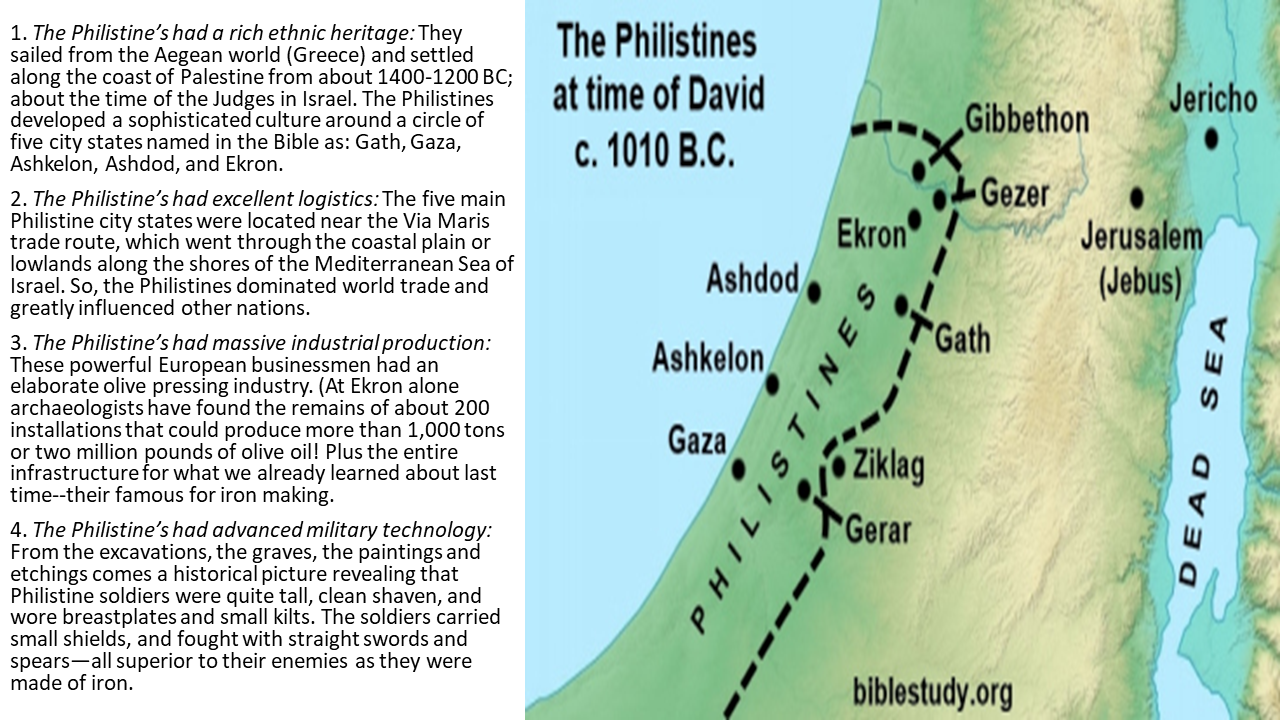
The Philistines had a rich ethnic heritage. They had sailed the Aegean world. They had come from Greece and settled on the coast of Palestine about the year 1400 BC, just about the time of the Exodus. These people, between 1400 and 1200, they were coming into this land. They were really growing during the time of the judges, and the Philistines developed a sophisticated culture around a circle of five cities. We know these from the text; it names them: Gath, Gaza, Ashkelon, Ashdod, and Ekron. And by the way, those cities are still around. They’re excavating them today, and when they excavate them, they find out that these Philistines had excellent logistics. These five cities were all along the greatest road of the ancient world called the Via Maris. It was the great road that came all the way from the far East in China and India and came across the mountains, and then it went to the Mediterranean. It hugged the Mediterranean coast and went down to the great center of the commercial world back then, which was Egypt, and they had built their five cities to be guarding that road. So, these logistical men had decided the coastal plain, the lowlands on the shore, was the way they could dominate the world’s trade routes of that day, and they did it. So, these smart Greeks came and set up great logistics.
Thirdly, they had massive industrial production. These powerful European businessmen is what they were, had elaborate industry. One of their cities, Ekron, alone produced a thousand tons, two million pounds of olive oil a year. Do you know how much you have to plant in acreage to have two million pounds of olive oil a year from one city? This is just one center that they’ve had time to excavate. This was a huge center. In fact, Gath speaks of olive press, the town Gath. They were all that way. These people had entire infrastructures built, and we’ve learned about them. They were famous, most of all, for their iron making. They had become the great iron, the foundry, the steel mills of the world.
The Philistines, fourthly, had advanced military technology. From the excavations, their graves and their paintings and their etchings, there’s a historical picture revealing that their soldiers were tall, clean shaving, wore breastplates, had small spears, and all of their armaments were superior to any of the enemies of the day because they were the world leaders in iron production and export. So, they were sophisticated and advanced in military, in logistics, in their industrial base.
.jpg)
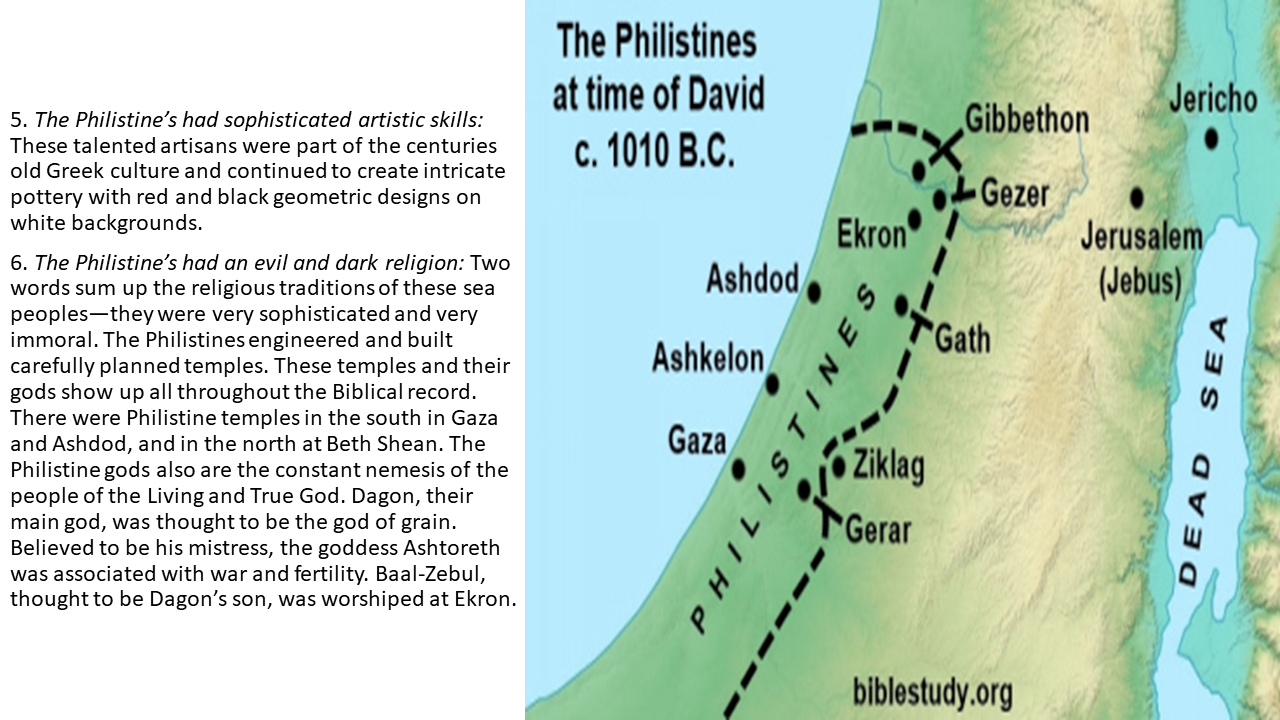
Fifthly, they were very, very advanced in their artistic skills. They were talented artisans from Greece. In fact, their pottery from the Philistine regions we find all over the ancient world. They exported their beautiful, painted, intricate. Kind of sounds like the far east today, doesn’t it? Just amazing their technology and their exports.
And finally, worst of all, they had a dark and evil religion. Two words would sum up the religious traditions of these sea peoples: they were very sophisticated, and they were very immoral. The Philistines would engineer in each city and build a carefully planned temple. The temples to their gods showed up all throughout the biblical record. You always find out about their gods. You always find the mention of their temples, and we find Samson getting in trouble with these things. We find the children of Israel going back after these same gods all the way through the reign of the kings. They have very advanced evil religion. In fact, all the way in the north, they had gotten a temple somehow up in the area in the north by Galilee. And that’s where Saul’s body we saw last time ended up at one of their temples in Beth She’ an. The Philistine gods were the constant nemesis of the people of the living and true God. Dagon, their main god, was the god of grain. His mistress was Ashtoreth, and Baalzebub was Dagon’s son. And so, this whole Baal /Ashtoreth combination you find all the way through the life of the children of Israel. So, this very sophisticated, very dark, very immoral, very evil religion permeated the land.
.jpg)
So, as Israel picked their first king, Saul, chosen to lead the people of God and to bring them to victory, he didn’t even understand what he was facing. He didn’t understand that there was no way that the Israelites with their wooden instruments could ever defeat the Philistines, ever. And that’s how God wanted it. Why? I think of 1 Peter 5:8 to us, be sober, be vigilant; your adversary the devil walks about like a roaring lion, seeking to devour us. We also have a great enemy that we can never, with our pitiful, weak instruments, ever defeat. But the Lord said what? Greater am I who am with you than your enemy that’s in the world. He has come to destroy the devil, and to destroy him, not by our strengths but by our weaknesses. We trust in Him. Exactly the same parallel that Saul had, we face every day. Either we go out underestimating the power of our enemy, or we go out in the power of the Lord in our weaknesses. If you want to know how to waste your life, neglect God’s leadership of your life so that you underestimate the strength of your enemy because you’ll get completely defeated.
.jpg)
Look at verse 8, second thing. What’s the second thing we can do to waste our life? Look at verse 8 of chapter 13 of 1 Samuel, just get impatient and use your impatience as an excuse to do your own thing instead of obeying God. Why? Because you can’t serve God by impatience. You and I cannot serve God by being impatient. And it says in verse 8, then he waited seven days. What I think happened is that he waited till the beginning of the seventh day. As the seventh day began, no, Samuel, God let me down. I’m going to do my own thing. That was Saul’s mode of operation. He had been told to wait for seven days, seven full days. He gave God six and the start of the seventh. Okay, God, You promised, You’re not keeping your end. I’m taking over. That’s what impatience is all about. I find that all the time it’s impatience that leads us to sin. Impatience with God’s timing on your marriage, on your job, on your family, on your personal needs, on fulfilling legitimate desires. Sin is when we want to fulfill legitimate needs and desires in our life in our time instead of God’s, in our way instead of His. That’s how Saul was. He was impatient. He had impatience, and he used that as an excuse to do his own thing, and we can’t serve God. Verse 8 says, he waited seven days, according to time set by Samuel. But Samuel did not come to Gilgal; and the people were scattered from him. This was an opportunity for Saul to trust and to say, God, I don’t understand. I don’t see what You’re doing, but I know You’re true and I know You told me to do this, and no matter what happens, I will obey. There’s a great little chorus: I will obey. I don’t need to understand. I will obey. That’s what we need to learn because Saul didn’t learn it. Saul was impatient with God’s plan; he sought the approval of man before he sought the approval of God. Look at what he says. The people were scattering. The people, they weren’t approving of his waiting. And what he should have said is, you can all leave if you want because I can defeat the Philistines by myself because me plus God will always make a majority. But that wasn’t how he operated in obedience, in faith. He operated impatiently; he underestimated the strength of the enemy. And when he found out how strong they were, he started operating on his own operating system and he got impatient. And if you want to waste your life, get impatient with God’s plan and use your impatience as an excuse for why you’re doing your own thing instead of obeying God’s Word because God has said, you’ll never serve Me by your impatience.
Now, remember, as we celebrate this morning, we’re redeemed. That means that God has paid the complete price for our sins. He has forgiven us past, present, and future. And that has to do with our eternal destiny and our standing with Him, but that has nothing to do with the consequences of the rotten decisions and choices we make in life. As I said a few weeks ago, I grew up ministering with my parents in a rescue mission. We would gloriously see these men saved at the mission. They would come and stay in our home. But God never gave one of them a new stomach, a new liver. He didn’t give them a start over again to have their first marriage that they destroyed with their drinking. He didn’t give them a chance to start over again with all their friends that they totally destroyed. They had to go on with a new beginning but with all that disaster behind them. God does not pick up the broken pieces of our lives. He gives us new purpose, He gives us new hope, He gives us new direction, but there are consequences for the decisions we make. That’s what the Judgment Seat of Christ about. That’s why stuff is going to burn up. That’s why Paul didn’t want to be disqualified, because there are consequences. And the consequence of impatience is usually excusing our disobedience, which is sin, which destroys something that God was wanting to do in our lives, and we get the second best in that matter, as we see with him. Of course, he fails completely.
.jpg)
Keep going. Look at verse 22 because another way to waste our life is neglecting our primary responsibility God has entrusted us with by only taking care of ourself. We can’t serve God by neglect. And it says in verse 22, so it came about, on the day of the battle, that there was neither sword nor spear found in any of the hands of the people who are with Saul and Jonathan. Do you know what the problem is here? Saul neglected to provide for those entrusted to his care. He made sure he had what he needed. Isn’t that an amazing sight? Can you see him marching in the battle with his sword and swinging it and looking behind him, and everybody else is holding their rake up? What a sight to see these people totally unprepared for the battle because the king that was supposed to prepare them, that was supposed to supply them, was supposed to be the one that was responsible for them, only took care of himself. You want to fail in life? You want to waste your life? Neglect your responsibilities, what God puts you to do and to be in your life, in your marriage, in your family, in your ministry, and just take care of yourself, me first. And it’ll happen as it happened to him. Saul neglected to provide those entrusted to his care. He made sure he had what he needed but not for those around him. He didn’t care that those around him weren’t armed for the battle.
In the New Testament, God says such a person is worse than an infidel. Did you catch that? Let me read to you 1 Timothy 5:8, if anyone does not provide for his own, especially for those under his household, he has denied the faith and is worse than an unbeliever. You know what God says? If you want to waste your life, neglect your primary responsibilities that God has entrusted you with, neglect to care for those God has entrusted you to care for, just care for yourself. That’s what Jeremiah 23 is all about, the religious leaders of the day in Jeremiah’s time, it says that they went down and they drank out of the streams, and they got the streams all dirty with their dirty hoofs. It portrayed them as animals drinking in the stream and muddying the water. And it says they only cared about themselves, not about those that they were entrusted. The shepherds were fouling the stream, and the sheep weren’t getting anything. You know what God says? Neglect your primary ministry responsibility by only watching out for yourself, and you have wasted your ministry, your life. Paul said, I don’t want to do that. I don’t want to waste my life. I don’t want to neglect my responsibility. He says, I’ve finished, Paul said, I’ve finished the course the Lord laid out for me. I have finished fulfilling my responsibilities, the primary responsibilities given to me.
.jpg)
Keep going to chapter 14. Let’s go to the next chapter real quickly before we go. Let me show you one more, and then we have to pray. Get so out of touch with the battle raging around you that God can be doing mighty things and you miss Him completely. That’s what happens in chapter 14. We can’t serve God by lazy indifference. Verses 2 and 3, and Saul, verse 2 of 1 Samuel 14, was sitting on the outskirts of Gibeah under a pomegranate tree which is in Migron. And the people were coming to him were about six hundred men. And Ahijah the son of Ahitub, Ichabod’s brother, the son of Phinehas, the son of Eli, the LORD’s priest in Shiloh, was wearing an ephod. But the people did not know that Jonathan was gone. You say, what’s that all about? If you read the rest of the chapter, Jonathan, Saul’s son, became a one-man army. And he just said, Lord, I believe that you could do something here, and so he said to his armor bearer, are you with me? And the guy said yes. And they went climbing straight up. And if you know the terrain of the land, it’s Ein Gedi, it’s this very, very rugged, steep, mountainous area. And Jonathan came up to the garrison at the top of the hill, and the Philistines had their outpost up there. They had all their defenses. And here’s a lone guy and his little armorbearer behind him. And Jonathan goes straight up, head on facing the Philistines, and they just were laughing up there and say, come on up, we’re going to chop you up. And he destroys the entire outpost, a one-man army climbing up by hand and he’s fighting with the other hand. You know what that was? That was an example of God making the battle to be won.
Where was Saul? Saul was, verse 2, sitting under this pomegranate tree. Saul became lazy, indifferent. He was unaware, his son, of the battle of the victory. He missed it all. He just was out of touch. He didn’t want to be walking with God. He didn’t want to know what was going on. He was just doing his own thing, sitting under the tree, talking to his friends. And if you want to waste your life, get so out of touch with what God is doing that He can be doing great and mighty things when you miss Him completely. Because we don’t serve God by lazy indifference. We don’t serve God by neglecting our primary responsibilities. We don’t serve God by getting impatient and using our impatience as an excuse to do our own thing. We don’t serve God when we neglect His leadership in our life and underestimate the power of the devil. And King Saul did all those things and a whole lot more.
.jpg)
What’s the lesson for us? Let’s close in 1 Corinthians 10. This is where we’ll pick up next time. This is a verse I’m sure most of us have memorized, verse 13. But the context of 1 Corinthians 10:13, which says, no temptation has overtaken you except such as is common. What’s the context of that? The 12 verses preceding it and look at the sixth verse of chapter 10. Now these things, what is that? That’s the recital of all these Old Testament events that are the record of the Scriptures for us. These things became our examples. Interesting. That’s the word for types in the Bible. Our types, our examples, to the intent that we should not lust after the things that they also lusted. And then he goes through another whole list. And then it says in verse 12, therefore let him who thinks he stands take heed—imperative command to us—take heed lest you fall. Saul did not take heed. He fell. All these examples, and Saul’s life included, are an example to us to take heed. That we don’t neglect God’s leadership of our life, that we don’t neglect to take care of those that God’s entrusted to us, that we don’t get impatient and make excuses for our terrible actions that we don’t miss the battle that’s going on because we’re so out of touch with God. And that we don’t, through lazy indifference, just let God be at work and we don’t even know it. Be careful. Verse 12 says, don’t fall because you think you stand. Remember, verse 13, that God is able to keep us because with the temptation He makes the way to escape that we may be able to bear it. That’s what God offers to us. He says, don’t waste your life.
.jpg)
Let’s bow for a word of prayer and ask Him to make us not only hearers but doers of His Word. Father in Heaven, thank You for the example of Saul, and thank You for the privilege to be Your servants. Let us take heed to Your Word so that we don’t fall from our own steadfastness, our faithfulness, and be led away by our flesh and not to walk and step with Your Spirit. Thank You for these sobering words. May we take them to heart. In the name of Jesus we pray, amen.
Notes
 The Lord of life, the Creator–God Himself, once said something very sobering. He said that the day of our death is better than the day of our birth (Ecclesiastes 7:1-2). Why would He tell us that? Because at the end, after the life is finished, the real person is known. That life with all of its opportunities and obstacles, accomplishments and failures is ready for review.
The chilling fact of God’s Word is the individual life analysis that God Himself then performs—an autopsy not of the cause of death, but of the purpose of life. That is why the constant theme of Paul’s exhortations to us in the church revolve around the idea of finishing well at the finish line, a life that survive the fires of the judgment seat, and a ‘well done good and faithful servant’ analysis of our race by the Lord Himself.
So we will get the consequences of our choices in Heaven. There is a reckoning day for believers. So we do need to have regular investment reviews to think of what we are living for.
That brings us back again to the life of King Saul. The ominous warning of Saul’s life is that he had everything going for him possible. He was big, strong, blessed, gifted, chosen, empowered, and given every opportunity to serve God. But he didn’t.
Saul failed because there were severe deficiencies in his character.
- God doesn’t need brains—He wants character.
- God doesn’t need brawn (huge strong muscles)—He wants integrity.
- God doesn’t need anyone’s wisdom, power, or wealth—He wants obedience.
- God doesn’t need ambitious confidence—He wants humble dependence.
Over and over in God’s Word we see that God summarizes an entire life in a few words. The challenge of that summary is two fold. When God summarizes a life He means it, and it is accurate.
Do you remember God’s summary of David’s life? We can call that David’s epitaph. God distills David’s seventy-year life down to just 9 words in English.
Acts 13:36 “For when David had served God’s purpose in his own generation, he fell asleep; he was buried with his fathers and his body decayed. NIV
So what was God’s summary of Saul’s life? God only needs one word—rejected. God says five times in just three verses that Saul rejected God by disregarding His Word, so God rejected him.
The word that God uses for Saul’s treatment of God and God’s response back to Saul is a very strong word.

The Hebrew word that the Holy Spirit chose to describe Saul’s treatment of God is the Hebrew word # 3988 mawas, used 76 times in the Old Testament and most often translated despise 25, refuse 9, reject 19, abhor 4, become loathsome 1, melt away. In context when ever this word is used about someone’s response to God–it is always bad. This is the word (despised) that described Israel’s murmuring in the wilderness just before He sent the plague to kill many of them; this is the word that described Job’s boils and sores (loathsome); and this is the word that is used by God for Israel’s attitude they (despised) the worship of God the basis for His allowing Israel to be destroyed by her enemies and carried off into captivity.
So Saul rejected God when he used selective, self-serving obedience in place of total and God-honoring obedience. And what did he get as his consequence for that bad choice? Look at the record God left for us.
1 Samuel 15:23, 26 For rebellion is as the sin of witchcraft, And stubbornness is as iniquity and idolatry. Because you have rejected the word of the Lord, He also has rejected you from being king.” 26 But Samuel said to Saul, “I will not return with you, for you have rejected the word of the Lord, and the Lord has rejected you from being king over Israel.” NKJV
1 Samuel 15:35 And Samuel went no more to see Saul until the day of his death. Nevertheless Samuel mourned for Saul, and the Lord regretted that He had made Saul king over Israel. NKJV
1 Samuel 16:1 Now the Lord said to Samuel, “How long will you mourn for Saul, seeing I have rejected him from reigning over Israel? Fill your horn with oil, and go; I am sending you to Jesse the Bethlehemite. For I have provided Myself a king among his sons.” NKJV
Can you imagine what it would be like to have it all and yet be rejected by God? I can’t because I want to obey the Lord. That longing, in spite of failures is the work of grace in our lives. You see David wasn’t perfect—just forgiven. Saul wasn’t perfect—just unconcerned.
1 Samuel 13:13-14 And Samuel said to Saul, “You have done foolishly. You have not kept the commandment of the Lord your God, which He commanded you. For now the Lord would have established your kingdom over Israel forever. 14 But now your kingdom shall not continue. The Lord has sought for Himself a man after His own heart, and the Lord has commanded him to be commander over His people, because you have not kept what the Lord commanded you.” NKJV
Which brings us back to Paul’s sermon in Acts 13.
Acts 13:22 And when He had removed him, He raised up for them David as king, to whom also He gave testimony and said, ‘I have found David the son of Jesse, a man after My own heart, who will do all My will.’ NKJV
David was imperfect, David was impatient, David was angry at times, wrathful at times, depressed, distressed, fearful, hopeless and tempted—yet he was God’s man in that he didn’t like being that way and didn’t want to stay that way. He was grieved over his sin against God. What God said mattered to David, but it didn’t seem to matter to Saul.
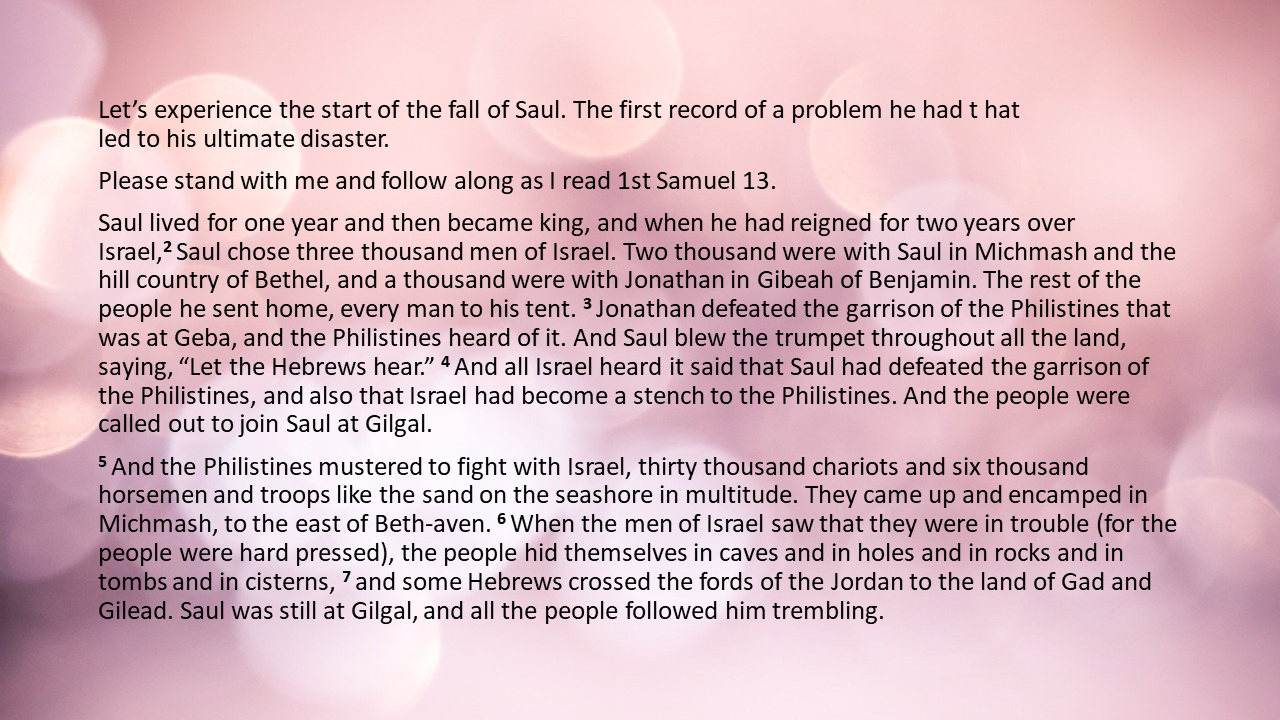
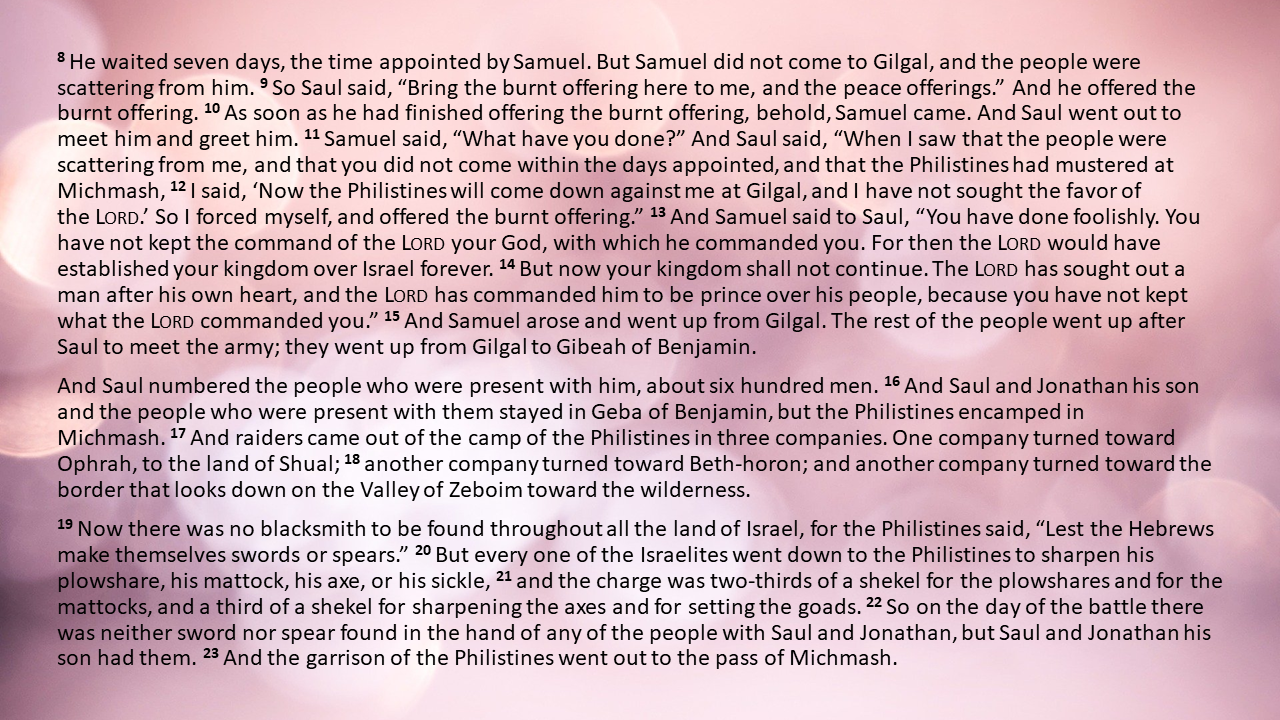
Let’s experience the start of the fall of Saul. The first record of a problem he had that led to his ultimate disaster.
Please stand with me and follow along as I read 1st Samuel 13.
Now go back with me through this chapter and note the glaring examples God records for us in ways to fail, waste your life. Here is how not to serve the Lord!
Just as the Spirit of God bears fruit, so does the flesh. When we don’t obey God we are in rebellion against Him. There is no middle ground. The fruit of the flesh is also quite easily spotted in ungodly attitudes and actions. King Saul would not walk in step with God, so his flesh reigned in his life. Saul lived a life of ignoring the warnings of departure from God’s way!
What were those signs? His pathway of rebellion involved the following elements I call “Ways we Don’t Serve God”! These are still danger signs to caution anyone who loves God, wants to serve Him and seeks to follow the Lord to this day.
 We could sum up the tragic shipwrecked life of King Saul by saying that you don’t serve God by doing what he did. Why not re-examine is life and see what made Saul the man who wasn’t after God’s heart. That is the contrast we find when we look at Saul and David side-by-side. (Emphasis added to the verses below.)
1. Neglect God’s Leadership of your life so that you underestimate the strength of your enemy—and get completely defeated. 1st Samuel 13.1-7
King Saul faced a whole new type of enemy, he was the King—and he didn’t even know how strong his enemies were! The times since Joshua’s conquest had produced a whole new type of enemy. Fresh in from the islands of the Mediterranean, the sea peoples settled on the coasts and mixing with the ancient inhabitants became the Philistines. Saul needed God to defeat his enemies. So do we. Saul neglected God’s leadership and failed. So will we if we also neglect to allow God to lead our lives.
Fact File on the Philistines:
1. The Philistine’s had a rich ethnic heritage: They sailed from the Aegean world (Greece) and settled along the coast of Palestine from about 1400-1200 BC; about the time of the Judges in Israel. The Philistines developed a sophisticated culture around a circle of five city states named in the Bible as: Gath, Gaza, Ashkelon, Ashdod, and Ekron.
2. The Philistine’s had excellent logistics: The five main Philistine city states were located near the Via Maris trade route, which went through the coastal plain or lowlands along the shores of the Mediterranean Sea of Israel. So, the Philistines dominated world trade and greatly influenced other nations.
3. The Philistine’s had massive industrial production: These powerful European businessmen had an elaborate olive pressing industry. (At Ekron alone archaeologists have found the remains of about 200 installations that could produce more than 1,000 tons or two million pounds of olive oil! Plus the entire infrastructure for what we already learned about last time–their famous for iron making.
4. The Philistine’s had advanced military technology: From the excavations, the graves, the paintings and etchings comes a historical picture revealing that Philistine soldiers were quite tall, clean shaven, and wore breastplates and small kilts. The soldiers carried small shields, and fought with straight swords and spears—all superior to their enemies as they were made of iron.
5. The Philistine’s had sophisticated artistic skills: These talented artisans were part of the centuries old Greek culture and continued to create intricate pottery with red and black geometric designs on white backgrounds.
6. The Philistine’s had an evil and dark religion: Two words sum up the religious traditions of these sea peoples—they were very sophisticated and very immoral. The Philistines engineered and built carefully planned temples. These temples and their gods show up all throughout the Biblical record. There were Philistine temples in the south in Gaza and Ashdod, and in the north at Beth Shean. The Philistine gods also are the constant nemesis of the people of the Living and True God. Dagon, their main god, was thought to be the god of grain. Believed to be his mistress, the goddess Ashtoreth was associated with war and fertility. Baal-Zebul, thought to be Dagon’s son, was worshiped at Ekron.1
So as Israel emerged from the period of the Judges, and picked their first king—he faced these newcomers to the region that had all new weapons that were far stronger than Israel’s—unless they would rely upon their true source of power— the Lord God Almighty. Saul was chosen to lead the people to seek God’s help and find His victory! The same is true for us each day.
1 Peter 5:8 Be sober, be vigilant; because your adversary the devil walks about like a roaring lion, seeking whom he may devour. NKJV
If you want to waste your life—neglect God’s Leadership of your life so that you underestimate the strength of your enemy—and get completely defeated. 1 Samuel 13.1-7.
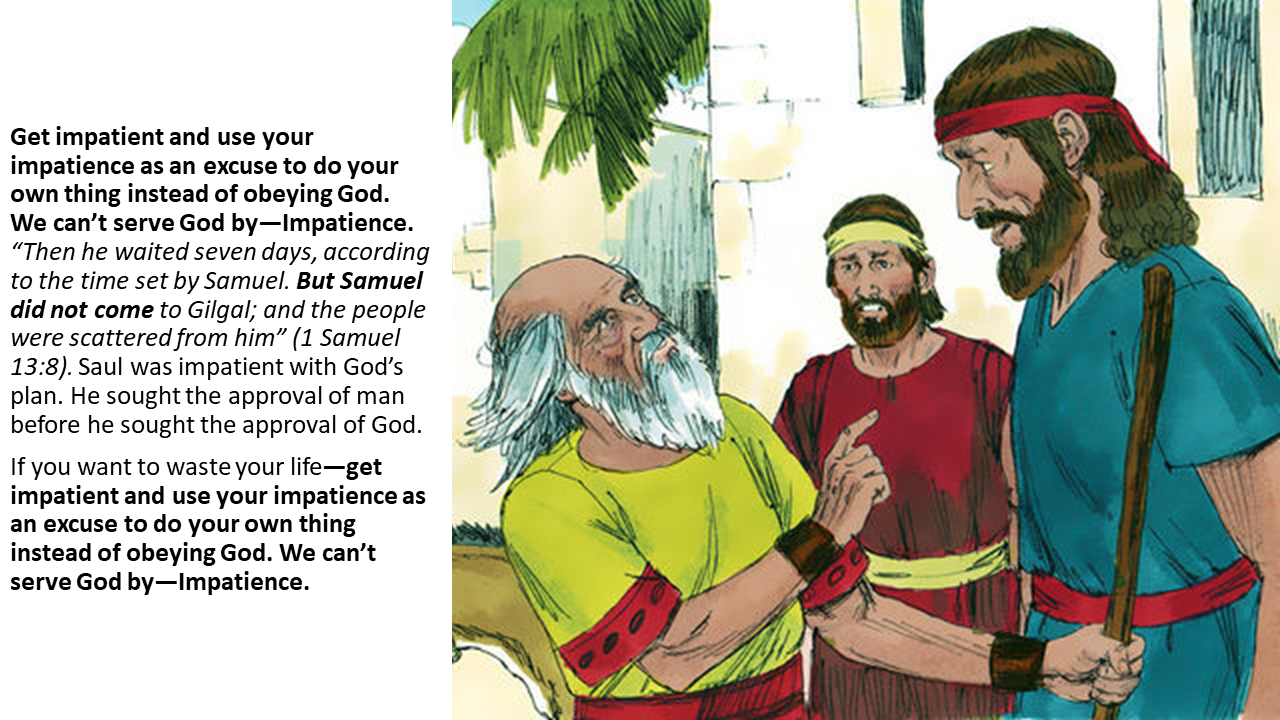
 2. Get impatient and use your impatience as an excuse to do your own thing instead of obeying God. We can’t serve God by—Impatience. “Then he waited seven days, according to the time set by Samuel. But Samuel did not come to Gilgal; and the people were scattered from him” (1 Samuel 13:8).
Saul was impatient with God’s plan. He sought the approval of man before he sought the approval of God.
If you want to waste your life—get impatient and use your impatience as an excuse to do your own thing instead of obeying God. We can’t serve God by—Impatience.
3. Neglect your primary responsibilities that God has entrusted to you by only taking care of your own needs. We can’t serve God by—Neglect. “So it came about, on the day of battle, that there was neither sword nor spear found in the hand of any of the people who were with Saul and Jonathan. But they were found with Saul and Jonathan his son” (1 Samuel 13:22).
Saul neglected to provide for those entrusted to his care. He made sure he had what he needed to defend himself, but not that those he cared for were armed for the battle. In the New Testament, God says such a person is worse than an infidel:
“If anyone does not provide for his own, and especially for those of his household, he has denied the faith and is worse than an unbeliever” (1 Timothy 5:8).
If you want to waste your life—neglect your primary responsibilities that God has entrusted to you by only taking care of your own needs. We can’t serve God by—Neglect.
4. Get so out of touch with the battle raging around you—that God can be doing mighty things, and you miss them completely. We can’t serve God by–Lazy indifference. “AND SAUL was sitting in the outskirts of Gibeah under a pomegranate tree which is in Migron. The people who were with him were about six hundred men. Ahijah the son of Ahitub, Ichabod’s brother, the son of Phinehas, the son of Eli, the Lord’s priest in Shiloh, was wearing an ephod. But the people did not know that Jonathan had gone” (1 Samuel 14:2-3).
Saul became lazy and indifferent; he was unaware of his son, the battle, and even the victory. He missed it all!
If you want to waste your life—get so out of touch with the battle raging around you—that God can be doing mighty things, and you miss them completely. We can’t serve God by–Lazy indifference.
1 Ray Vander Laan, with Stephen and Amanda Sorenson, Faith Lessons on the Promised Land Leader’s Guide. Grand Rapids, Michigan: Zondervan Publishing House, 1999, Pg. 136.
Slides


Check Out All The Sermons In The Series
You can find all the sermons and short clips from this series, David’s Spiritual Secret here.
Looking To Study The Bible Like Dr. Barnett?
Dr. Barnett has curated an Amazon page with a large collection of resources he uses in his study of God’s Word. You can check it out here.